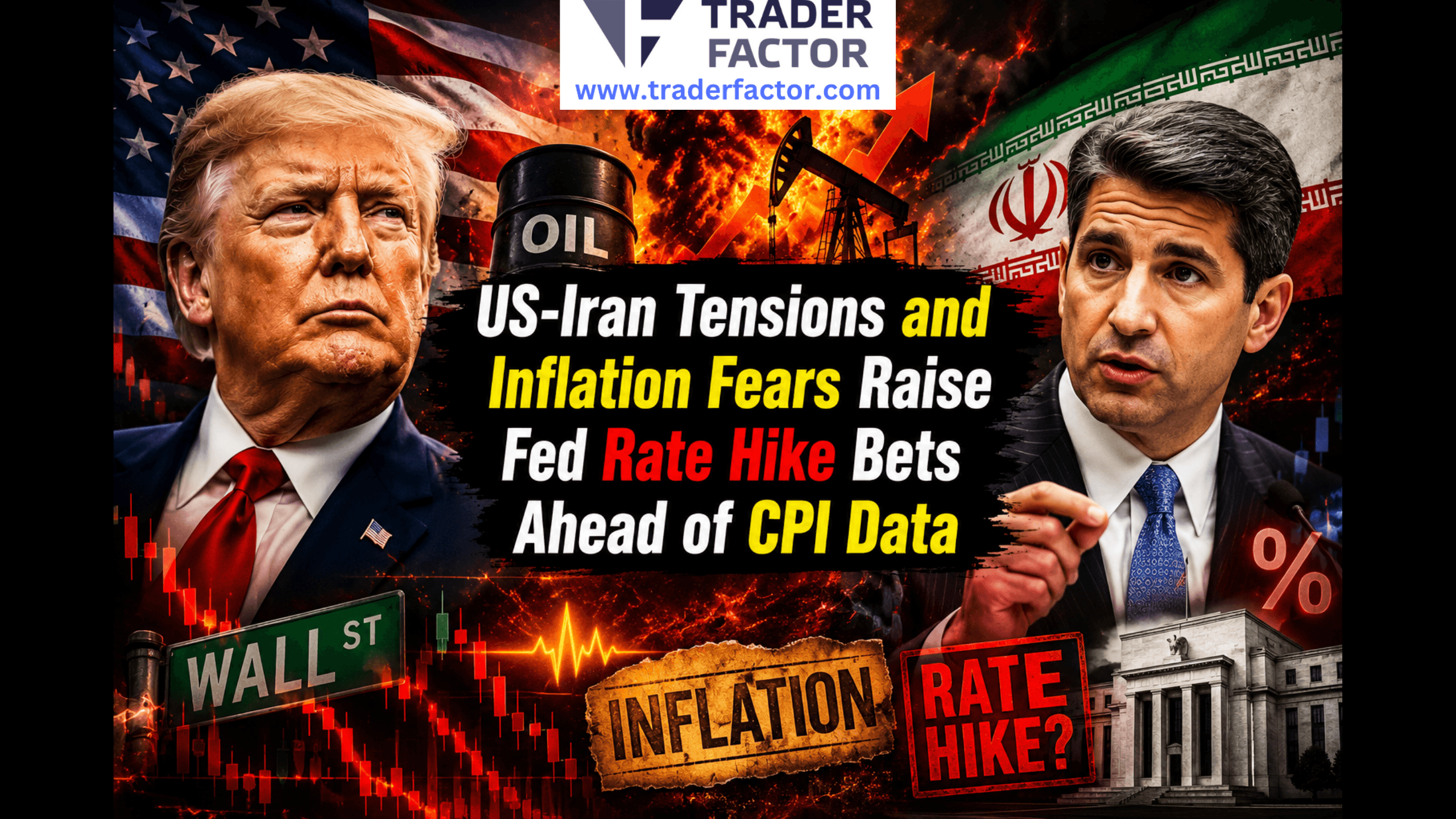

Markets brace for CPI volatility as oil prices rise and Fed rate hike fears grow amid escalating US-Iran tensions.Find the full market report.
⚡ Key Takeaways
US-Iran Tensions and Inflation Fears Raise Fed Rate Hike Bets Ahead of CPI Data
TraderFactor Market Report May 12, 2026
Global markets are entering a high-volatility phase as geopolitical tensions between the United States and Iran combine with rising inflation fears ahead of Tuesday’s critical US CPI report. Oil prices remain elevated as fragile ceasefire discussions continue failing to ease supply concerns in the Middle East. Traders are increasingly betting that persistent inflation could force the Federal Reserve to maintain higher interest rates for longer, while some analysts now see a growing possibility of future rate hikes instead of cuts. Markets are also closely monitoring the nomination process for incoming Fed Chair Kevin Warsh.
🔥 QUICK ANSWER 🔥
❤️🔥 Markets are reacting to rising oil prices, fragile US-Iran ceasefire talks, and expectations for hotter US inflation data. Higher CPI could strengthen the dollar, pressure equities and gold, and increase expectations for tighter Federal Reserve policy.
Support and Resistance Snapshot
📊 Support & Resistance Snapshot
| Asset | Price | S3 | S2 | S1 | Pivot | R1 | R2 | R3 | BIAS |
|---|---|---|---|---|---|---|---|---|---|
| DXY | 98.126 | 97.30 | 97.60 | 97.90 | 98.10 | 98.50 | 98.90 | 99.40 | BULLISH |
| Gold | 4724 | 4630 | 4660 | 4690 | 4710 | 4750 | 4800 | 4860 | BEARISH |
| EURUSD | 1.17594 | 1.1640 | 1.1680 | 1.1720 | 1.1750 | 1.1790 | 1.1840 | 1.1890 | BEARISH |
| GBPUSD | 1.35860 | 1.3470 | 1.3510 | 1.3550 | 1.3580 | 1.3620 | 1.3670 | 1.3720 | BEARISH |
| NZDUSD | 0.59572 | 0.5860 | 0.5890 | 0.5920 | 0.5950 | 0.5990 | 0.6030 | 0.6070 | BEARISH |
| AUDUSD | 0.72331 | 0.7150 | 0.7180 | 0.7210 | 0.7230 | 0.7270 | 0.7310 | 0.7360 | BEARISH |
| USDCAD | 1.36922 | 1.3600 | 1.3630 | 1.3660 | 1.3690 | 1.3730 | 1.3780 | 1.3840 | BULLISH |
| USDJPY | 157.563 | 156.00 | 156.50 | 157.00 | 157.40 | 158.00 | 159.00 | 160.00 | BULLISH |
| USDCHF | 0.77975 | 0.7730 | 0.7760 | 0.7780 | 0.7800 | 0.7840 | 0.7880 | 0.7920 | BULLISH |
| BTCUSD | 81264 | 79000 | 80000 | 80600 | 81000 | 82000 | 84000 | 86000 | NEUTRAL |
| OIL | 95.605 | 91.50 | 93.00 | 94.50 | 95.50 | 97.50 | 100.00 | 104.00 | BULLISH |
| NAS100 | 29236 | 28700 | 28900 | 29100 | 29200 | 29500 | 29900 | 30300 | NEUTRAL/BEARISH |
| US30 | 49685 | 49000 | 49200 | 49400 | 49600 | 49900 | 50300 | 50700 | NEUTRAL/BEARISH |
| SP500 | 7409 | 7340 | 7370 | 7390 | 7410 | 7450 | 7500 | 7550 | NEUTRAL/BEARISH |
✅ BULLISH (green) = Look for buying opportunities on dips toward support.
❌ BEARISH (red) = Look for selling opportunities on rallies toward resistance.
⚠️ NEUTRAL (gold) = Wait for breakout confirmation before committing.
Market Analysis
Gold Analysis
“Why is gold volatile despite geopolitical tensions?” Gold remains volatile because safe-haven demand is clashing with stronger US dollar expectations ahead of CPI data.
Gold recently touched a three-week high before pulling back as bullish momentum weakened near resistance. Price action continues consolidating within a broad range while intraday rejection signals suggest caution near highs.
Geopolitical tensions continue supporting defensive demand for gold. However, stronger CPI expectations and rising Fed rate hike bets are increasing Treasury yields and supporting the USD, which is creating bearish pressure on precious metals.
Oil Analysis
“Why are oil prices remaining elevated?” Oil prices remain elevated because fragile US-Iran negotiations are failing to fully calm supply concerns, and Trump recently stated that the Iran ceasefire is on “life support.”

WTI crude continues trading within a strong bullish structure after aggressive breakout momentum. Buyers remain active above key support zones while volatility expands alongside geopolitical headlines.
The combination of escalating tensions and the potential for supply disruptions around the Strait of Hormuz continues to support crude prices. Markets are pricing geopolitical supply risk directly into oil, which in turn increases inflation expectations globally.
US Dollar (DXY)
“Why is the US dollar bullish ahead of CPI?” The US dollar is bullish because higher inflation expectations are causing markets to anticipate tighter monetary policy from the Federal Reserve.
The DXY continues producing higher lows while momentum indicators favor upside continuation above support structure. Traders are positioning for a stronger dollar ahead of inflation data.
Higher inflation often strengthens the dollar because markets expect the Federal Reserve to maintain tighter policy. Current expectations for CPI to rise toward 3.7% are increasing demand for the USD, especially as some analysts now see a growing possibility of future rate hikes instead of cuts.
Euro (EURUSD)
“Why is the euro vulnerable to dollar strength?” The euro remains vulnerable because rising Treasury yields and stronger Fed tightening expectations continue to favor the US dollar over the common currency.
The pair is beginning to show signs of weakness near resistance zones, with momentum slowing ahead of inflation data. EURUSD is showing signs of bearish rejection near recent highs.
The divergence between Fed and ECB policy expectations continues to weigh on the euro. Markets see a higher probability of US rate hikes than European tightening, keeping the pair under pressure.
British Pound (GBPUSD)
“Why is sterling under pressure?” Sterling remains under pressure despite broader market stability, as traders focus on US inflation and Fed policy rather than UK-specific fundamentals.
GBPUSD is consolidating below resistance while failing to sustain bullish continuation. Momentum indicators suggest sellers remain active near current levels.
Markets are increasingly focused on US inflation and Fed policy ahead of Thursday’s UK GDP report. Unless UK data surprises strongly to the upside, the dollar narrative is likely to dominate price action.
Australian Dollar (AUDUSD)
“Why is the Aussie dollar struggling?” The Australian dollar is struggling because commodity currencies are becoming increasingly sensitive to stronger USD flows and rising geopolitical tensions.
AUDUSD is struggling to maintain bullish structure as momentum weakens near resistance. The pair has shown repeated failures to sustain breaks above key levels.
As a risk-sensitive currency, the Aussie is vulnerable to both stronger dollar demand and geopolitical uncertainty. Any further escalation in Middle East tensions or hotter inflation data could push it lower.
New Zealand Dollar (NZDUSD)
“Why is the kiwi dollar pressured?” The New Zealand dollar remains pressured by defensive dollar demand and broader macro uncertainty.
NZDUSD price action remains weak below key resistance structure, with consistent lower highs forming on shorter timeframes.
Broader macro uncertainty and stronger US yields continue weighing on the kiwi dollar. Like the Aussie, the kiwi is sensitive to risk sentiment, and the current environment is not favorable for the currency.
Canadian Dollar (USDCAD)
“Why is USDCAD bullish despite rising oil prices?” USDCAD remains supported because broader USD strength driven by inflation fears is currently outweighing the supportive effect of stronger crude oil prices on the Canadian dollar.
The pair continues building bullish continuation structure above support. Buyers have been defending dips, keeping the uptrend intact.
Although rising oil prices usually support the loonie, the current environment sees dollar strength dominating across the board. Markets are prioritizing the inflation and Fed policy narrative over Canada’s commodity link.
Japanese Yen (USDJPY)
“Why is USDJPY strongly bullish?” USDJPY remains strongly bullish because yield differentials between the US and Japan continue supporting carry-trade demand for the dollar against the low-yielding yen.
Momentum remains firmly bullish with higher highs and higher lows continuing across multiple timeframes. The pair shows no signs of trend exhaustion.
The interest rate gap between the US and Japan remains wide, and unless the Bank of Japan signals a major policy shift, the uptrend is likely to persist. Rising US yields ahead of CPI further support dollar demand.
Swiss Franc (USDCHF)
“Why is USDCHF strengthening?” USDCHF continues strengthening alongside the broader dollar as markets favor USD demand amid rising inflation concerns and expectations for tighter monetary policy.
Price continues building bullish continuation momentum above consolidation support. The pair has been making steady higher lows.
Markets continue favoring USD demand amid rising inflation concerns and expectations for tighter monetary policy. The franc is not seeing the same safe-haven demand as the dollar in this environment.
Bitcoin
“Why is Bitcoin remaining resilient?” Bitcoin remains resilient above key psychological support levels, though crypto markets remain highly sensitive to liquidity conditions and Fed policy expectations.
BTC continues consolidating near major support zones while momentum stabilizes after recent volatility. The $80,000 level remains a key psychological floor.
Crypto markets remain highly sensitive to liquidity conditions, Fed policy expectations, and broader risk sentiment. Any dovish surprise from the Fed or softer inflation data could trigger a rally, while hawkish outcomes may pressure prices.
US Equities (NAS100, US30, SP500)
“Why are US equities vulnerable near record highs?” US equities remain elevated but increasingly vulnerable to inflation-driven volatility, as higher inflation and rising rates can pressure valuations through higher discount rates.
The NAS100 remains bullish overall but price action is becoming increasingly unstable near highs. The Dow remains near major psychological levels after recently breaking above 50,000, while the S&P 500 continues trading near all-time highs with volatility increasing ahead of CPI.
Higher inflation and rising rates can pressure tech valuations through higher discount rates. Industrial and cyclical sectors remain sensitive to inflation expectations and borrowing costs. Persistent inflation could pressure equities if markets begin pricing additional Fed tightening.
Spreads from 0.0 Pips
ECN raw pricing. No markups on major pairs.
$7/Lot RT Commission
ECN only. Transparent, no hidden per-trade fees.
Zero Commission (Standard)
Standard accounts pay only the spread. Simple.
Triple Swap Wednesdays
Know before you hold. Swaps apply overnight.
Free Deposits & Crypto WD
USDT withdrawals are fast & cheap. No broker fees.
$10 Inactivity Fee
After 90 days idle. Just one trade resets it.
Save $600/Month
ECN vs Standard on 100 lots. Cost advantage is real.
No Hidden Platform Fees
No subscription. No surprise maintenance charges.
Geopolitical Developments
“How are Trump-Iran tensions affecting markets?” Trump’s statement that the Iran ceasefire is on “life support” has intensified fears of prolonged Middle East instability, sending oil prices higher and raising inflation concerns.
- Trump says the Iran ceasefire is on “life support”
- Oil prices continue rising due to supply concerns
- Markets remain highly reactive to Middle East headlines
- Geopolitical tensions are now feeding directly into inflation expectations
The combination of geopolitical risk and rising crude prices remains one of the biggest macro drivers currently affecting global markets.
Economic Calendar & Key Events
“What economic data should traders watch today?” Traders are focused on Tuesday’s CPI report, which is expected to show inflation rising from 3.3% to 3.7%, while the Kevin Warsh Fed chair nomination vote is also a major catalyst.
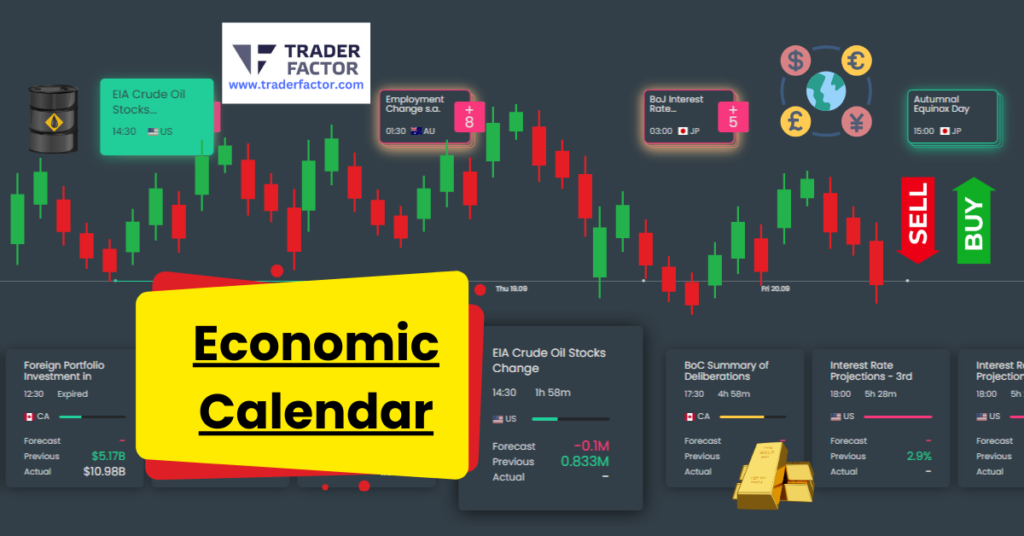
Tuesday – US CPI Inflation Report: Markets expect CPI inflation to rise from 3.3% to 3.7%. The Federal Reserve targets inflation around 2%. Higher inflation can strengthen the USD, increase Treasury yields, pressure gold and equities, delay future rate cuts, and increase odds of future rate hikes.
How oil prices affect inflation: The US-Iran conflict is pushing oil prices higher, increasing transportation costs, manufacturing expenses, and consumer energy prices. These costs eventually feed into CPI and PPI inflation metrics.
Fed rate hike bets increasing: The current Fed rate range is 3.5% to 3.75%. Markets are increasingly discussing the possibility of future rate hikes rather than cuts. Why? Inflation risks remain elevated, oil prices continue rising, the labor market remains relatively strong, and Fed officials remain cautious about easing too early. Some analysts now estimate roughly a 10% probability of future rate hikes if inflation remains persistent into late 2026.
Kevin Warsh Fed Chair Vote: The Senate will vote on Kevin Warsh’s nomination as Federal Reserve Chairperson for May 2026–2030. Requirements: 60 votes to close debate and a simple majority for final approval. Markets may react strongly depending on expectations around future interest rates, inflation policy, and monetary tightening pace. Warsh’s leadership could significantly influence market expectations heading into 2027.
Wednesday – US PPI Report: Expected month-over-month: 0.5%. PPI measures inflation producers face before goods reach consumers and often acts as a leading indicator for future CPI trends.
Thursday – Retail Sales & Unemployment Claims: Key events include US Retail Sales, US Unemployment Claims, and UK Monthly GDP Report. Some Eurozone countries will observe holidays, potentially reducing market liquidity.
Friday: Markets expected to remain relatively quiet with no major scheduled economic releases.
Final Outlook to Inflation, Fed Policy and Market Impact
Markets are entering a highly sensitive macro environment where rising oil prices are increasing inflation fears, inflation fears are strengthening the USD, Fed rate hike expectations are returning, gold and equities face pressure from higher yields, and geopolitical tensions continue supporting volatility.
This week’s CPI report may become the most important catalyst for determining whether markets continue pricing a “higher-for-longer” Federal Reserve scenario.
Short-Term Outlook:
- USD → Bullish
- Oil → Bullish
- Gold → Bearish/Volatile
- Equities → Vulnerable near highs
- Bitcoin → Neutral
- Volatility → Expected to remain elevated throughout the week
About the Author
Zahari Rangelov
Head of Business Development, TraderFactor
Zahari specializes in broker analysis, regulatory research, and trading education. He has over a decade of experience helping traders navigate the complex world of online brokers. His expertise spans technical and fundamental analysis, medium-term trading strategies, risk management, and trading psychology. A respected mentor and speaker, Zahari regularly leads webinars and seminars covering market sentiment, speculative instruments, and automated trading systems. His research-backed, practical approach has established him as a trusted authority within the global trading community.
Reviewed By:
Reviewed by Alex Kanyi, Head of Compliance at TraderFactor
“This report is for general information only. Trading involves significant risk. Seek independent advice before acting on any content.”
[Subscribe to the TraderFactor Newsletter]
Last Updated: May 2026
Disclaimer:
All information has been prepared by TraderFactor or partners. The information does not contain a record of TraderFactor or partner’s prices or an offer of or solicitation for a transaction in any financial instrument. No representation or warranty is given as to the accuracy or completeness of this information. Any material provided does not have regard to the specific investment objective and financial situation of any person who may read it. Past performance is not a reliable indicator of future performance.