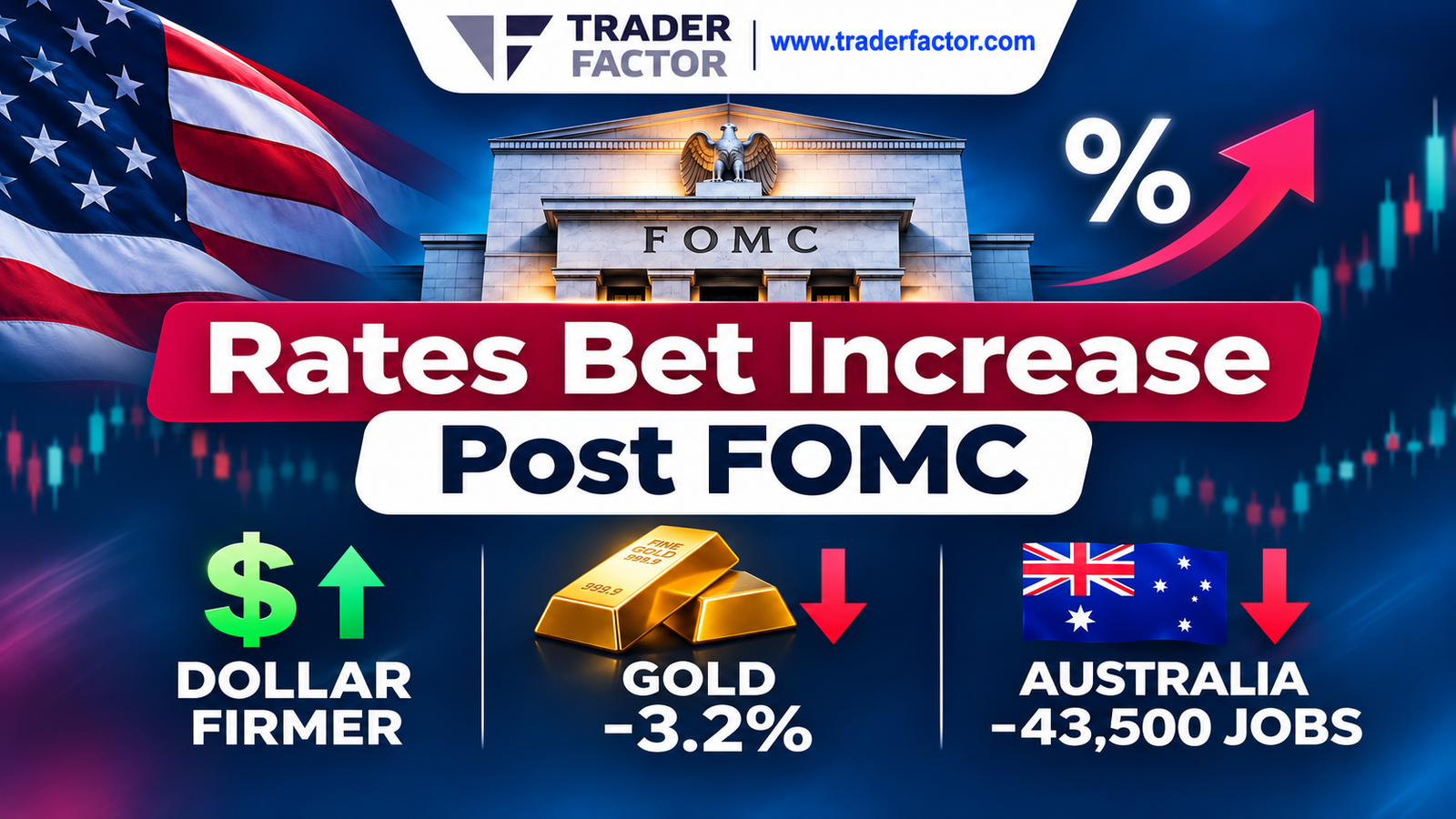

TRADERFACTOR | FOREX MARKET TODAY | NOVEMBER 19, 2026
Forex Market Today: Hawkish FOMC Minutes Lift Dollar as Gold Plunges 3.2% and Australia Jobs Slump
FOMC Minutes • Fed Rate Hikes • Gold • US Dollar • Australian Employment • Nvidia • Wall Street
By Phyllis Wangui | Senior Market Analyst, TraderFactor
🌍 FOMC Minutes Reinforce Fed Tightening as Gold and Global Markets React
Global financial markets begin Thursday, November 19, with the US Dollar near a 19-month high after hawkish Federal Open Market Committee (FOMC) minutes reinforced expectations of further interest-rate increases.
Minutes from the Federal Reserve’s October 27–28 meeting showed that almost all policymakers expected additional monetary tightening to become appropriate under their baseline economic projections. A couple of participants even suggested that an increase exceeding 25 basis points might deserve consideration if inflation data remained unfavorable.
Separately, Fed Governor Christopher Waller raised the possibility of a 50-basis-point rate increase in December, or a faster series of hikes in 2027. His remarks added to pressure on interest-rate-sensitive assets.
Gold experienced one of the session’s most significant moves, falling approximately 3.2% on Wednesday toward $3,700. Bitcoin and crude oil also declined, while the Dollar gained against most major currencies.
Meanwhile, Australia’s latest labour-market report delivered another surprise. Employment fell by 43,500 in October and the unemployment rate increased to 4.9%, its highest level in five years. AUD/USD consequently slipped toward a 10-month low near 0.6692.
Attention now turns to US initial jobless claims, the Philadelphia Fed Manufacturing Index, additional central-bank commentary and Friday’s Japanese inflation data. Traders will also assess whether Nvidia’s strong earnings can restore confidence in technology stocks after its shares fell despite beating expectations.
⚡ Quick Answer: What Did the FOMC Minutes Reveal?
The FOMC minutes revealed broad expectations for further US interest-rate increases as inflation remains above the Fed’s 2% target. Some policymakers considered stronger tightening if inflation failed to improve. The hawkish outlook supported the Dollar, pressured Gold and contributed to uncertainty across global stocks and cryptocurrencies.
❓ Question of the Day
Will the hawkish FOMC minutes extend the US Dollar rally and push Gold toward fresh lows, or could weakening economic data trigger a market reversal?
The answer will depend on incoming economic reports, changing interest-rate expectations and whether investors believe the Federal Reserve can contain inflation without significantly weakening growth.
📌 Key Market Takeaways — November 19, 2026
- FOMC Minutes:
Almost all policymakers anticipated further rate increases under their baseline outlooks. - December Fed Meeting:
Some officials discussed the possibility of tightening by more than 25 basis points if inflation data disappointed. - Christopher Waller:
The Fed governor separately suggested a 50-basis-point December hike or faster tightening in 2027. - US Dollar:
DXY strengthened toward a 19-month high, with the index recently around 103.8. - Gold:
XAU/USD lost approximately 3.2% on Wednesday, reaching levels not seen in more than a year. - Australian Employment:
The economy lost 43,500 jobs in October, while unemployment increased to 4.9%. - AUD/USD:
The Australian Dollar fell toward 0.6692 after the disappointing employment report. - UK Inflation:
Annual CPI rose to 3.6% in October from 3.5% in September, maintaining pressure on the Bank of England. - Eurozone Inflation:
Final October CPI confirmed annual inflation at 4.0%, up from 3.8%. - Wall Street:
The Dow declined 1.1% and S&P 500 fell 0.2%, although the Nasdaq Composite gained 0.4%. - Nvidia:
The stock fell approximately 2.9% despite strong earnings, illustrating investors’ concerns about AI valuations. - Bitcoin:
BTC remains under pressure around $63,000 after Wednesday’s selloff. - Crude Oil:
WTI weakened after higher US inventories and the resumption of some Iraqi oil flows added to supply concerns.
💹 Global Market Snapshot: Thursday Morning
Indicative early-Thursday market references, with Wednesday’s closing figures shown separately for US stock indices.
| Market | Reference Level | Market Position |
|---|---|---|
| US Dollar Index | Around 103.8 | Near 19-month high |
| Gold (XAU/USD) | Around $3,750 | Attempting to stabilize after selloff |
| EUR/USD | Around 1.0977 | Bearish Dollar-driven pressure |
| GBP/USD | Around 1.3152 | Near one-month low |
| AUD/USD | Around 0.6692 | Near 10-month low |
| USD/JPY | Around 159.39 | Approaching 160 |
| Bitcoin | Around $63,100 | Fragile recovery attempt |
| WTI Crude Oil | Around $82 | Under selling pressure |
| S&P 500 | 7,323.63 | Wednesday close: −0.2% |
| Nasdaq Composite | 24,429.88 | Wednesday close: +0.4% |
| Dow Jones | 50,198.17 | Wednesday close: −1.1% |
Forex and commodity levels are indicative early-Asian-session observations, not live synchronized quotes. US stock-market figures are confirmed Wednesday cash-market closes. Prices may change before publication.
🔎 Why Today’s FOMC Aftermath Matters
Wednesday’s market reaction illustrates how monetary policy can affect several asset classes simultaneously. Higher expected US interest rates generally increase the appeal of Dollar-denominated assets, while raising the opportunity cost of holding non-yielding Gold.
However, the relationship is not always straightforward. US Treasury yields declined on Wednesday despite hawkish Fed commentary, as falling oil prices and defensive buying of government bonds influenced markets.
The next stage will depend on whether US labour-market data confirm economic resilience or reveal growing weakness. Today’s jobless claims and Philadelphia Fed survey could therefore influence expectations about the pace of future tightening.
📚 Recommended Reading: The Complete FOMC Weekly Outlook
Explore the week’s Federal Reserve developments, major inflation releases, Nvidia earnings, forex forecasts and support and resistance levels.
📊 FOMC Minutes: Wednesday’s Market Recap and Thursday’s Economic Calendar
Wednesday’s hawkish FOMC minutes strengthened expectations of further US interest-rate increases. Gold extended its decline, Wall Street ended mixed and the US Dollar remained firm. Thursday’s focus shifts to American labour-market data and the implications of Australia’s unexpected employment losses.
📉 Wednesday Recap: Wall Street Struggles After Hawkish FOMC Minutes
US equities finished Wednesday, November 18, with mixed performances as investors evaluated Nvidia’s strong earnings alongside the Federal Reserve’s latest meeting minutes.
The Nasdaq Composite managed a modest gain, but the S&P 500 extended its losing streak to five consecutive sessions. The Dow Jones recorded a sharper decline as investors continued to question the outlook for borrowing costs, economic growth and corporate profitability.
| US Stock Index | Wednesday Close | Change |
|---|---|---|
| S&P 500 | 7,323.63 | −0.2% |
| Dow Jones | 50,198.17 | −1.1% |
| Nasdaq Composite | 24,429.88 | +0.4% |
| Russell 2000 | 2,714.31 | +0.5% |
What Moved Wall Street?
- FOMC minutes: Policymakers signalled that additional tightening would probably be needed to contain inflation.
- Nvidia earnings: The company’s strong results initially encouraged buyers, but its stock later reversed course.
- AI valuations: Investors remained uncertain about whether the sector’s exceptional growth justified existing valuations.
- Bond markets: Treasury yields eased as oil prices declined and investors reassessed economic risks.
🏦 What Did the FOMC Minutes Actually Reveal?
The Federal Reserve published the minutes of its October 27–28 meeting on Wednesday, November 18. They revealed broad agreement that further monetary tightening would probably be necessary to bring inflation sustainably back toward the Fed’s 2% objective.
At the October meeting, the Committee voted 10–2 to maintain the federal funds target range at 3.75%–4.00%. Lisa Cook and Beth Hammack preferred an immediate 25-basis-point increase.
Five Important Messages From the FOMC Minutes
1. Further Rate Increases Remain Likely
Almost all policymakers believed that additional tightening would probably be appropriate under their baseline expectations for inflation and employment.
2. Larger Rate Hikes Were Discussed
Two participants indicated that an increase exceeding 25 basis points at the next meeting could warrant consideration if incoming inflation figures proved unfavorable. This was a possibility discussed, not a decision.
3. Inflation Remains Too High
Policymakers described inflation as elevated and broad-based. They were concerned that prolonged price pressures could become entrenched in the expectations of households and businesses.
4. Economic Resilience Supports a Restrictive Stance
At the October meeting, members assessed economic activity as expanding strongly, with resilient domestic spending and an unemployment rate that had changed little.
5. Financial Stability and AI Investment Risks Are Growing
Officials also discussed the possibility that disappointing returns on artificial intelligence investments could trigger asset-price corrections. Rapidly expanding AI-related debt and complex financing arrangements attracted particular attention.
The next scheduled FOMC meeting is December 8–9, 2026. The November 18 release was a publication of earlier discussions, not a new interest-rate decision.
💵 How Are the FOMC Minutes Affecting the Dollar and Gold?
The latest FOMC minutes reinforce the argument for keeping US monetary policy restrictive while inflation remains elevated. This has important implications for the Dollar, Treasury yields, Gold, major currencies and US equities.
- US Dollar: Expectations of higher interest rates can increase demand for Dollar-denominated assets.
- Gold: Higher expected real yields can reduce the attractiveness of non-yielding bullion.
- Forex pairs: EUR/USD, GBP/USD and AUD/USD may remain vulnerable if the Dollar extends its advance.
- Wall Street: Higher borrowing costs and discount rates may pressure equity valuations, particularly in growth sectors.
- Bitcoin: Restrictive financial conditions may reduce demand for speculative investments.
However, markets do not always move in a straight line following hawkish news. Positioning, oil prices, safe-haven flows and incoming economic data can produce different reactions across assets.
🇦🇺 Australia Loses 43,500 Jobs as Unemployment Rises to 4.9%
Australia’s October employment report delivered a significant surprise on Thursday. The number of employed people fell by 43,500, while the unemployment rate rose to 4.9%, its highest level since October 2021.
| Employment Indicator | October 2026 | September 2026 |
|---|---|---|
| Unemployment Rate | 4.9% | 4.7% |
| Employment Change | −43,500 | — |
| Participation Rate | 66.6% | 66.8% |
| Underemployment Rate | 6.2% | 6.3% |
Why Does This Matter for AUD/USD?
- Employment weakness: Most of the job losses occurred in part-time employment.
- RBA dilemma: The central bank must balance persistent inflation against evidence of a cooling labour market.
- Australian Dollar: Disappointing employment figures may weaken expectations of further aggressive tightening.
- US Dollar: Hawkish FOMC expectations create an additional challenge for AUD/USD.
AUD/USD outlook:
The pair remains vulnerable to renewed selling pressure unless the US Dollar weakens or Australian economic developments improve the currency’s outlook.
🇬🇧 🇪🇺 UK and Eurozone Inflation Add to Central-Bank Concerns
UK CPI Rises to 3.6% in October
UK annual consumer-price inflation increased to 3.6% in October from 3.5% in September. Monthly CPI rose 0.5%, while the CPIH measure, which includes owner-occupiers’ housing costs, rose 3.7% annually.
- Headline CPI: 3.6% year-on-year.
- Monthly CPI: +0.5%.
- GBP/USD impact: Persistent inflation could limit the Bank of England’s policy flexibility, although Sterling remains sensitive to Dollar strength.
Eurozone Inflation Reaches 4.0%
Eurostat’s final October report confirmed Eurozone inflation at 4.0% annually, up from 3.8% in September. Energy and services were important contributors to overall price pressures.
- Eurozone headline inflation: 4.0%.
- Previous reading: 3.8%.
- EUR/USD impact: Persistent inflation supports expectations of a restrictive ECB stance, but the Dollar’s interest-rate outlook remains an important influence.
📅 Today’s Economic Calendar — Thursday, November 19, 2026
With the FOMC minutes already released, today’s US data will provide the next test of the Federal Reserve’s inflation and growth outlook.
| Time (UTC) | Economic Event | Result / Forecast | Markets to Watch |
|---|---|---|---|
| 00:30 | Australian Employment | Released: −43,500 jobs; 4.9% unemployment | AUD/USD, AUD/JPY |
| 13:30 | US Initial Jobless Claims | Forecast: ~197K–200K; previous: 200K | DXY, Gold, US yields |
| 13:30 | Philadelphia Fed Manufacturing Index | Forecasts: ~20–23; previous: 20.9 | USD, bonds, Wall Street |
| 14:25 | Fed Vice Chair Jefferson Speaks | Scheduled remarks on economic shocks | USD, Treasury yields |
| 15:00 | US Leading Economic Index | October; previous: 0.0% | USD, US stocks |
| 19:15 | Fed Governor Barr Speaks | Scheduled remarks on artificial intelligence | USD, technology sentiment |
All times are UTC. US data forecasts vary by provider and are estimates, not released outcomes. The employment report was available at preparation time; US releases and speeches were still upcoming.
🇺🇸 US Jobless Claims: The Next Test After Hawkish FOMC Minutes
Initial jobless claims measure the number of people filing for unemployment benefits for the first time. After the hawkish FOMC minutes, investors will look for evidence that the US labour market remains resilient despite restrictive borrowing costs.
Stronger Labour-Market Scenario
Claims materially below forecasts may reinforce expectations that the economy can tolerate higher interest rates. This could support the Dollar and weigh on Gold.
Weaker Labour-Market Scenario
Claims substantially above expectations could increase concerns about employment conditions, potentially limiting the Dollar’s advance and supporting a short-term recovery in Gold.
🏭 Philadelphia Fed Manufacturing: Can US Industry Remain Resilient?
The November Philadelphia Fed Manufacturing Index will offer a fresh reading of factory conditions in the region. October’s headline index stood at 20.9, indicating expanding manufacturing activity.
- Stronger reading: Could support the Dollar by reinforcing US growth resilience.
- Weaker reading: May add to concerns about industrial slowing.
- Prices components: Could provide useful clues about input costs and inflation pressures.
- Employment components: May help investors assess the strength of manufacturing labour demand.
The survey will be particularly relevant after October’s decline in total US industrial production.
🔎 FOMC Aftermath: Three Scenarios for Thursday
- Scenario 1 — Strong US Data:
Lower unemployment claims and resilient manufacturing could reinforce the Dollar’s advantage and maintain pressure on Gold. - Scenario 2 — Weak US Data:
Higher jobless claims and disappointing manufacturing figures could encourage some traders to reduce bullish Dollar positions. - Scenario 3 — Mixed Reports:
Contradictory economic data may produce volatile, two-way movements as investors balance the hawkish FOMC outlook against growth concerns.
📚 Recommended Reading: Yesterday’s FOMC Market Analysis
Revisit the market outlook before the FOMC minutes, including the Dollar, Gold, Nvidia earnings, major currencies and technical levels.
🎯 Market Outlook: What Should Traders Watch Next?
The FOMC minutes have reinforced expectations of further monetary tightening, helping the Dollar maintain its strong position. However, slowing economic indicators could complicate the outlook.
Australia’s employment decline illustrates that restrictive interest rates can create pressure on economic activity. In Europe, persistent inflation continues to influence ECB and Bank of England expectations.
Today’s US jobless claims, Philadelphia Fed Manufacturing Index and central-bank commentary could help determine whether the Dollar extends its rally, Gold stabilises or global equities face another volatile session.
FOMC Aftermath: Dollar, Gold and Major Forex Pairs Face Fresh Volatility
The hawkish FOMC minutes continue to influence global currency markets, with the US Dollar trading close to a 19-month high. Gold is attempting to stabilise following a sharp selloff, while the Australian Dollar has weakened after disappointing employment figures.
🏦 FOMC Minutes: Why the Dollar Remains Supported
Minutes from the Federal Reserve’s October meeting showed that almost all policymakers anticipated further interest-rate increases under their baseline economic outlooks. A couple of participants also discussed the possibility of raising rates by more than 25 basis points if inflation data remained unfavourable.
This reinforces expectations that US interest rates may remain elevated for longer. However, the FOMC minutes describe discussions held in October and must be considered alongside more recent inflation and employment reports.
Three Developments to Monitor
- Interest-rate expectations: Further tightening may continue supporting the Dollar.
- US economic resilience: Today’s jobless claims and manufacturing figures could reinforce or weaken the hawkish outlook.
- Market positioning: With much of December’s expected tightening already priced in, even strong Fed signals may not produce unlimited Dollar gains.
💵 US Dollar Index (DXY): Hawkish FOMC Keeps Buyers in Control
The US Dollar Index was recently near 103.88, supported by expectations of further Fed tightening. Demand for the Dollar has remained firm despite some declines in Treasury yields, reflecting differences between currency and bond-market reactions.
Support: 103.60, followed by 103.35.
Resistance: 104.00, followed by 104.30.
- Bullish scenario: A sustained move above 104.00 could encourage further Dollar strength.
- Bearish scenario: Losing 103.60 could trigger a short-term correction.
- Today’s catalyst: US initial jobless claims and Philadelphia Fed manufacturing data.
🥇 Gold Price Today: XAU/USD Attempts Recovery After FOMC Selloff
Gold suffered a sharp decline on Wednesday as hawkish Federal Reserve commentary and expectations of further interest-rate increases encouraged selling.
Bullion subsequently attempted to recover during early Thursday trading, reaching approximately $3,753. However, the broader short-term trend remains under pressure after the break below the psychologically important $3,800 level.
Gold Support and Resistance
- Immediate support: $3,720–$3,700.
- Recovery resistance: $3,767, followed by $3,800.
- Key driver: Dollar strength, Treasury yields and Fed rate expectations.
Bullish scenario:
A move above $3,767 could encourage further recovery attempts toward $3,800. A sustained break higher would be needed to improve the near-term outlook.
Bearish scenario:
Renewed selling below $3,720 could bring $3,700 into focus, particularly if strong US data reinforce expectations of tighter monetary policy.
🌍 Major Forex Pairs: Seven Currency Markets to Watch
The FOMC minutes have strengthened the Dollar’s monetary-policy advantage, but domestic developments remain important. Below are the technical areas and economic catalysts for each major currency pair.
🇪🇺 EUR/USD: Euro Struggles as Dollar Approaches 19-Month High
EUR/USD trades around 1.0977, near its lowest levels since April 2025. The Dollar’s strength continues to weigh on the Euro despite persistent Eurozone inflation, which may keep the European Central Bank cautious about monetary easing.
- Support: 1.0950, followed by 1.0920.
- Resistance: 1.1000, followed by 1.1025.
- Bullish scenario: A sustained recovery above 1.1000 may improve the short-term outlook.
- Bearish scenario: A break below 1.0950 could extend the decline.
Main catalysts: FOMC expectations, US labour-market data and ECB commentary.
🇬🇧 GBP/USD: Sterling Near One-Month Low After UK Inflation
GBP/USD trades near 1.3152 after Wednesday’s UK inflation report. Headline CPI rose to 3.6% annually, but the reading was broadly consistent with expectations and did little to offset Dollar strength.
- Support: 1.3135, followed by 1.3100.
- Resistance: 1.3195, followed by 1.3220.
- Bullish scenario: A recovery above 1.3195 could support Sterling.
- Bearish scenario: Sustained trading below 1.3135 may expose 1.3100.
Main catalysts: FOMC expectations, Bank of England commentary and Friday’s UK retail sales.
🇦🇺 AUD/USD: Australian Dollar Slides After Employment Shock
AUD/USD fell toward 0.6692 after Australian employment declined by 43,500 in October and unemployment climbed to 4.9%. The weak figures complicate the Reserve Bank of Australia’s outlook, particularly as wages and inflation remain elevated.
- Support: 0.6670, followed by 0.6650.
- Resistance: 0.6710, followed by 0.6740.
- Bullish scenario: Reclaiming 0.6710 could help the pair stabilise.
- Bearish scenario: Losing 0.6670 could reinforce the existing downtrend.
Main catalysts: Australian employment, RBA expectations, Chinese demand and FOMC policy.
🇳🇿 NZD/USD: Kiwi Consolidates Below 0.5500
NZD/USD trades around 0.5493 after recent weakness. New Zealand’s economic outlook, Reserve Bank policy expectations and broader risk sentiment remain important, while the hawkish FOMC minutes provide support to the US Dollar.
- Support: 0.5483, followed by 0.5450.
- Resistance: 0.5503, followed by 0.5530.
- Bullish scenario: A sustained move above 0.5503 could encourage recovery attempts.
- Bearish scenario: A break below 0.5483 may expose the next downside area.
Main catalysts: FOMC policy, New Zealand economic indicators and global risk appetite.
🇨🇦 USD/CAD: Dollar Strength and Lower Oil Pressure the Loonie
USD/CAD trades near 1.4336 as the strong Dollar and weaker crude oil prices weigh on the Canadian Dollar. The contrast between Fed tightening expectations and the Canadian economic outlook also favours the pair.
- Support: 1.4315, followed by 1.4295.
- Resistance: 1.4350, followed by 1.4400.
- Bullish scenario: A break above 1.4350 could extend the advance.
- Bearish scenario: Losing 1.4295 may signal a deeper correction.
Main catalysts: FOMC expectations, crude oil, Canadian economic data and US Treasury yields.
🇯🇵 USD/JPY: Yen Remains Vulnerable Near 160
USD/JPY trades around 159.39 as the US interest-rate advantage continues to support the Dollar. However, the proximity of 160 increases the importance of official Japanese commentary and possible market intervention risks.
- Support: 159.07, followed by 158.70.
- Resistance: 159.60, followed by 160.00.
- Bullish scenario: A sustained break above 159.60 could bring 160 into focus.
- Bearish scenario: A fall below 159.07 could encourage profit-taking.
Main catalysts: FOMC expectations, US yields, intervention concerns and Friday’s Japanese CPI.
🇨🇭 USD/CHF: Hawkish Fed Supports Dollar Against Swiss Franc
USD/CHF trades near 0.8431 after recent gains. Expectations of tighter Federal Reserve policy support the Dollar, although global uncertainty may continue generating defensive demand for the Swiss Franc.
- Support: 0.8424, followed by 0.8410.
- Resistance: 0.8448, followed by 0.8462.
- Bullish scenario: A sustained break above 0.8448 may encourage further gains.
- Bearish scenario: Losing 0.8410 could weaken the short-term bullish outlook.
Main catalysts: FOMC expectations, global risk sentiment and Swiss National Bank policy.
🔗 Three Market Relationships Worth Monitoring
- FOMC and the US Dollar: Further tightening expectations support the Dollar, but investors must consider how much policy tightening is already reflected in prices.
- Dollar and Gold: A stronger Dollar and higher real interest-rate expectations may limit Gold recovery attempts, although safe-haven demand can sometimes offset these pressures.
- Australian Jobs and AUD/USD: Weak employment reduces confidence in Australia’s growth outlook and may complicate the RBA’s efforts to contain inflation.
📚 Recommended Reading: Divergence in Forex Trading
Sharp moves following FOMC announcements can create changes in market momentum. Learn how traders use bullish and bearish divergence to evaluate possible trend exhaustion and reversals.
🎯 FOMC, Dollar and Forex Outlook: The Bottom Line
The Dollar continues to benefit from expectations of additional Federal Reserve interest-rate increases. Major currencies remain vulnerable, particularly AUD/USD after Australia’s employment shock and GBP/USD following a relatively unsurprising UK inflation release.
Gold is attempting to recover from Wednesday’s heavy losses, but its short-term outlook remains sensitive to the Dollar and changing Treasury yields.
Thursday’s US jobless claims and Philadelphia Fed Manufacturing Index could challenge or reinforce the hawkish interpretation of the FOMC minutes. Traders should watch whether market reactions are supported by sustained price movement rather than isolated volatility.
Price references reflect different time-stamped observations from the early November 19 session and are not live quotes. Support and resistance are indicative analysis zones, not guaranteed targets. Market conditions may change substantially following new economic releases.
🌍 FOMC Aftermath: Bitcoin, Crude Oil, Nvidia and Wall Street Face Fresh Pressure
The hawkish FOMC minutes continue to influence global financial markets. Bitcoin remains under pressure, crude oil has suffered a sharp decline, and Nvidia’s earnings have failed to restore sustained confidence in technology stocks. Meanwhile, geopolitical tensions and uncertainty about global demand are adding to market volatility.
₿ Bitcoin Price Today: BTC Struggles Near $63,000 After Hawkish FOMC Minutes
Bitcoin remains under selling pressure after declining nearly 3% on Wednesday. The cryptocurrency traded around $63,000 during early Thursday trading, extending a difficult period for digital assets.
Concerns about tighter US monetary policy, weaker risk appetite and liquidations of leveraged cryptocurrency positions have contributed to recent volatility.
What Is Driving Bitcoin?
- FOMC expectations: Further interest-rate increases could maintain restrictive financial conditions.
- Risk sentiment: Uncertainty about technology stocks may influence demand for speculative assets.
- Market liquidity: Selling pressure and liquidations can amplify short-term movements.
- Dollar strength: A firm US Dollar may add to pressure on Bitcoin, although the relationship is not consistent.
BTC/USD Technical Outlook
Support: $62,000, followed by $60,000.
Resistance: $63,300, followed by $65,000.
Market outlook: A sustained recovery above $63,300 could improve short-term sentiment. However, failure to defend $62,000 would leave Bitcoin vulnerable to further declines.
🛢️ Crude Oil Outlook: WTI Falls 3.2% as US Inventories Rise
Crude oil prices declined sharply on Wednesday after the latest US inventory figures raised concerns about excess supply.
WTI settled at $83.26 per barrel, down 3.2%, while Brent declined 1.3% to $91.95. Early Thursday trading showed WTI near $83.17 and Brent around $92.12.
| Oil Market Indicator | Latest Confirmed Reading |
|---|---|
| US Crude Inventories | +3.4 million barrels |
| Total US Crude Stocks | 417.8 million barrels |
| WTI Wednesday Settlement | $83.26 (−3.2%) |
| Brent Wednesday Settlement | $91.95 (−1.3%) |
Four Important Oil Market Drivers
- Higher US inventories: The inventory increase exceeded expectations and reinforced concerns about supply.
- FOMC tightening: Higher interest rates could slow economic activity and energy-demand growth.
- Global supply expectations: Recovering shipments through the Strait of Hormuz have reduced some immediate supply concerns.
- Middle East tensions: Continuing risks to shipping and energy infrastructure prevent the supply outlook from becoming entirely bearish.
WTI Technical Outlook
Support: $82.00, followed by $80.50.
Resistance: $84.00, followed by $85.00.
Outlook: Oil remains under pressure from inventory builds and surplus expectations, but geopolitical developments could still produce sudden upward price movements.
🤖 Nvidia Shares Fall Despite Strong Earnings: What Went Wrong?
Nvidia reported quarterly revenue of $115.8 billion, an increase of 103% from a year earlier. Data-centre revenue reached $107.6 billion, while the company projected approximately $130 billion in revenue for the following quarter.
Despite the strong financial results, Nvidia shares fell approximately 2.9% on Wednesday. Investors remained concerned about technology-sector valuations, company leadership uncertainty and the sustainability of exceptionally rapid AI investment.
Why Strong Earnings Did Not Guarantee a Stock Rally
- High expectations: Investors had already priced in substantial AI growth.
- Leadership uncertainty: Recent management developments continued to affect sentiment.
- Financing concerns: Investors are examining the long-term economics of large AI infrastructure projects.
- FOMC policy: Higher borrowing costs can weigh on growth-stock valuations.
NASDAQ outlook: Nvidia’s results confirm strong demand for AI infrastructure, but a sustained technology-sector recovery will require broader investor confidence.
📉 Wall Street Outlook: S&P 500 Extends Losing Streak
US equities finished Wednesday mixed as investors reacted to the FOMC minutes and Nvidia’s earnings. The S&P 500 extended its losing streak to five sessions, while the Nasdaq recovered modestly.
| US Index | Wednesday Close | Daily Change |
|---|---|---|
| S&P 500 | 7,323.63 | −0.23% |
| Dow Jones | 50,198.17 | −1.11% |
| Nasdaq Composite | 24,429.88 | +0.42% |
| Nasdaq 100 | 27,116.26 | +0.42% |
What Could Move US Stocks Today?
- US jobless claims: Could reveal whether the labour market remains resilient.
- Philadelphia Fed survey: May influence growth expectations.
- FOMC expectations: Additional tightening could pressure interest-rate-sensitive valuations.
- AI sentiment: Nvidia’s share-price reaction and Anthropic’s market debut could influence broader technology shares.
🌐 Geopolitical Outlook: Iran, Energy Supply and US–China Relations
Beyond monetary policy, geopolitical developments remain important for commodity prices, inflation expectations and global investor sentiment.
1. Strait of Hormuz and Middle East Oil Supply
- Shipping risks remain elevated amid the ongoing conflict involving Iran.
- Reports of damage to oil tankers highlight the continuing vulnerability of regional energy transport.
- Any significant interruption could lift crude oil prices and complicate inflation expectations.
2. US–China Technology Competition
- Export restrictions and competition over advanced semiconductors remain important risks for global technology companies.
- Investors will monitor US–China discussions for changes to trade and technology policies.
- Policy developments could influence semiconductor stocks, NAS100 and risk-sensitive currencies.
3. US–China–Russia Diplomatic Discussions
- High-level discussions involving the three countries are drawing attention to global security and trade relations.
- Iran, Ukraine, trade restrictions and access to advanced technology are among the key subjects.
- Markets will look for concrete policy outcomes rather than assuming that diplomatic discussions alone will reduce geopolitical risks.
📊 FOMC Aftermath: Support and Resistance Levels for 14 Markets
The technical overview covers the Dollar Index, seven major currency pairs, Gold, Bitcoin, WTI, Nasdaq 100, Dow Jones and S&P 500. Yellow cells show reference prices, green cells support and pink cells resistance.
| Instrument | Reference | Support | Resistance | Near-Term Bias |
|---|---|---|---|---|
| DXY | ~103.81 | 103.60 / 103.35 | 104.00 / 104.30 | Firm |
| EUR/USD | ~1.0975 | 1.0949 / 1.0927 | 1.0995 / 1.1020 | Bearish |
| GBP/USD | ~1.3150 | 1.3117 / 1.3089 | 1.3191 / 1.3237 | Bearish |
| AUD/USD | ~0.6692 | 0.6683 / 0.6661 | 0.6718 / 0.6732 | Bearish |
| NZD/USD | ~0.5493 | 0.5479 / 0.5469 | 0.5502 / 0.5515 | Cautious |
| USD/CAD | ~1.4336 | 1.4293 / 1.4261 | 1.4348 / 1.4371 | Bullish |
| USD/JPY | ~159.39 | 159.08 / 158.83 | 159.60 / 159.88 | Cautious |
| USD/CHF | ~0.8431 | 0.8401 / 0.8370 | 0.8452 / 0.8472 | Firm |
| Gold (XAU/USD) | ~$3,753 | $3,720 / $3,700 | $3,767 / $3,800 | Bearish |
| Bitcoin (BTC/USD) | ~$63,000 | $62,000 / $60,000 | $63,300 / $65,000 | Fragile |
| WTI Crude Oil | ~$83.17 | $82.00 / $80.50 | $84.00 / $85.00 | Bearish |
| Nasdaq 100 (NAS100) | 27,116* | 26,850 / 26,580 | 27,236 / 27,500 | Mixed |
| Dow Jones (US30) | 50,198* | 50,000 / 49,500 | 50,500 / 51,000 | Bearish |
| S&P 500 | 7,324* | 7,300 / 7,250 | 7,400 / 7,450 | Bearish |
*US stock-index references are Wednesday, November 18 cash-market closes, not Thursday futures or broker CFD quotes. Forex, Gold, Bitcoin and WTI reference prices come from time-stamped market observations and are not a live synchronized feed. Currency technical levels use nearby daily pivot zones; other support and resistance areas are indicative price-action levels selected for analysis. Recheck all levels after major data releases.
🔗 Five Important Market Relationships After the FOMC Minutes
- FOMC and Dollar:
Further tightening expectations support the Dollar, although weak US economic data could limit gains. - Dollar and Gold:
A stronger Dollar and restrictive interest rates may pressure bullion, but safe-haven buying can alter the relationship. - Nvidia and NAS100:
Strong earnings may not guarantee a market recovery when valuations and company-specific risks remain elevated. - Bitcoin and Financial Conditions:
Tighter monetary policy can reduce demand for speculative assets, though Bitcoin has additional market-specific drivers. - Oil and Inflation:
Falling oil prices may eventually ease inflation pressures, while renewed geopolitical disruptions could reverse that trend.
📚 Recommended Reading: Yesterday’s FOMC Market Analysis
Review how markets were positioned before the FOMC minutes, including the Dollar, Gold, Nvidia earnings, Bitcoin, crude oil and key technical levels.
🎯 Bitcoin, Oil and Wall Street: The Market Outlook
The hawkish FOMC minutes have reinforced expectations of further monetary tightening, creating a challenging environment for Gold, cryptocurrencies and interest-rate-sensitive equities.
Bitcoin remains fragile near $63,000, while WTI is attempting to stabilise after a 3.2% decline. Nvidia’s strong earnings demonstrate continued AI demand, but the company’s negative share-price reaction highlights broader market uncertainty.
The next major test will come from US labour-market data and Federal Reserve commentary. Strong economic indicators could extend the Dollar’s advantage, while evidence of weaker growth may encourage recovery attempts across Gold and risk-sensitive assets.
🎯 Final Market Outlook: Hawkish FOMC Minutes Keep Dollar in Focus
Global markets are approaching the end of another volatile trading week as investors reassess the implications of the Federal Reserve’s hawkish FOMC minutes, persistent inflation and signs of weakening economic activity.
The Dollar remains relatively firm, Gold is attempting to stabilise after a sharp selloff, and the Australian Dollar has weakened following disappointing employment figures. Bitcoin, crude oil and Wall Street also face uncertainty as investors weigh tighter monetary policy against growth risks.
🏦 FOMC Minutes: What Have Traders Learned This Week?
The October FOMC minutes highlighted the Federal Reserve’s continued determination to contain inflation. Almost all policymakers expected further tightening to be appropriate under their baseline economic outlooks, while some participants discussed the possibility of a larger interest-rate increase if inflation failed to improve.
The Three Biggest Takeaways
- Inflation remains the Fed’s priority:
Policymakers are concerned that elevated inflation could persist without sufficiently restrictive monetary policy. - Further tightening remains possible:
The minutes reinforced expectations of additional rate increases, but did not establish the size of December’s decision. - Economic data could change expectations:
Slower retail sales, employment weakness and industrial activity will remain important when investors reassess the Fed’s outlook.
The next scheduled FOMC interest-rate decision takes place on December 9, 2026.
💹 Final Outlook for Major Markets
- US Dollar Index:
The Dollar retains a firm underlying bias, supported by expectations of further interest-rate increases. Its next move will depend on whether incoming US data confirm economic resilience. - Gold (XAU/USD):
The decline below $3,800 has weakened short-term sentiment. A sustained recovery would require renewed buying interest and potentially a softer Dollar or lower real yields. - EUR/USD and GBP/USD:
Both pairs remain exposed to Dollar strength, although Eurozone and UK inflation could keep their respective central banks cautious about easing. - AUD/USD:
Australia’s unexpected employment losses have complicated the RBA outlook and added to downside pressure. - USD/JPY:
The pair remains sensitive to the US–Japan interest-rate differential, Japanese inflation and intervention concerns near 160. - Bitcoin:
BTC remains vulnerable to liquidity conditions, changes in risk appetite and cryptocurrency-specific selling pressure. - Crude Oil:
Higher inventories and uncertain demand are weighing on prices, although geopolitical supply risks could create sudden reversals. - US Stock Indices:
Strong AI earnings may support selected technology shares, but interest-rate expectations and valuations remain significant risks.
📅 Friday’s Economic Calendar: Japan CPI, UK and Canada Retail Sales
Friday, November 20, brings several important economic releases that could influence currency markets before the weekend. Japanese inflation, UK and Canadian consumer spending, and US consumer confidence are the main indicators to monitor.
| Time (UTC) | Economic Event | What Matters? | Assets to Watch |
|---|---|---|---|
| Thu 23:30 | Japan October CPI | Inflation and BoJ policy expectations | USD/JPY, JPY crosses |
| Fri 07:00 | UK Retail Sales | October consumer spending and growth | GBP/USD, GBP crosses |
| Fri 13:30 | Canada Retail Sales | September consumer demand | USD/CAD, CAD crosses |
| Fri 15:00 | US Michigan Consumer Sentiment | Final November sentiment and inflation expectations | DXY, Gold, US indices |
All times are UTC. Japan’s CPI release takes place at 08:30 JST Friday, equivalent to 23:30 UTC Thursday. Release schedules may change, and actual results should be checked once published.
🔎 Three Market Risks to Watch on Friday
1. Japanese Inflation and USD/JPY
Stronger-than-expected Japanese CPI could reinforce expectations of Bank of Japan policy tightening and support the Yen. Softer inflation might leave USD/JPY more sensitive to the US interest-rate advantage.
2. UK and Canadian Consumer Spending
UK and Canadian retail sales will help investors evaluate whether consumers remain resilient despite elevated borrowing costs. Unexpectedly weak figures could challenge the outlook for Sterling or the Canadian Dollar.
3. US Consumer Confidence and Inflation Expectations
The final University of Michigan consumer sentiment report could influence US growth expectations. Its inflation-expectations component will be particularly important after the hawkish FOMC minutes.
📌 Trading Considerations After the FOMC Minutes
Economic releases can generate rapid movements in the Dollar, Gold and major currency pairs. Traders evaluating these markets may find the following considerations useful:
- Check the full release: A headline figure may conceal important details or revisions.
- Watch Treasury yields: Their reaction may help explain movements in the Dollar and Gold.
- Monitor spreads and liquidity: Trading costs can widen around major announcements.
- Reassess technical levels: Strong price movements can invalidate previously identified support and resistance.
- Manage leverage carefully: Unexpected volatility can produce losses exceeding initial expectations.
🎯 Forex Market Today: Final FOMC Outlook
Thursday’s market outlook remains dominated by the Federal Reserve’s hawkish FOMC minutes. Persistent inflation and expectations of further monetary tightening continue to favour the US Dollar, while Gold, major currencies and speculative assets face a challenging environment.
However, Australia’s disappointing employment figures and slowing US economic activity demonstrate that the global growth outlook is becoming increasingly complicated. Further interest-rate increases may help contain inflation but could also place greater pressure on employment, spending and corporate earnings.
Friday’s Japanese inflation figures, UK and Canadian retail sales, and US consumer sentiment will provide the next important signals for currency markets before the weekend.
The central question remains: Can the Federal Reserve bring inflation under control without triggering a sharper slowdown in economic growth?
📚 Recommended Reading: The Full FOMC Weekly Outlook
Explore the week’s Federal Reserve developments, global inflation data, Nvidia earnings, the economic calendar and major forex market forecasts.
💼 Compare Forex Brokers With TraderFactor
Looking for a forex broker? Explore TraderFactor’s broker directory and compare trading platforms, regulation, spreads, account features and trading conditions.
Broker comparisons are informational. Trading involves risk.
📩 Stay Informed With TraderFactor Market Insights
Follow TraderFactor’s research coverage for analysis of economic data, central-bank policies, forex markets, Gold, commodities and global financial developments.
📅 Published: November 19, 2026
Risk Disclaimer
This TraderFactor market report is intended for informational and educational purposes only. It does not constitute personalised financial advice, investment recommendations or an offer to buy or sell financial instruments.
Forex, commodities, cryptocurrencies, stocks and leveraged financial products involve substantial risk. Market prices, economic forecasts and technical levels may change without notice. Past performance does not guarantee future results. Readers should conduct independent research and evaluate their financial circumstances and risk tolerance before trading.
✍️ About the Author

Phyllis Wangui
Senior Market Analyst | TraderFactor
Phyllis Wangui provides analysis of global financial markets, macroeconomic developments, central-bank policy and currency-market trends. Her coverage helps readers understand the economic events influencing forex, commodities and major indices.
Reviewed by Alex Kanyi
Head of Compliance | TraderFactor
TraderFactor publishes market commentary and educational resources to support informed understanding of financial instruments, economic developments and the risks associated with trading.