
In a significant policy shift, the Bank of Japan (BOJ) announced a rate hike, increasing its key short-term interest rate to 0.75% from 0.5%. This move, the fourth under Governor Kazuo Ueda, brings the BOJ rate to its highest level in three decades. The latest Bank of Japan news was widely anticipated by markets as the central bank continues to steer away from its long-standing ultra-loose monetary policy. Despite this historic Japan rate hike, the Japanese yen paradoxically weakened against the US dollar.
Bank of Japan’s Policy Decision and Economic Outlook
The central bank’s decision reflects its ongoing efforts to achieve sustainable inflation and wage growth. The unanimous vote to raise the rate was underpinned by confidence in the economic outlook.
Justification for the Rate Increase
The BOJ justified the rate adjustment by pointing to positive signs in the economy, particularly concerning wages and prices. Officials expressed confidence that a cycle of moderate wage increases and corresponding price rises will be maintained. The bank’s statement highlighted that the probability of achieving its 2% inflation target in the latter half of the 2025 projection period is increasing. This is supported by expectations of continued steady wage growth into the next year, with the bank seeing a low risk of this trend being interrupted. Furthermore, underlying CPI inflation has continued to rise as businesses pass on higher labor costs to consumers.

Future Monetary Policy Guidance
Looking ahead, the Bank of Japan has signaled a data-dependent approach to future policy adjustments. While the current rate hike marks a significant step, the bank emphasized that accommodative financial conditions will remain in place for now, as real interest rates are expected to stay in negative territory. This is intended to continue supporting economic activity. The BOJ’s official statement noted that if the economic outlook for activity and prices improves as projected, it will continue to raise the policy interest rate. This cautious but clear guidance suggests further normalization is on the horizon, dependent on incoming Japan interest rate data.
Market Reaction and Currency Dynamics
The market’s response to the widely expected Bank of Japan rate hike was counter-intuitive, particularly in the currency markets. The move provides insight into investor sentiment and the complex factors influencing exchange rates.

The Yen’s Unexpected Decline
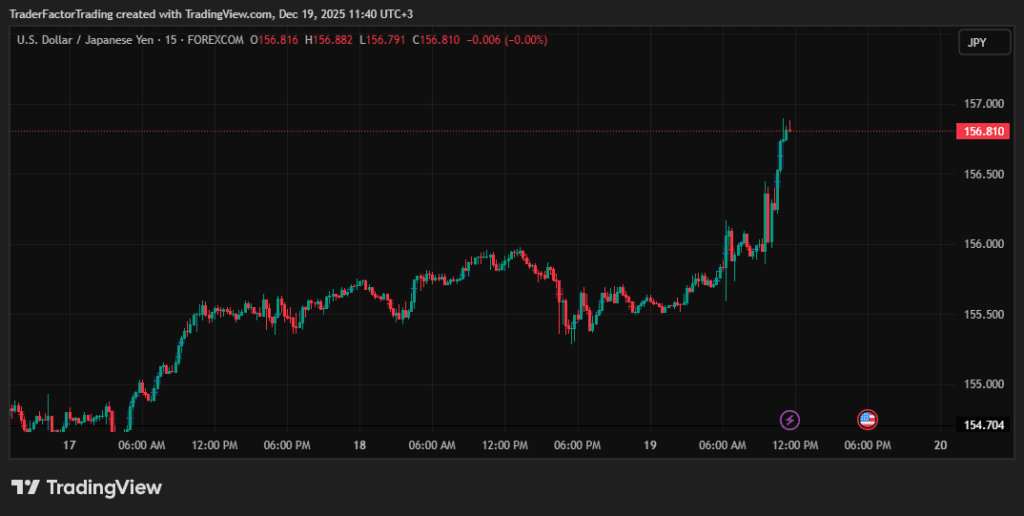
Despite the increase in the Bank of Japan rates, the yen weakened against the US dollar. The Bank of Japan yen to USD exchange rate saw the dollar gain, with the USD/JPY pair rising toward 156.40. This “buy the rumor, sell the fact” reaction occurred because the 25-basis-point hike was already fully priced in by traders. The market had been looking for more aggressive, or “hawkish,” guidance on the future path of rate increases. The absence of a firm roadmap for the next steps led yen bulls to unwind their positions, causing the Bank of Japan yen exchange rate today to fall.
Equity and Bond Market Movements
In contrast to the currency market, Japanese stock markets responded positively. The benchmark Nikkei 225 index jumped by as much as 1.42% following the announcement. Investors welcomed the clarity and the bank’s commitment to maintaining accommodative conditions in the short term. Banking sector stocks rallied on the prospect of improved lending margins. The Japan interest rate chart for government bonds also saw movement, with yields on ten-year bonds rising. This reflects the new reality of higher borrowing costs and has implications for Japan’s significant public debt. The historical context of Bank of Japan rates history shows this is a major pivot from decades of near-zero rates.
Frequently Asked Questions (FAQs)

What happens if the BOJ raises rates?
When the Bank of Japan raises rates, it increases borrowing costs for banks, businesses, and consumers. This is typically done to control inflation, and it can lead to a stronger yen, although other market factors can influence the outcome.
Why is the Japanese yen falling?
The yen is falling because the recent rate hike was already expected and priced in by the market. Traders were anticipating more aggressive guidance on future hikes, and its absence led them to sell the yen. The interest rate differential with other major economies, like the U.S., also keeps pressure on the currency.
Is the yen predicted to go up or down?
Predictions for the yen are mixed. Some analysts believe it will strengthen as the BOJ continues to normalize policy. Others argue that as long as interest rates in Japan remain significantly lower than in other countries, the yen will face downward pressure. The dollar to yen exchange rate by date will be volatile.

What is the Bank of Japan interest rate?
Following the most recent policy meeting, the Bank of Japan’s key short-term interest rate is set at around 0.75%. This is the target for the uncollateralized overnight call rate.
Did the BOJ raise rates?
Yes, the Bank of Japan raised its key policy interest rate by 0.25 percentage points, from “around 0.5%” to “around 0.75%,” during its latest monetary policy meeting.
What time is the BOJ rate announcement?
The Bank of Japan typically concludes its two-day monetary policy meetings and releases its statement around midday in Tokyo. There is no set time, but it usually falls between 11:30 AM and 1:00 PM Japan Standard Time.

What is a BOJ rate hike?
A BOJ rate hike refers to a decision by the Bank of Japan’s policy board to increase its target for the short-term policy interest rate. This action makes borrowing more expensive and is a tool used to tighten monetary conditions.
Conclusion
The Bank of Japan’s decision to raise its interest rate to a 30-year high is a pivotal moment in its monetary policy history. While the move signals a commitment to tackling inflation, the yen’s subsequent fall highlights the market’s demand for a clearer and more aggressive path forward.

Disclaimer:
All information has been prepared by TraderFactor or partners. The information does not contain a record of TraderFactor or partner’s prices or an offer of or solicitation for a transaction in any financial instrument. No representation or warranty is given as to the accuracy or completeness of this information. Any material provided does not have regard to the specific investment objective and financial situation of any person who may read it. Past performance is not a reliable indicator of future performance.