

Bitcoin price held steady on Friday, trading around the $92,400 mark following a volatile week influenced by major economic announcements. After an initial dip, the leading cryptocurrency demonstrated resilience, rebounding strongly after the U.S. Federal Reserve announced its third interest rate cut of the year. Investors are now closely watching market indicators and macroeconomic signals to gauge Bitcoin’s next move. With a market capitalization of approximately $1.85 trillion and significant daily trading volume, Bitcoin’s price action reflects a complex interplay between institutional interest, investor sentiment, and broader financial market dynamics that continue to shape its trajectory.
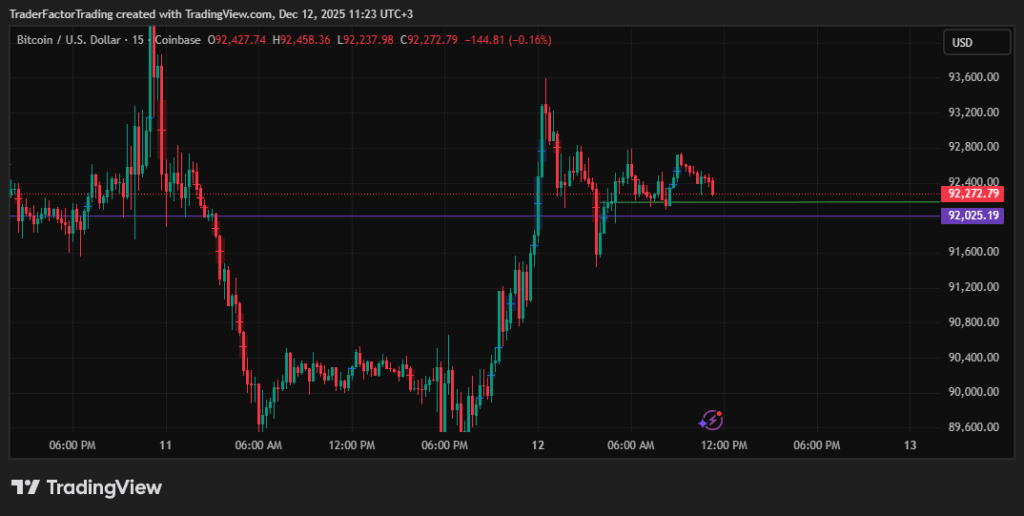
Bitcoin’s Market Performance This Week
The price of Bitcoin experienced notable fluctuations throughout the week, navigating key support and resistance levels amidst significant economic news. The asset demonstrated a capacity to absorb market shocks, ultimately closing the week with a marginal gain. This performance highlights the market’s current sensitivity to external financial events while retaining a cautiously optimistic undertone.
Price Action and Key Levels
Bitcoin is currently trading between $92,441 and $92,487, marking a 24-hour increase of roughly 2.50%. The trading week saw the price reach a high of approximately $94,500 before pulling back to a low of around $89,425. Despite this volatility, the cryptocurrency managed a slight weekly increase of 0.04%. The 24-hour trading volume has been robust, hovering between $47 billion and $59 billion, indicating active participation from traders and investors as they react to the unfolding economic landscape and position themselves accordingly.

Impact of Major Economic Events
This week’s price action was heavily influenced by several key economic releases from the United States, most notably the Federal Reserve’s policy decision. The market’s reaction to these events provides insight into how digital assets are increasingly interconnected with traditional financial systems and macroeconomic trends.

The Federal Reserve’s Rate Cut
On December 10, the Federal Reserve implemented a 25-basis-point rate cut, bringing the benchmark interest rate to a range of 3.50% to 3.75%. Initially, Bitcoin’s price dipped following the announcement, a common “sell the news” reaction. However, it quickly recovered and climbed above the $92,000 level. This rebound suggests that some market participants view the looser monetary policy as a positive signal for risk assets like Bitcoin, potentially driving capital toward alternative stores of value.
JOLTS Data and Powell’s Commentary
Earlier in the week, the release of the Job Openings and Labor Turnover Survey (JOLTS) introduced some uncertainty into the markets, though Bitcoin’s price remained relatively stable. Furthermore, comments from Fed Chair Jerome Powell, which adopted a cautious tone regarding future rate cuts, prompted mixed reactions. Despite this, the overall price action for Bitcoin suggests that investor optimism is prevailing, with some analysts pointing to the possibility of the asset testing higher resistance levels if it can maintain its current support.
Wrapping the Bitcoin Price Performance
In conclusion, Bitcoin has demonstrated considerable stability following the Federal Reserve’s recent rate decision. While its immediate price action is tied to macroeconomic events, the asset’s ability to recover from initial dips indicates underlying strength and investor confidence, setting a cautiously optimistic tone for the near future.

Disclaimer:
All information has been prepared by TraderFactor or partners. The information does not contain a record of TraderFactor or partner’s prices or an offer of or solicitation for a transaction in any financial instrument. No representation or warranty is given as to the accuracy or completeness of this information. Any material provided does not have regard to the specific investment objective and financial situation of any person who may read it. Past performance is not a reliable indicator of future performance.