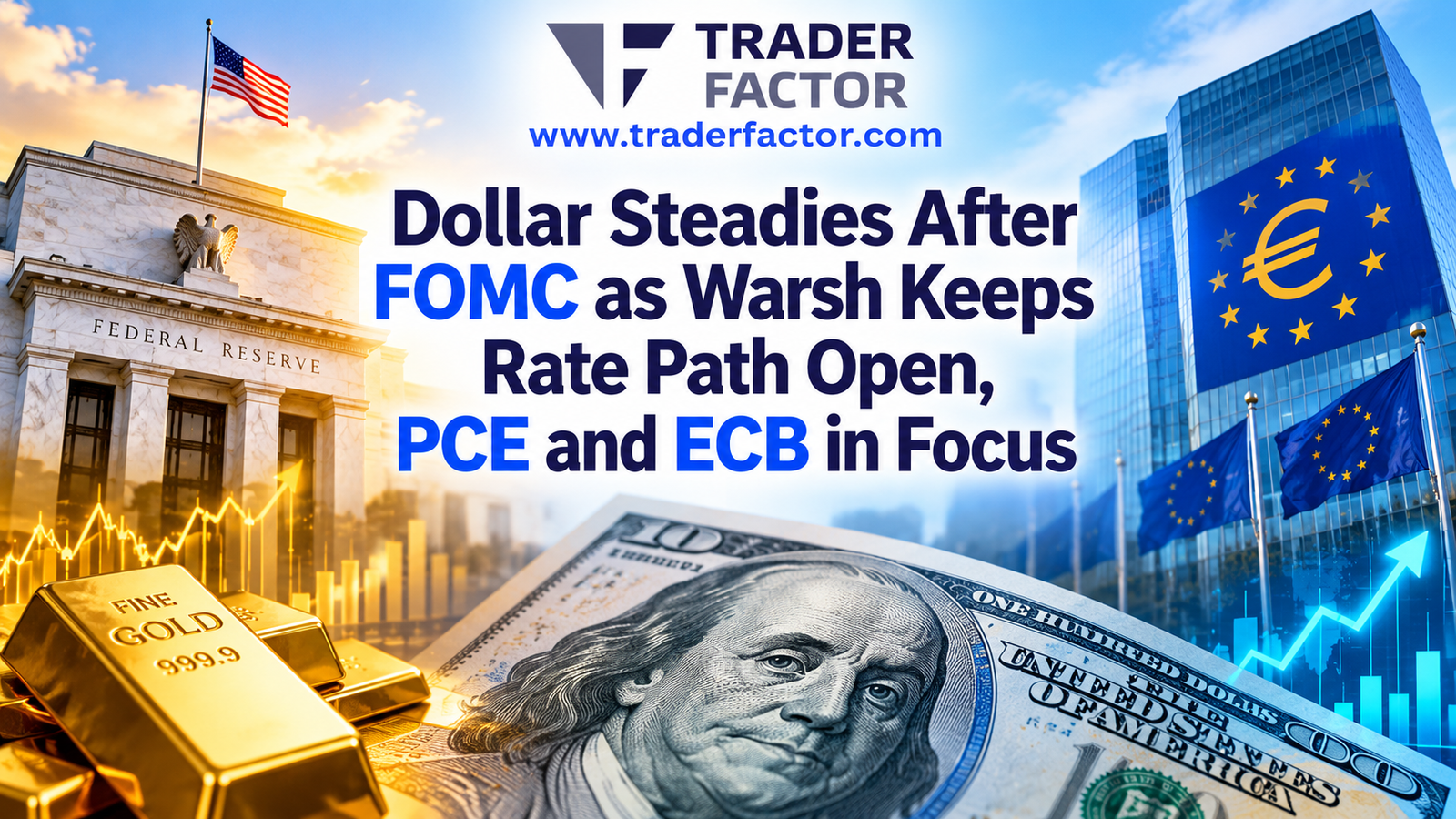

Forex Market Today: Dollar Steadies After Fed Hold as Warsh Keeps Rate Path Open, PCE and ECB in Focus
Federal Reserve • Kevin Warsh • US GDP • PCE Inflation • ECB • Gold • Oil • Forex • Big Tech
🌍 TraderFactor at Wiki Finance Expo Cyprus 2026
Zahari Rangelov will represent TraderFactor and speak at Wiki Finance Expo Cyprus 2026 on November 6 in Limassol.
See event details →
⭐ ActivTrades Review 2026
Explore ActivTrades spreads, fees, platforms, regulation, safety and client-fund protection.
The Fed Paused — But It Did Not Close the Door
The Federal Reserve left interest rates unchanged on Wednesday, but the meeting produced a more complicated message than the headline decision suggests.
The federal funds target range remains at 3.75%–4.00%.
The vote was 10–2.
Fed Governor Lisa Cook and Cleveland Fed President Beth Hammack both preferred an immediate 25-basis-point rate increase.
That dissent matters.
It shows that inflation concerns inside the Federal Open Market Committee are strong enough for two policymakers to argue that September’s rate increase should have been followed immediately by another move.
At the same time, Chair Kevin Warsh sounded less aggressive during his press conference than the hawkish dissent initially suggested.
Warsh said the US economy is not running too hot and argued that strong economic growth itself is not necessarily the source of inflation.
He highlighted stronger productivity, resilient investment and healthy domestic demand.
Most importantly, Warsh suggested the Fed should be able to restore price stability without deliberately damaging economic growth or employment.
That message briefly pushed Treasury yields lower and weakened the Dollar.
But there was no clear promise that the rate-hiking cycle is finished.
That makes today’s US GDP and PCE inflation reports critical: the Fed has paused, but the data will decide whether December becomes another rate-hike meeting.
❓ Question of the Day
Was Wednesday’s Fed decision a genuine pause — or simply a waiting period before another hike?
Today’s GDP and PCE inflation data could give markets a much clearer answer.
📌 Key Market Takeaways
- Fed:
Rates remain at 3.75%–4.00% after a 10–2 vote. - Hawkish dissent:
Cook and Hammack wanted an immediate 25-basis-point hike. - Warsh:
The Fed Chair said the economy does not appear overheated and stressed stronger productivity. - December:
Markets still see a high probability of another Fed increase before year-end. - Gold:
Bullion remains near $4,050 as traders reassess the Fed and wait for PCE. - Oil:
WTI jumped on renewed Middle East supply concerns Wednesday before easing again early Thursday. - Dollar:
The Dollar initially weakened during Warsh’s press conference and is now broadly steady. - Big Tech:
Microsoft delivered strong cloud growth, while Alphabet’s heavy AI spending triggered a sharp after-hours share decline. - Today:
US GDP, PCE inflation, jobless claims and the ECB decision dominate the macro calendar.
⚠️ TRADER ALERT: DAYLIGHT SAVING TIME
Europe has already moved clocks back while most of the US and Canada change on November 1, so check your broker and economic-calendar times carefully.
🏦 FOMC Recap: A Hold With a Hawkish Undercurrent
The Federal Reserve kept the federal funds target range at 3.75%–4.00%.
That was widely expected.
What was less comfortable for markets was the internal split.
Two policymakers wanted rates increased immediately.
The statement also upgraded the Fed’s description of economic activity, saying the economy is expanding at a strong pace.
Domestic spending remains resilient.
Capital investment remains robust.
Productivity growth has strengthened.
Employment conditions remain relatively stable.
And inflation remains elevated.
That is not the language of a central bank preparing to cut rates.
Instead, the Fed is signaling that it can afford to wait while it collects more information.
The policy question has therefore shifted from “Will the Fed hike in October?” to “What would convince the Fed to hike again in December?”
🎙️ What Kevin Warsh Actually Told Markets
Warsh’s press conference softened some of the hawkish implications of the FOMC statement.
He said the economy is not running too hot.
That distinction is important.
If the Fed believed economic growth itself was generating excessive inflation, it would have a stronger reason to slow demand aggressively.
Instead, Warsh argued that productivity has improved and that strong investment — particularly around AI and broader capital expenditure — is increasing the economy’s ability to grow.
In other words, faster growth does not automatically mean more inflation if the economy is becoming more productive at the same time.
Warsh also indicated that the Fed does not want monetary policy to unnecessarily damage employment or economic expansion.
But he did not declare victory over inflation.
He emphasized that inflation remains above the Fed’s 2% objective and that policymakers need more information.
He also avoided giving markets strong forward guidance on exactly when the next rate move will come.
This combination explains the mixed market reaction: Warsh sounded confident about growth, but he left future tightening available if inflation remains persistent.
What Does This Mean for the Rate Outlook?
There are now two competing narratives.
The first is hawkish.
Inflation is elevated, two FOMC members wanted another hike immediately, energy remains expensive and the economy is growing strongly.
That supports another increase in December.
The second narrative is more patient.
Warsh does not believe the economy is overheating, productivity is improving and financial conditions are already restrictive.
The Fed may therefore prefer to wait and see whether September’s rate increase and high long-term yields gradually cool inflation.
Today’s PCE inflation report is the first major test of which interpretation is correct.
📊 How Markets Reacted to the Fed
💵 Dollar
The Dollar initially had a muted response to the rate decision.
It weakened more noticeably as Warsh spoke.
EUR/USD recovered after the press conference while Treasury yields briefly gave back earlier gains.
The Dollar has stabilized again during Thursday’s Asian session as traders wait for GDP and inflation data.
🥇 Gold
Gold was volatile during the Fed decision and Warsh press conference.
Bullion initially benefited as yields eased and the Dollar softened.
But Gold has slipped back toward the $4,050 region early Thursday as markets wait for PCE.
Today’s inflation report is therefore more important for Gold than yesterday’s unchanged policy rate.
📉 Treasury Yields
Treasury yields swung sharply after the Fed.
The 10-year yield ended around 5.02% and has moved back toward approximately 5.05% in early Thursday trade.
That level remains critical for equities, the Dollar, Gold and Bitcoin.
📈 US Equities
Wall Street finished modestly higher.
The S&P 500 gained around 0.3%.
The Dow added roughly 0.2%.
The Nasdaq Composite gained about 0.3%.
However, today’s futures market tells a different story because investors are now processing Microsoft and Alphabet earnings.
🇨🇦 Bank of Canada Raises Rates
The Bank of Canada delivered a 25-basis-point increase on Wednesday, lifting its policy rate to 2.50%.
It was the Bank’s first rate increase in more than three years.
Governor Tiff Macklem said the inflation outlook has deteriorated as high energy prices raise costs throughout the economy.
The Bank also said another rate increase may eventually be needed.
That creates a significant contrast with the RBNZ, which surprised markets by holding rates earlier Wednesday.
For USD/CAD, the outlook is now a contest between a more hawkish Bank of Canada, the Fed’s uncertain December path and volatile Oil prices.
🛢️ Oil Rebounded Wednesday — Then Eased Again
Oil reversed Tuesday’s decline during Wednesday’s session.
WTI jumped roughly 3% to settle near $102.78 per barrel as renewed attacks and supply concerns returned to the Middle East risk premium.
That matters directly for the Fed.
Warsh specifically acknowledged the relationship between Oil prices and interest rates.
If crude falls sustainably, future headline inflation should receive some relief.
If Oil remains above $100 or returns toward recent highs, the Fed has less room to tolerate inflation.
Early Thursday, WTI has eased back toward the $102 area as markets continue weighing diplomatic efforts against supply disruption risk.
Oil remains one of the most important variables for the December Fed decision.
💻 Microsoft and Alphabet Deliver Very Different Market Reactions
Microsoft: Cloud Growth Remains Strong
Microsoft reported quarterly revenue of approximately $92.3 billion, up 19% year-on-year.
Microsoft Cloud revenue increased 30%.
Azure revenue increased 48%.
The results exceeded expectations across revenue, operating income and earnings.
Microsoft shares gained in after-hours trading as investors welcomed continued strength in cloud and AI-related demand.
Alphabet: Strong Cloud, But Spending Concerns Hit the Stock
Alphabet reported revenue of approximately $127.6 billion, up 25% from a year earlier.
Google Cloud revenue more than doubled to approximately $30.7 billion.
But investors focused heavily on the cost of Alphabet’s AI investment programme, cash burn and concerns surrounding the core advertising business.
Alphabet shares fell sharply after the close.
Nasdaq futures are consequently lower this morning despite Microsoft’s strong results.
🇺🇸 Today’s Main Event: GDP and PCE Arrive Together
The US economic calendar becomes unusually important at 8:30 a.m. ET.
Advance third-quarter GDP and September PCE inflation are released at the same time.
GDP
Consensus expectations point toward annualized third-quarter growth around 3.2%, up from approximately 2.2% in the second quarter.
A strong GDP figure would support Warsh’s assessment that the economy remains healthy.
But strong growth alone may not necessarily be hawkish because Warsh explicitly argued that higher productivity allows the economy to grow faster without automatically creating inflation.
PCE Inflation
This is likely to matter more.
Headline PCE inflation is expected around 0.5% month-on-month and 3.6% year-on-year.
Core PCE is expected around 0.3% month-on-month and 3.1% year-on-year.
Both remain well above the Fed’s 2% objective.
If PCE exceeds forecasts, markets could quickly rebuild expectations for December tightening. A softer report could reinforce the idea that Wednesday’s hold may last longer.
👷 Initial Jobless Claims
Weekly claims are also released at 8:30 a.m. ET.
Markets expect claims around the high-190,000 area following the previous 194,000 reading.
Another low number would reinforce the argument that the labour market remains resilient enough for the Fed to keep monetary policy restrictive.
🇪🇺 ECB Decision: A Pause, Not Necessarily the End
The European Central Bank announces its latest policy decision today.
The deposit rate currently stands at 2.50%.
A large majority of economists expect the ECB to leave rates unchanged.
But the policy debate remains hawkish.
The ECB has already raised rates twice this year as elevated energy prices pushed inflation higher.
Markets increasingly expect another increase in December.
The complication is financial conditions.
Government bond yields have risen sharply, particularly in France.
Those higher yields tighten financial conditions even when the ECB itself does not change policy.
Christine Lagarde must therefore balance persistent inflation against the possibility that bond markets are already doing part of the ECB’s tightening work.
For EUR/USD, today’s ECB press conference may matter almost as much as the rate decision itself.
📊 Forex Market Today: Early Thursday Snapshot
Approximate early-session references. Prices can change rapidly ahead of GDP, PCE and the ECB.
| Market | Reference | Main Driver |
|---|---|---|
| DXY | ~102.2 | PCE / Fed repricing |
| EUR/USD | ~1.113–1.114 | ECB / PCE |
| GBP/USD | ~1.332 | Fed / UK fiscal outlook |
| AUD/USD | ~0.706 | Hot CPI / RBA |
| NZD/USD | ~0.562 | RBNZ hold |
| USD/CAD | ~1.400 | BoC hike / Oil |
| USD/JPY | ~158.0 | Fed / BoJ |
| USD/CHF | ~0.827 | Yields / risk sentiment |
| Gold | ~$4,050 | PCE / real yields |
| Silver | ~$54 | Dollar / yields |
| Bitcoin | ~$80.9K | Fed / liquidity |
| WTI | ~$102 | Middle East |
| US 10Y | ~5.05% | PCE / December Fed |
| Nasdaq 100 Futures | ~29,700 | Alphabet / Microsoft |
| S&P 500 | 7,744 Wednesday close | Fed / earnings / PCE |
💵 US Dollar: PCE Now Determines Whether the Fed Pause Looks Hawkish
DXY is trading around the low-102 region after giving back some of its pre-Fed strength.
Yesterday’s press conference prevented the Dollar from extending higher because Warsh resisted the idea that strong growth automatically requires more monetary tightening.
But Dollar bears also face a problem.
The Fed has not signaled that rates are high enough permanently.
Two policymakers wanted a hike immediately and inflation remains above target.
That leaves the Dollar highly sensitive to today’s PCE report.
DXY reference zones:
Support: 101.90 / 101.60 | Resistance: 102.50 / 102.80
🇪🇺 EUR/USD: ECB Takes Over From the Fed
EUR/USD recovered following Warsh’s press conference before easing slightly in Asian trade.
The Fed is no longer the only driver.
The ECB decision later today can change the Euro’s rate advantage quickly.
A hawkish Lagarde who keeps December tightening firmly open could help the Euro.
A more cautious message focused on bond-market stress could limit the upside.
Support: 1.1100 / 1.1060 | Resistance: 1.1180 / 1.1230
🇬🇧 GBP/USD: UK Budget Reaction Remains Muted
Sterling has remained relatively stable after Wednesday’s UK Budget.
The government prioritised fiscal stability and adherence to borrowing rules rather than delivering a large expansionary programme.
That helped prevent a major gilt-market shock.
GBP/USD now returns to the Dollar side of the equation, making US PCE particularly important.
Support: 1.3280 / 1.3220 | Resistance: 1.3370 / 1.3430
🇦🇺 AUD/USD: Hot Inflation Keeps RBA Expectations Firm
The Australian Dollar remains supported by Wednesday’s hotter-than-expected inflation report.
Annual inflation accelerated to 4.3%.
That keeps another Reserve Bank of Australia hike firmly in the conversation.
AUD/USD therefore has one of the stronger domestic monetary-policy stories among the major currencies.
Support: 0.7020 / 0.6980 | Resistance: 0.7080 / 0.7120
🇳🇿 NZD/USD: Recovering After the RBNZ Shock
The Kiwi suffered a sharp decline Wednesday after the RBNZ unexpectedly kept the OCR at 2.75%.
However, the close 4–3 vote showed that the central bank remains divided.
The decision delayed tightening rather than definitively ending it.
NZD/USD has recovered modestly as the post-Fed Dollar weakened.
Support: 0.5580 / 0.5540 | Resistance: 0.5660 / 0.5700
🇨🇦 USD/CAD: BoC Hike Supports the Canadian Dollar
The Bank of Canada raised rates to 2.50% and warned that further tightening may be required.
That provides the Canadian Dollar with monetary-policy support.
But Oil volatility remains crucial.
Higher crude generally supports Canada through export revenues while simultaneously increasing global inflation risk.
Support: 1.3950 / 1.3900 | Resistance: 1.4040 / 1.4100
🇯🇵 USD/JPY: BoJ Risk Moves Closer
USD/JPY remains near 158 as US yields hold around 5%.
The Bank of Japan becomes the next major central-bank risk.
Japanese inflation remains above target, keeping another policy adjustment possible later this year.
A stronger PCE report today would increase US yields and could push USD/JPY higher before the BoJ.
Support: 157.00 / 156.50 | Resistance: 158.50 / 159.20
🇨🇭 USD/CHF
USD/CHF remains sensitive to both US yields and geopolitical developments.
The Swiss Franc could regain safe-haven demand if Middle East tensions worsen again.
Support: 0.8230 / 0.8190 | Resistance: 0.8310 / 0.8360
🥇 Gold: PCE May Matter More Than the Fed Decision
Gold remains around the $4,050 region after an extremely volatile Fed session.
The policy rate itself did not change.
But Warsh’s comments temporarily lowered yields and weakened the Dollar, which helped Gold recover from intraday pressure.
The next question is whether today’s inflation numbers validate that move.
A hotter PCE report would strengthen the argument for a December hike.
That could push Treasury yields and the Dollar higher and weigh on Gold.
A softer PCE print would reinforce the idea that the Fed can remain on hold.
That would normally be more supportive for bullion.
Geopolitical risk remains a separate source of demand.
Oil above $100 creates an unusual two-sided effect for Gold.
Higher Oil can support Gold as a geopolitical hedge, but it can also raise inflation expectations and real yields.
Support: $4,025 / $4,000 / $3,975 | Resistance: $4,080 / $4,120
🥈 Silver
Silver is holding around the $54 region.
Its monetary-policy sensitivity remains similar to Gold, while industrial-demand expectations provide an additional driver.
Support: $53 / $52 | Resistance: $55.50 / $57
🛢️ WTI: Supply Risk Versus Diplomatic Hope
Oil remains extremely headline-sensitive.
Wednesday’s rally reflected renewed concern about attacks on regional energy infrastructure.
Thursday’s pullback reflects continued diplomatic efforts aimed at reducing escalation.
The result is a market where geopolitical risk can add or remove several dollars from crude very quickly.
Support: $100 / $98 | Resistance: $103 / $105
₿ Bitcoin: Still Waiting for the Liquidity Signal
Bitcoin remains around the $81,000 area.
The Fed hold itself did not produce a decisive crypto breakout.
That is because the important question remains the future path of real rates and liquidity.
A softer PCE report could lower yields and support Bitcoin.
A hotter report could reinforce December Fed-hike expectations.
Coinbase earnings after today’s US close provide an additional crypto-market catalyst.
Support: $79.5K / $78K | Resistance: $82.5K / $84K
📉 US 10-Year Yield: The 5% Battle Continues
The US 10-year Treasury yield remains around 5.05%.
That makes today’s PCE report extremely important.
If inflation surprises higher, yields could move further above 5%.
That would tighten financial conditions without the Fed needing to raise rates immediately.
If yields fall significantly, technology valuations, Gold and Bitcoin could receive relief.
The bond market may ultimately tell traders more about the December Fed outlook than the Dollar itself.
📈 US Stocks: Fed Relief Meets an Alphabet Shock
Nasdaq 100
Nasdaq futures are lower this morning after Alphabet fell sharply after its earnings report.
Microsoft’s stronger results are providing some support, but they have not fully offset the Alphabet decline.
Today’s GDP and PCE numbers now add another layer of rate-sensitive risk.
Support: 29,500 / 29,200 | Resistance: 29,900 / 30,200
S&P 500
The S&P 500 closed around 7,744 after a modest post-Fed gain.
The broader index now faces competing forces: resilient economic growth, restrictive yields and highly concentrated technology-sector earnings risk.
Support: 7,700 / 7,650 | Resistance: 7,780 / 7,825
US30
The Dow closed around 52,475 Wednesday.
The index remains less exposed to Alphabet’s selloff than the Nasdaq but remains highly sensitive to GDP, yields and industrial earnings.
Support: 52,000 / 51,600 | Resistance: 52,800 / 53,200
📅 Economic Calendar — Thursday, October 29
8:30 a.m. ET — US Q3 Advance GDP
Consensus is around 3.2% annualized growth.
8:30 a.m. ET — September PCE Inflation
Headline and core inflation will directly influence December Fed expectations.
8:30 a.m. ET — Initial Jobless Claims
Another low reading would reinforce labour-market resilience.
2:15 p.m. CET — ECB Rate Decision
The deposit rate is expected to remain at 2.50%.
2:45 p.m. CET — Christine Lagarde Press Conference
Markets will listen for clues on another possible ECB hike in December.
💼 Earnings in Focus Today
Before the US Open
- Eli Lilly — healthcare demand and pricing
- Mastercard — global consumer spending
- Caterpillar — industrial and infrastructure demand
After the US Close
- Amazon — AWS, AI investment and consumer spending
- Intel — semiconductor demand and manufacturing
- Coinbase — crypto trading and institutional activity
- Starbucks — consumer demand and margins
🔭 Tomorrow: Bank of Japan and Energy Earnings
Friday keeps the macro calendar active.
- Bank of Japan policy decision
- Tokyo inflation data
- US Employment Cost Index
- ExxonMobil earnings
- Chevron earnings
USD/JPY, Oil and global bond markets therefore remain exposed to another major policy session before the week ends.
TraderFactor Support & Resistance Map
Approximate reference zones only. GDP, PCE and central-bank decisions can create rapid breaks through normal technical levels.
| Asset | Reference | Support | Resistance | Main Driver |
|---|---|---|---|---|
| DXY | 102.2 | 101.90 / 101.60 | 102.50 / 102.80 | PCE / Fed |
| Gold | ~4050 | 4025 / 4000 / 3975 | 4080 / 4120 | PCE / yields |
| EUR/USD | 1.113–1.114 | 1.1100 / 1.1060 | 1.1180 / 1.1230 | ECB / PCE |
| GBP/USD | 1.332 | 1.3280 / 1.3220 | 1.3370 / 1.3430 | PCE / yields |
| AUD/USD | 0.706 | 0.7020 / 0.6980 | 0.7080 / 0.7120 | RBA / Fed |
| NZD/USD | 0.562 | 0.5580 / 0.5540 | 0.5660 / 0.5700 | RBNZ / Fed |
| USD/CAD | ~1.400 | 1.3950 / 1.3900 | 1.4040 / 1.4100 | BoC / Oil |
| USD/JPY | 158.0 | 157.00 / 156.50 | 158.50 / 159.20 | PCE / BoJ |
| USD/CHF | 0.827 | 0.8230 / 0.8190 | 0.8310 / 0.8360 | Fed / risk |
| Bitcoin | ~80.9K | 79.5K / 78K | 82.5K / 84K | Fed / Coinbase |
| WTI | ~102 | 100 / 98 | 103 / 105 | Middle East |
| Nasdaq 100 | ~29,700 futures | 29,500 / 29,200 | 29,900 / 30,200 | Alphabet / PCE |
| S&P 500 | 7,744 | 7,700 / 7,650 | 7,780 / 7,825 | PCE / earnings |
| US30 | 52,475 | 52,000 / 51,600 | 52,800 / 53,200 | GDP / yields |
🔗 Continue Your Market Research
🎯 TraderFactor Bottom Line
Federal Reserve:
The October pause did not end the tightening debate.
Warsh:
Growth does not appear excessive, productivity is improving and the Fed does not want to unnecessarily damage employment.
Inflation:
Still too high for the Fed to declare victory.
Dollar:
Initially weakened after Warsh but has stabilized before today’s data.
Gold:
Holding near $4,050 as PCE and real yields become the next catalysts.
Oil:
Back near $102 after Wednesday’s geopolitical rebound.
Bitcoin:
Still waiting for a clearer liquidity signal.
Stocks:
Microsoft delivered strong results, while Alphabet’s post-earnings decline is weighing on Nasdaq futures.
ECB:
A hold is expected, but December tightening remains possible.
Yesterday the Fed gave markets time. Today GDP and PCE will tell traders whether that time is likely to end with another rate hike.
💼 Compare Forex Brokers With TraderFactor
Compare regulation, fees, platforms, account types and broker features before choosing a provider.
About the Author

Phyllis Wangui
Senior Market Analyst, TraderFactor
Phyllis Wangui is a seasoned financial markets analyst with over a decade of experience in forex and CFD brokerage evaluation.
Specializing in regulatory compliance and risk assessment, she leads the TraderFactor reviews team in delivering transparent, data-driven broker breakdowns that help retail traders navigate complex offshore and Tier-1 trading environments.
Reviewed by Alex Kanyi
Head of Compliance | TraderFactor
“This report is for general information only. Trading involves significant risk. Seek independent advice before acting on any content.”
📩 Subscribe to the TraderFactor Newsletters
Stay informed with educational trading content, market analysis and insights from the TraderFactor research team.
Last Updated: October 2026
🚀 START FOREX WITH A SMALLER DEPOSIT
New to forex?
Explore brokers with lower minimum deposits, beginner-friendly platforms and useful trading tools.
✓ Beginner Friendly ✓ Low Minimum Deposits ✓ Compare Features
Last Updated: October 29, 2026
Risk Disclaimer:
This report is for general information and educational purposes only and does not constitute financial advice. Forex, commodities, cryptocurrencies, bonds and equity indices can move rapidly following economic data, central-bank decisions, earnings and geopolitical developments.