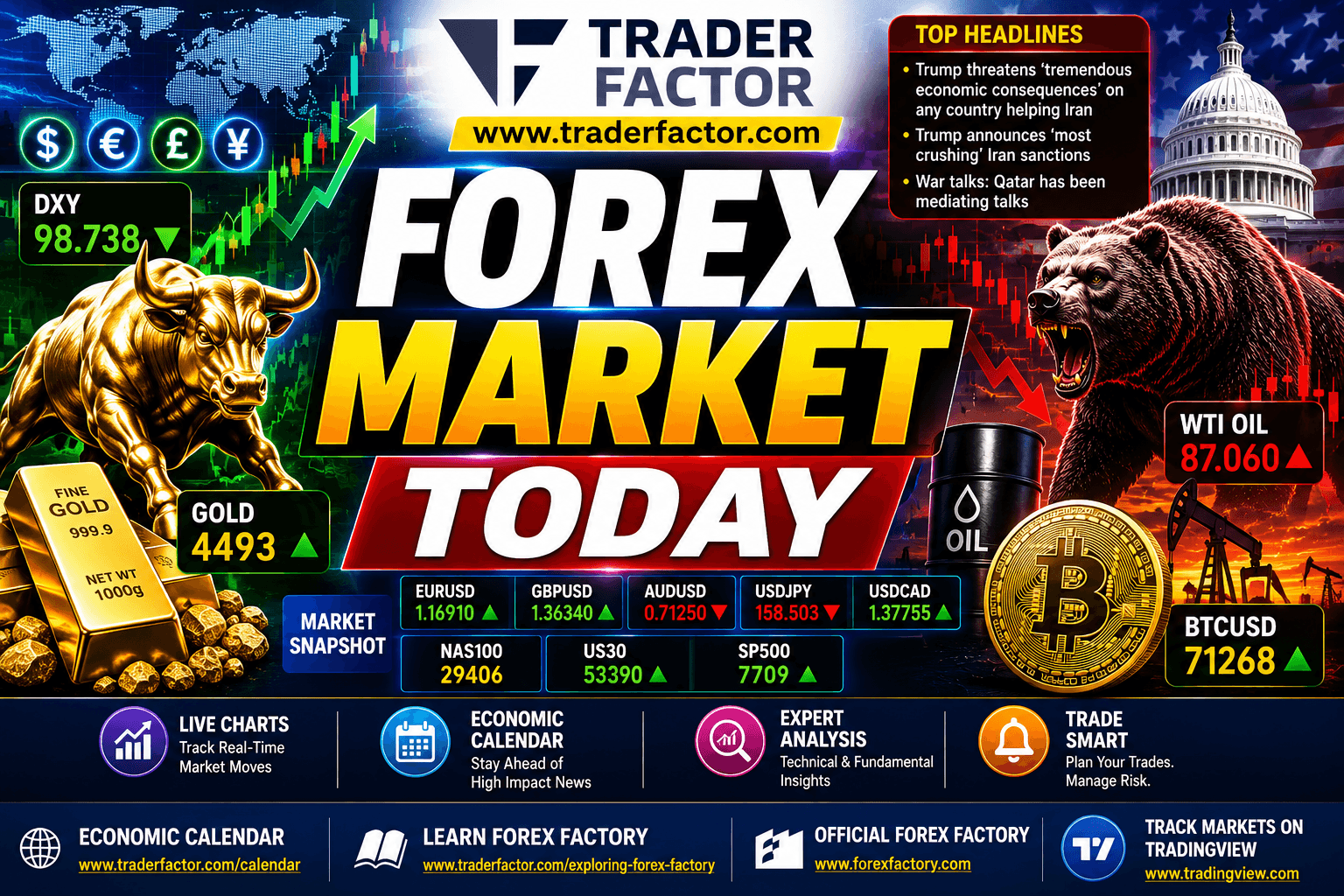

Forex Market Today: Dollar, gold, Bitcoin and oil react to hawkish FOMC minutes, cooling inflation, weaker jobs data and renewed US-Iran tensions.
📊 Forex Market Today — Key Takeaways
🟢 FOMC minutes show rising concern about persistent inflation risks
🔴 Three Fed officials supported a 25-basis-point rate hike
🟡 US inflation is cooling but remains above the Fed’s 2% target
🔵 US-Iran tensions continue driving headline volatility
🟢 Gold strengthens as geopolitical risk and dollar weakness compete with higher yields
🔴 Australia’s weaker employment report pressures the AUD
🟡 Bitcoin returns above $70,000 but remains sensitive to USD and risk sentiment
🔥 Oil remains elevated as Hormuz and supply risks dominate energy markets
Forex Market Today: Dollar, Gold, Bitcoin and Oil React to FOMC Minutes and Iran Tensions
Forex markets remain highly sensitive to the combination of Federal Reserve policy expectations, cooling US inflation, weaker labor-market conditions and renewed geopolitical uncertainty. The release of the latest FOMC minutes has reinforced the debate over whether the Federal Reserve may need to keep rates higher for longer or consider another increase if inflation remains persistent. At the same time, US-Iran tensions and developments surrounding the Strait of Hormuz continue to influence the dollar, oil and gold. Traders are also assessing Australia’s weaker labor-market data and watching upcoming PMI releases for fresh clues about global growth and central-bank policy.
⚡ Quick Market Answer
The US dollar remains caught between two competing forces: hawkish FOMC minutes are supporting the case for higher rates, while softer inflation and weaker employment data are limiting expectations for aggressive tightening.
Meanwhile, US-Iran tensions are keeping oil and safe-haven flows highly sensitive to headlines. Gold remains supported, Bitcoin has recovered above $70,000, while major currencies are trading around key technical levels.
Support and Resistance Snapshot
📈 Support, Resistance & Market Bias
| Asset | Current Price | Support | Resistance | Bias |
|---|---|---|---|---|
| DXY | 98.738 | 98.20 | 99.50 | ➡ Neutral |
| Gold | 4493 | 4440 | 4550 | 📈 Bullish |
| EURUSD | 1.16910 | 1.1620 | 1.1750 | 📈 Bullish |
| GBPUSD | 1.36340 | 1.3550 | 1.3700 | 📈 Bullish |
| NZDUSD | 0.59508 | 0.5900 | 0.6000 | 📈 Bullish |
| AUDUSD | 0.71250 | 0.7050 | 0.7180 | 📉 Bearish |
| USDCAD | 1.37755 | 1.3700 | 1.3900 | ➡ Neutral |
| USDJPY | 158.503 | 157.50 | 160.00 | ➡ Neutral |
| USDCHF | 0.79843 | 0.7900 | 0.8050 | 📉 Bearish |
| BTCUSD | 71268 | 69000 | 73000 | 📈 Bullish |
| WTI Oil | 87.060 | 84.00 | 90.00 | 📈 Bullish |
| NAS100 | 29406 | 29000 | 30000 | ➡ Neutral |
| US30 | 53390 | 52800 | 54000 | ➡ Neutral |
| SP500 | 7709 | 7600 | 7800 | 📈 Bullish |
Market Analysis
Currencies / Forex
The forex market is being driven by a complicated mix of monetary-policy expectations and geopolitical risk. The latest FOMC minutes revealed a divided Federal Reserve, with three policymakers supporting a 25-basis-point increase at the July meeting while several others indicated that additional tightening could become necessary if inflation remains persistent. The Fed nevertheless maintained the federal funds target at 3.50%–3.75%.
At the same time, recent inflation and employment data are making the policy outlook less straightforward. Cooling inflation and weaker labor-market conditions could eventually give policymakers more room to ease, while higher energy costs and geopolitical disruption could keep inflation elevated. This tension is likely to keep the dollar volatile rather than establish a clean one-way trend.
EURUSD
EURUSD remains constructive near 1.16910 as the euro benefits from a softer dollar environment. The pair is approaching the 1.1700 region, making that area an important test for further upside momentum.
From a broader macro perspective, the pair remains highly sensitive to changes in US rate expectations. If traders interpret the FOMC minutes as sufficiently hawkish to push Treasury yields higher, EURUSD could face renewed selling. Conversely, softer US data and declining yields would strengthen the bullish case.
GBPUSD
GBPUSD continues to trade firmly around 1.36340 after recovering from previous dollar strength.
The pound remains supported by expectations surrounding UK monetary policy, although traders should remain cautious because renewed USD demand can quickly reverse gains. The 1.3550 region provides an important support zone, while 1.3700 represents a significant upside barrier.
NZDUSD
NZDUSD remains supported near 0.59500 as broad dollar weakness provides assistance to the New Zealand dollar.
However, the pair remains sensitive to global risk sentiment. A stronger dollar caused by geopolitical escalation or renewed hawkish Fed expectations could push NZDUSD back toward the 0.5900 region.
AUDUSD
AUDUSD faces renewed pressure following Australia’s weaker labor-market report. Employment fell by 15,800 in July while unemployment increased to 4.5%, the highest level since late 2021.
The weaker labor data reduces pressure on the Reserve Bank of Australia to tighten policy further. Technically, AUDUSD is still holding above 0.7050, but a break below that area could expose the pair to deeper losses. A recovery through 0.7180 would improve the short-term outlook.
USDCAD
USDCAD remains relatively elevated around 1.37755 despite strong oil prices.
Normally, higher crude prices support the Canadian dollar because Canada is a major energy exporter. However, broad USD demand and geopolitical uncertainty are preventing the Canadian dollar from fully benefiting from the rise in oil.
USDJPY
USDJPY remains elevated around 158.50 as the interest-rate differential continues to favor the dollar.
The pair remains close to psychologically important levels, and traders should also consider the possibility of intervention concerns if yen weakness accelerates. A sustained break below 157.50 could weaken the bullish structure, while a move toward 160.00 would place renewed focus on Japanese policy risks.
USDCHF
USDCHF remains below 0.8000 as the Swiss franc benefits from defensive demand.
The pair is particularly sensitive to changes in geopolitical risk. A stronger risk-off environment could increase demand for the franc, while a stronger US yield advantage could help USDCHF recover.
| 🚀 Top-Rated Forex Broker Reviews Compare brokers, spreads, leverage, platforms & trading conditions. | ||
|---|---|---|
| 🔥 IronFX Trading Conditions | ⭐ PU Prime Spreads & Platforms | 📈 NAGA Social Trading |
| ⚡ TMGM Execution Speed | 💹 M4 Markets Account Types | 💼 RS Prime Broker Overview |
| 👑 OneRoyal Regulation & Safety | 🎯 Skilling Platform Review | 📊 DeltaStock Broker Features |
| 🚀 Eightcap Trading Experience | 🧪 Alchemy Markets Broker Analysis | ✅ ActivTrades Expert Review |
| 💰 VS Capital Broker Rating | ⚖️ High Leverage Compare Leverage | 📉 Low Spreads Trading Costs |
| Compare Broker Features, Costs, Regulation, Platforms & Leverage Explore our independent broker reviews before choosing your next trading account. | ||
Crypto / Bitcoin
Bitcoin has recovered strongly toward $71,268 after previously trading under pressure. The recovery suggests that risk appetite remains relatively resilient despite the hawkish tone of the FOMC minutes.
The $69,000 area now becomes an important support zone, while $73,000 represents the next major resistance. A sustained break above resistance could encourage further upside, but Bitcoin remains vulnerable to a renewed dollar rally, rising Treasury yields or a broader geopolitical risk-off move.
Gold
Gold has strengthened toward $4,493 as investors balance geopolitical risk against the impact of higher US yields and hawkish Federal Reserve expectations.
The latest Fed minutes create a headwind because expectations for additional tightening can strengthen the dollar and increase the opportunity cost of holding a non-yielding asset. However, the geopolitical environment continues to provide an important counterweight. Recent market coverage also highlights the competing effects of hawkish Fed expectations and US-Iran tensions on gold.
Technically, gold is approaching the $4,500 psychological resistance area. A decisive break above $4,550 could strengthen the bullish structure, while a move below $4,440 would suggest that profit-taking and yield pressure are becoming dominant.
Stocks / Equities
Equity markets remain caught between strong corporate and economic resilience and concerns about interest rates staying elevated. Hawkish FOMC minutes can pressure valuations, particularly in technology stocks, because higher yields increase the discount rate applied to future earnings.
However, softer labor-market conditions and cooling inflation provide an opposing argument. If investors increasingly believe the Fed is approaching the end of its tightening cycle, equities could regain momentum. The market therefore remains highly sensitive to Treasury yields.
NAS100
The NAS100 is trading around 29,406. Technology stocks remain sensitive to changes in interest-rate expectations because higher yields can reduce the attractiveness of future growth earnings.
The index needs to regain the 30,000 area to establish stronger bullish momentum. Support around 29,000 remains important for maintaining the current structure.
US30
The US30 is trading near 53,390 and continues to benefit from its exposure to industrial, financial and value-oriented companies.
The index may prove relatively resilient if investors rotate away from high-duration technology stocks. However, renewed geopolitical escalation or a sharp increase in yields could pressure the broader equity market.
S&P 500
The S&P 500 is trading around 7,709 and remains close to major highs.
The 7,800 region is an important resistance zone. A successful breakout could encourage further bullish momentum, while a decline through 7,600 would suggest that investors are becoming more cautious about the rate outlook.
Geopolitics
Geopolitical risk remains one of the most important drivers across global markets. The United States has intensified economic pressure on Iran, with President Trump threatening severe consequences for countries that assist Tehran economically and announcing further sanctions.
The Strait of Hormuz remains particularly important because disruptions to energy transportation can increase oil prices and feed inflation expectations. This creates a difficult environment for the Federal Reserve because higher energy costs could slow the progress of inflation toward the 2% target.
Qatar continues to play a diplomatic role in attempts to facilitate talks, but markets remain highly headline-driven. Any indication of renewed negotiations could reduce oil and safe-haven premiums, while further escalation could produce the opposite reaction.
Economic Calendar
Wednesday — FOMC Minutes
The July 28–29 FOMC minutes were released on August 19 and provided important insight into the Fed’s internal debate.
The committee voted 9–3 to maintain the federal funds target at 3.50%–3.75%, with three members favoring a 25-basis-point increase. Policymakers also discussed the possibility that persistent inflation from energy costs, tariffs and strong demand could require additional tightening.
For traders, the key message is that the Federal Reserve remains divided. The minutes therefore increase the importance of future inflation and employment reports.
Thursday — Australia Employment Report
Australia’s July employment report showed employment falling by 15,800 while the unemployment rate increased to 4.5%. The result points to a cooling labor market and reduces pressure for another immediate RBA rate increase.
The data is particularly important for AUDUSD because weaker employment can reduce expectations for tighter monetary policy.
Thursday — US Weekly Jobless Claims
Weekly jobless claims provide a timely indication of labor-market conditions.
A sustained increase in claims could reinforce expectations that the US labor market is cooling and potentially reduce expectations for further Fed tightening. Stronger employment conditions would have the opposite effect.
Friday — Flash Manufacturing PMI
Friday’s Flash Manufacturing PMI releases for the Eurozone, United Kingdom and United States will provide an early look at business activity.
Stronger-than-expected US data could support the dollar, while weaker US activity could reinforce expectations for future policy easing. European and UK results could create additional volatility across EURUSD and GBPUSD.
Forex Factory Calendar
📅 Track Market-Moving Events
Follow FOMC events, inflation reports, employment data and PMI releases before trading forex, gold, oil and stocks.
📅 This Week’s Calendar
|
👉 Learn Forex Factory
|
Official Calendar
Final Outlook
The market is currently being pulled in opposite directions.
The hawkish FOMC minutes suggest that some Federal Reserve officials remain prepared to raise rates if inflation fails to return convincingly toward 2%. At the same time, cooling inflation and weaker employment conditions are increasing expectations that monetary tightening may be approaching its limit.
Geopolitics adds another layer of uncertainty. Continued US-Iran tensions and risks surrounding the Strait of Hormuz can keep oil prices elevated and potentially complicate the inflation outlook.
For now, traders should expect elevated volatility across the dollar, gold, oil, Bitcoin and equities as markets digest the Fed’s message alongside geopolitical headlines.
FAQs: FOMC Meeting, FOMC News & FOMC 2026
🔵 What does FOMC mean?
FOMC stands for Federal Open Market Committee, the Federal Reserve body responsible for setting U.S. monetary policy.
🟣 What date is the next FOMC meeting?
The next scheduled FOMC meeting is September 15–16, 2026. The July 28–29 meeting minutes were released on August 19.
🟢 What time is the FOMC release?
FOMC news, statements and minutes are generally released at 2:00 p.m. Eastern Time. Always confirm the exact time on the FOMC calendar.
🟠 What is FOMC news in forex?
FOMC news can move forex markets by changing expectations for U.S. interest rates. Hawkish policy can support the USD, while dovish expectations may weaken it.
🔴 What is FOMC trading?
FOMC trading involves positioning around Federal Reserve decisions, statements, minutes and changing interest-rate expectations. Volatility can increase sharply around major releases.
⚡ How to trade FOMC in forex?
Compare the Fed’s message with market expectations and monitor the DXY, Treasury yields and major currency pairs for confirmation before entering a trade.
📊 How to trade FOMC news?
One approach is to wait for the initial volatility to settle and then trade a confirmed breakout or reversal. Avoid excessive leverage during the first reaction.
🔮 What is the prediction for FOMC?
The FOMC 2026 outlook depends on inflation, employment, growth and financial conditions. Traders are watching whether policymakers remain focused on inflation or become more concerned about labor-market weakness.
🎯 What is FOMC in trading strategy?
FOMC events can be incorporated into a macro trading strategy by identifying expected rate outcomes, market positioning and potential bullish or bearish scenarios before the release.
📅 How often is FOMC news?
The FOMC meeting normally takes place eight times each year, although additional meetings can occur when necessary.
🥇 Will FOMC affect gold?
Yes. The FOMC decision can significantly affect gold through the USD and Treasury yields. Hawkish expectations can pressure gold, while dovish expectations can support it.
₿ How will FOMC affect crypto?
FOMC news can affect Bitcoin and crypto through liquidity, interest-rate expectations and risk appetite. A dovish Fed environment can support crypto, while higher-rate expectations may pressure it.
🔁 How frequently does FOMC happen?
The FOMC 2026 schedule normally contains eight meetings per year. Minutes from regular meetings are generally released about three weeks after each policy decision.
About the Author
Phyllis Wangui
Senior Market Analyst, TraderFactor
Phyllis Wangui is a seasoned financial markets analyst with over a decade of experience in forex and CFD brokerage evaluation. Specializing in regulatory compliance and risk assessment, she leads the TraderFactor reviews team in delivering transparent, data-driven broker breakdowns that help retail traders navigate complex offshore and Tier-1 trading environments.

Reviewed by Alex Kanyi
Head of Compliance | TraderFactor
“This report is for general information only. Trading involves significant risk. Seek independent advice before acting on any content.”
Subscribe to the TraderFactor Newsletters
Last Updated: August 2026
Disclaimer:
All information has been prepared by TraderFactor or partners. The information does not contain a record of TraderFactor or partner’s prices or an offer of or solicitation for a transaction in any financial instrument. No representation or warranty is given as to the accuracy or completeness of this information. Any material provided does not have regard to the specific investment objective and financial situation of any person who may read it. Past performance is not a reliable indicator of future performance.