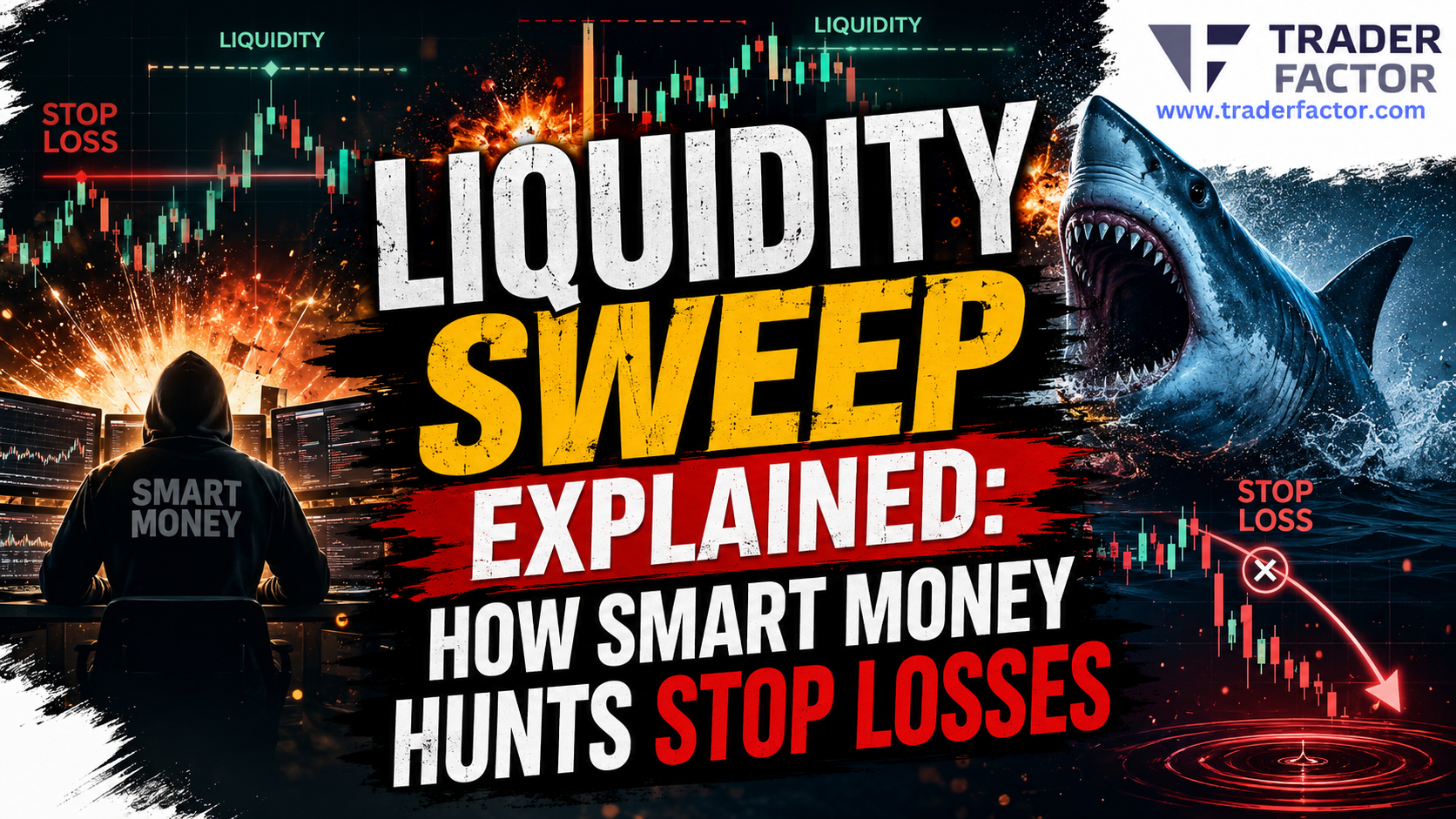

Learn what a liquidity sweep is in forex trading, how smart money hunts stop losses, and how to identify liquidity grabs before major market moves.
Table of Contents
Toggle📌 Key Takeaways: Liquidity Sweep in Forex
- Liquidity sweeps target areas where stop losses are clustered.
- Smart money uses sweeps to access market liquidity efficiently.
- Buy-side liquidity sits above swing highs and resistance.
- Sell-side liquidity sits below swing lows and support.
- Most liquidity sweeps appear as false breakouts or stop hunts.
- Price often reverses after liquidity has been collected.
- Equal highs and equal lows are common liquidity targets.
- London and New York sessions frequently produce liquidity sweeps.
- Confirmation is essential before entering after a sweep.
- Market structure shifts strengthen liquidity sweep trade setups.
- Fair Value Gaps and Order Blocks improve entry precision.
- Risk management remains critical even with high-probability setups.
- Sweeps help reveal the true directional intent of institutions.
- Not every breakout is genuine; many are liquidity grabs.
- Successful traders wait for rejection and confirmation signals.
Liquidity Sweep Explained: How Smart Money Hunts Stop Losses
Have you ever entered a trade only to watch price hit your stop loss before moving exactly in the direction you predicted?
This frustrating experience is one of the reasons many traders begin studying liquidity sweeps and Smart Money Concepts (SMC). What appears to be market manipulation is often a deliberate move toward liquidity.
A liquidity sweep occurs when price temporarily moves beyond a key high or low to trigger stop losses and pending orders before reversing direction. These movements are commonly used by institutional traders to access the liquidity needed to execute large positions.
Understanding liquidity sweeps can help traders avoid false breakouts, identify high-probability trade setups, and improve their forex chart analysis.
In this guide, you’ll learn what a liquidity sweep is, why it happens, how smart money hunts stop losses, and how to identify liquidity sweeps on charts using real market examples.
What Is a Liquidity Sweep in Forex?
A liquidity sweep is a temporary move into a liquidity zone where price triggers stop losses and pending orders before reversing direction.
These zones often exist above market highs and below market lows because that is where retail traders commonly place stop losses.
A liquidity sweep is sometimes called:
- Liquidity grab
- Stop hunt
- Liquidity run
- Smart money sweep
The primary purpose of a liquidity sweep is to provide institutional traders with enough liquidity to enter or exit large positions.
For example, if Gold forms equal highs and thousands of traders place stop losses above those highs, institutions may push price into that area, triggering those stops before reversing lower.
This process allows smart money to access the orders needed to fill their positions.
Why Do Liquidity Sweeps Happen?
Liquidity sweeps occur because institutions need liquidity.
Unlike retail traders, banks and hedge funds cannot simply click a button and instantly fill massive orders without affecting market prices.
Large institutions often require significant buying or selling interest to execute trades efficiently.
This is where retail traders unknowingly provide liquidity.
Common liquidity sources include:
- Stop losses
- Breakout traders
- Pending buy stops
- Pending sell stops
When these orders accumulate around obvious chart levels, they create liquidity pools that attract institutional attention.
Price often moves toward these pools before making its true directional move.
How Smart Money Hunts Stop Losses
Stop losses are one of the largest sources of liquidity in financial markets.
Most retail traders place stop losses in predictable locations such as:
- Above resistance
- Below support
- Above equal highs
- Below equal lows
- Above trendlines
- Below trendlines
Because these locations are obvious, institutions know where large clusters of orders are likely sitting.
Smart money may deliberately push price into these areas to trigger stop losses.
Once those orders are activated, institutions gain access to the liquidity needed to enter larger positions.
This is why many traders feel like the market is targeting their stops.
In reality, price is targeting liquidity.
Buy Side Liquidity Sweep Explained
A buy side liquidity sweep occurs when price moves above a significant high to trigger stop losses from sellers and breakout buy orders.
This type of liquidity sweep usually occurs above:
- Equal highs
- Swing highs
- Resistance levels
- Previous Day High
- Weekly highs
How a Buy Side Liquidity Sweep Forms
Step 1
Price forms equal highs or a clear resistance level.
Step 2
Retail traders place sell stop losses above those highs.
Step 3
Breakout traders place buy stop orders above resistance.
Step 4
Price pushes above the highs and triggers those orders.
Step 5
Institutions sell into the liquidity.
Step 6
Price reverses lower.
This creates what appears to be a breakout but is actually a liquidity sweep.
Gold Example
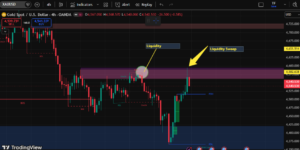
A look at the Gold trading around 4540 after forming equal highs near 4555.
Many traders expect a breakout above resistance.
Price briefly pushes above 4555, triggering buy side liquidity.
Moments later, strong selling pressure enters the market and Gold reverses lower.
This is a classic buy side liquidity sweep.
Sell Side Liquidity Sweep Explained
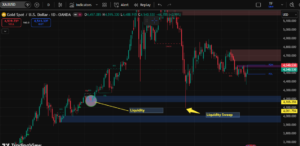
A sell side liquidity sweep occurs when price moves below a significant low to trigger stop losses from buyers and breakout sell orders.
This type of sweep often occurs below:
- Equal lows
- Swing lows
- Support levels
- Previous Day Low
- Weekly lows
How a Sell Side Liquidity Sweep Forms
Step 1
Price forms equal lows.
Step 2
Retail traders place stop losses below support.
Step 3
Breakout traders place sell stop orders below the lows.
Step 4
Price sweeps below support.
Step 5
Institutions buy into the liquidity.
Step 6
Price reverses upward.
This often traps traders who entered short positions expecting a bearish breakout.
Liquidity Sweep vs Liquidity Grab
Many traders use these terms interchangeably.
In most cases, a liquidity sweep and liquidity grab describe the same concept.
Both involve:
- Taking liquidity from stop losses
- Triggering pending orders
- Creating temporary price movements
- Allowing institutions to enter positions
Some traders define a liquidity grab as a quick rejection while a liquidity sweep may involve a deeper penetration into liquidity.
For practical trading purposes, both terms refer to the market targeting liquidity before a reversal.
How to Identify a Liquidity Sweep on a Chart
Learning to identify liquidity sweeps can dramatically improve trade entries and exits.
Equal Highs
Equal highs are one of the most common liquidity targets.
When multiple highs form at the same level, stop losses accumulate above them.
These areas often become buy side liquidity targets.
Equal Lows
Equal lows attract stop losses from buyers.
These areas often become sell side liquidity targets.
Previous Day High and Previous Day Low
Professional traders frequently monitor these levels because they contain significant liquidity.
Price often reacts strongly after sweeping these zones.
Session Highs and Session Lows
London and New York session highs and lows frequently attract liquidity.
Many stop hunts occur during major market opens.
Trendline Liquidity
Trendlines create predictable areas where retail traders place stop losses.
Institutions often exploit these levels through liquidity sweeps.
Liquidity Sweep vs Real Breakout
One of the biggest challenges in trading is distinguishing between a liquidity sweep and a genuine breakout.
Signs of a Liquidity Sweep
- Long candle wicks
- Fast rejection
- Immediate reversal
- Low follow-through
- Failure to hold above or below the level
Signs of a Real Breakout
- Strong candle closes
- Multiple candles confirming direction
- Sustained momentum
- Successful retests
- Continued market structure in breakout direction
Understanding this difference helps traders avoid entering false breakouts.
Liquidity Sweeps and Market Structure
Liquidity sweeps become even more powerful when combined with market structure analysis.
Key concepts include:
- Break of Structure (BOS)
- Change of Character (CHOCH)
- Higher highs and higher lows
- Lower highs and lower lows
A liquidity sweep by itself is not always enough to justify a trade.
The strongest setups occur when a sweep is followed by a market structure shift.
For example:
- Gold sweeps sell side liquidity.
- A bullish CHOCH forms.
- A bullish BOS follows.
- Price retests a key zone.
- The market rallies toward buy side liquidity.
This sequence provides a stronger confirmation than the sweep alone.
Common Liquidity Sweep Mistakes
Chasing the Breakout
Many traders enter immediately after price breaks a high or low.
This often leads to getting trapped in liquidity sweeps.
Ignoring Market Structure
Liquidity works best when combined with trend analysis and structure.
Entering Before Confirmation
Patience is critical.
Wait for BOS, CHOCH, or strong rejection candles.
Trading During Low Liquidity Hours
Liquidity sweeps are generally more reliable during active market sessions.
Poor Risk Management
Even strong liquidity setups can fail.
Always use proper position sizing and risk management.
Simple Liquidity Sweep Trading Strategy
Step 1: Identify Liquidity Pools
Mark:
- Equal highs
- Equal lows
- Previous Day High
- Previous Day Low
- Session highs and lows
Step 2: Wait for the Sweep
Allow price to take the liquidity.
Avoid entering before the sweep occurs.
Step 3: Look for Confirmation
Watch for:
- BOS
- CHOCH
- Strong rejection candles
Step 4: Enter on Retest
Wait for price to retest the swept area or an order block.
Step 5: Target Opposite Liquidity
Markets often move from one liquidity pool to another.
This provides logical take profit targets.
Why Liquidity Sweeps Matter in Smart Money Concepts
Liquidity sweeps are a cornerstone of Smart Money Concepts trading.
They help traders understand:
- Institutional order flow
- Market manipulation
- Stop hunts
- Liquidity pools
- High-probability reversals
Instead of reacting emotionally to price spikes, traders begin identifying where liquidity exists and how smart money may use it.
This shift in perspective often leads to better decision-making and improved trading consistency.
Final Thoughts
Liquidity sweeps are one of the most important concepts in forex trading and Smart Money Concepts.
They explain why price often moves beyond obvious highs and lows before reversing direction.
Rather than viewing these moves as random market behavior, traders should understand them as liquidity events driven by institutional order flow.
By learning to identify:
- Buy side liquidity sweeps
- Sell side liquidity sweeps
- Equal highs
- Equal lows
- BOS
- CHOCH
you can improve your forex chart analysis and avoid many of the traps that catch beginner traders.
The market is constantly searching for liquidity. Once you understand where that liquidity exists, you begin seeing price action through the eyes of smart money rather than the eyes of the crowd.
Frequently Asked Questions
What is a liquidity sweep in forex?
A liquidity sweep occurs when price temporarily moves into a liquidity zone, triggering stop losses and pending orders before reversing direction.
What is a liquidity grab?
A liquidity grab is another term commonly used to describe a liquidity sweep.
Why do liquidity sweeps happen?
Liquidity sweeps occur because institutions need liquidity to execute large positions.
What is a buy side liquidity sweep?
A buy side liquidity sweep occurs when price moves above highs to trigger stop losses and buy orders before reversing lower.
What is a sell side liquidity sweep?
A sell side liquidity sweep occurs when price moves below lows to trigger stop losses and sell orders before reversing higher.
Are liquidity sweeps manipulation?
Liquidity sweeps are a normal part of market mechanics and institutional order execution, though many retail traders view them as market manipulation.
Can beginners trade liquidity sweeps?
Yes. Beginners can trade liquidity sweeps effectively when they combine them with market structure, risk management, and proper confirmation signals.
TraderFactor
Phyllis Wangui is a seasoned financial markets analyst with over a decade of experience in forex and CFD brokerage evaluation. Specializing in regulatory compliance and risk assessment, she leads the TraderFactor reviews team in delivering transparent, data-driven broker breakdowns that help retail traders navigate complex offshore and Tier-1 trading environments.

Reviewed by Alex Kanyi
Head of Compliance | TraderFactor
“This report is for general information only. Trading involves significant risk. Seek independent advice before acting on any content.”
[Subscribe to the TraderFactor Newsletter]
Last Updated: May 2026
Disclaimer:
All information has been prepared by TraderFactor or partners. The information does not contain a record of TraderFactor or partner’s prices or an offer of or solicitation for a transaction in any financial instrument. No representation or warranty is given as to the accuracy or completeness of this information. Any material provided does not have regard to the specific investment objective and financial situation of any person who may read it. Past performance is not a reliable indicator of future performance.