
Learn the difference between spreads and commissions and calculate which costs less for your trading style. Real broker examples and hidden fees revealed.
Forex Spreads vs. Commissions: Which Costs Less? (2026 Calculator)
You find a forex broker advertising “zero commissions” and “tight spreads.” You open an account, start trading, and at the end of the month, your profits seem smaller than expected. What happened?
You paid trading costs—you just didn’t see them leaving your account.
Every forex trade has a cost. The only question is how you pay it:
- Through the spread (the difference between the buy and sell price)
- Through a separate commission per lot
- Or a combination of both
In this guide, we’ll break down each model, show you exactly how to calculate your true trading costs, compare real brokers from our reviews, and help you choose the structure that saves you the most money based on your trading style.
Key Takeaways
- Every trade has a cost – you either pay through the spread, a commission, or both.
- Spread-only accounts are simpler but often more expensive for active traders.
- Commission-based (Raw) accounts offer ultra-tight spreads and lower total costs if you trade frequently.
- The best choice depends on your trading style and volume – we’ll show you how to calculate exactly what you should pay.
- TraderFactor reviews include real cost data so you can compare brokers side-by-side.
The Hidden Cost of Every Trade
Why this matters:
Over a month of trading, the difference between a high-cost and low-cost broker could be hundreds or even thousands of dollars. That’s money that stays in your pocket—or leaks out without you realizing it.
What Are Spreads? (The Classic Model)
Definition
The spread is the difference between the bid price (the price at which you can sell) and the ask price (the price at which you can buy).
Example:
- EUR/USD bid: 1.1000
- EUR/USD ask: 1.1003
- Spread: 0.0003 (or 3 pips)
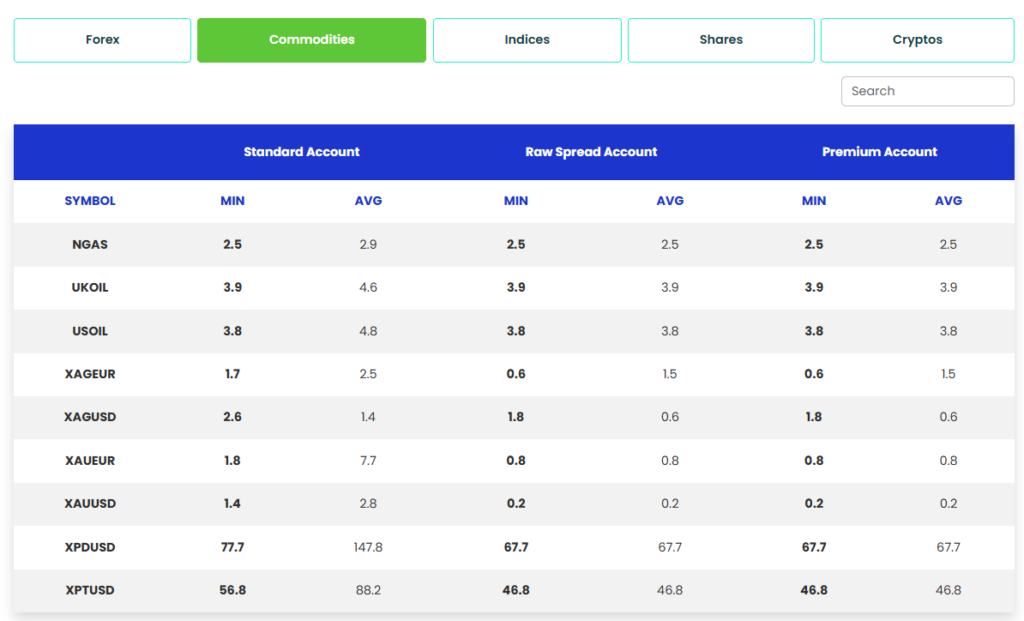
How Brokers Make Money with Spreads
In a spread-only model, the broker builds their fee directly into the price you see. They give you a slightly worse price than the actual interbank market rate and keep the difference. This is the traditional model that most beginner-friendly brokers use.
Types of Spreads
| Type | Description | Pros | Cons |
|---|---|---|---|
| Fixed Spread | Spread remains constant regardless of market conditions | Predictable costs, easy to calculate, good for beginners | Often wider than variable spreads; broker may widen during news despite “fixed” claim |
| Variable Spread | Spread fluctuates with market liquidity and volatility | Can be extremely tight during peak trading hours (London/New York overlap) | Widens significantly during high-impact news events |

Who Is the Spread-Only Model Best For?
- Beginners who want simplicity and predictable costs
- Swing traders who hold positions for days or weeks and trade infrequently
- Traders who use fixed spreads to backtest strategies with consistent costs
What Are Commissions? (The ECN/Raw Model)
Definition
A commission is a separate, transparent fee charged per trade, usually based on the volume traded. This model is common with ECN (Electronic Communication Network) and Raw Spread accounts.
Example:
- $3.50 per side per lot (or $7 round turn)
- You trade 1 standard lot (100,000 units) of EUR/USD
- You pay $7 total regardless of the spread

The “Raw Spread” Account
In this model, the broker gives you access to raw interbank spreads—which can be as low as 0.0 pips on major pairs during liquid times—and then charges a flat commission. The broker’s revenue comes entirely from the commission, so they have no incentive to widen your spreads.
Why Brokers Use This Model
- Transparency: You see exactly what you’re paying; no hidden markup.
- Attracts active traders: Scalpers and day traders demand tight spreads.
- Fairness: The broker’s profit is aligned with your trading volume, not with giving you worse prices.

Who Is the Commission Model Best For?
- Scalpers who open and close many trades in a single session
- Day traders who execute multiple trades daily
- High-volume traders who can benefit from the lower per-lot cost
- Experienced traders who understand cost structures and want maximum transparency
Spread-Only vs. Commission-Only vs. Hybrid Models
Many brokers offer multiple account types. Here’s how they compare:
| Model | How It Works | Typical Spread (EUR/USD) | Typical Commission | Best For |
|---|---|---|---|---|
| Spread-Only (Standard) | Broker fee built into spread | 1.0 – 1.5 pips | $0 | Beginners, low-frequency traders |
| Commission-Only (Raw/ECN) | Ultra-tight interbank spread + flat fee per lot | 0.0 – 0.3 pips | $3–$8 per lot per side | Scalpers, high-volume traders |
| Hybrid | Moderate spread + reduced commission | 0.4 – 0.8 pips | $2–$4 per lot per side | Intermediate traders who want balance |
The Math: How to Calculate Your True Trading Cost
This is the most important section. If you learn nothing else, learn how to do this calculation.
Formula for Spread-Only Accounts
Total Cost = (Spread in pips) × (Pip Value) × (Number of Lots)
Example:
- Spread: 1.2 pips
- Pip value for EUR/USD: $10 per standard lot (for most brokers)
- Lots traded: 5
- Total cost = 1.2 × $10 × 5 = $60

Formula for Commission-Only Accounts
Total Cost = (Commission per Lot Round Turn) × (Number of Lots)
Example:
- Commission: $7 per lot round turn (some brokers charge per side; always check)
- Lots traded: 5
- Total cost = $7 × 5 = $35
Formula for Hybrid Accounts
Total Cost = (Spread Cost) + (Commission Cost)
Example:
- Spread: 0.4 pips
- Commission: $3.50 per lot round turn
- Lots: 5
- Spread cost = 0.4 × $10 × 5 = $20
- Commission cost = $3.50 × 5 = $17.50
- Total = $37.50

The Break-Even Point: When Does Commission Become Cheaper?
Let’s compare a typical spread-only account (1.2 pips) with a typical raw account (0.1 pip spread + $7 commission) at different volumes.
| Lots Traded | Spread-Only Cost (1.2 pips) | Raw Account Cost (0.1 pip + $7/lot) | Cheaper Model |
|---|---|---|---|
| 1 lot | $12 | ($1 + $7) = $8 | Raw account |
| 5 lots | $60 | ($5 + $35) = $40 | Raw account |
| 10 lots | $120 | ($10 + $70) = $80 | Raw account |
| 20 lots | $240 | ($20 + $140) = $160 | Raw account |
Key insight: For active traders, commission-based models almost always cost less—the savings grow with volume. However, raw accounts often require higher minimum deposits ($200–$500), so they may not be suitable for tiny accounts.
Real Examples: Comparing Four Popular Brokers
Let’s apply this math to real brokers from TraderFactor’s reviews. (Data current as of March 2026.)
Example 1: TMGM (Standard Account)
- Model: Spread-only
- EUR/USD spread: 1.1 pips (typical)
- Commission: $0
- Cost per 10 lots: 1.1 × $10 × 10 = $110

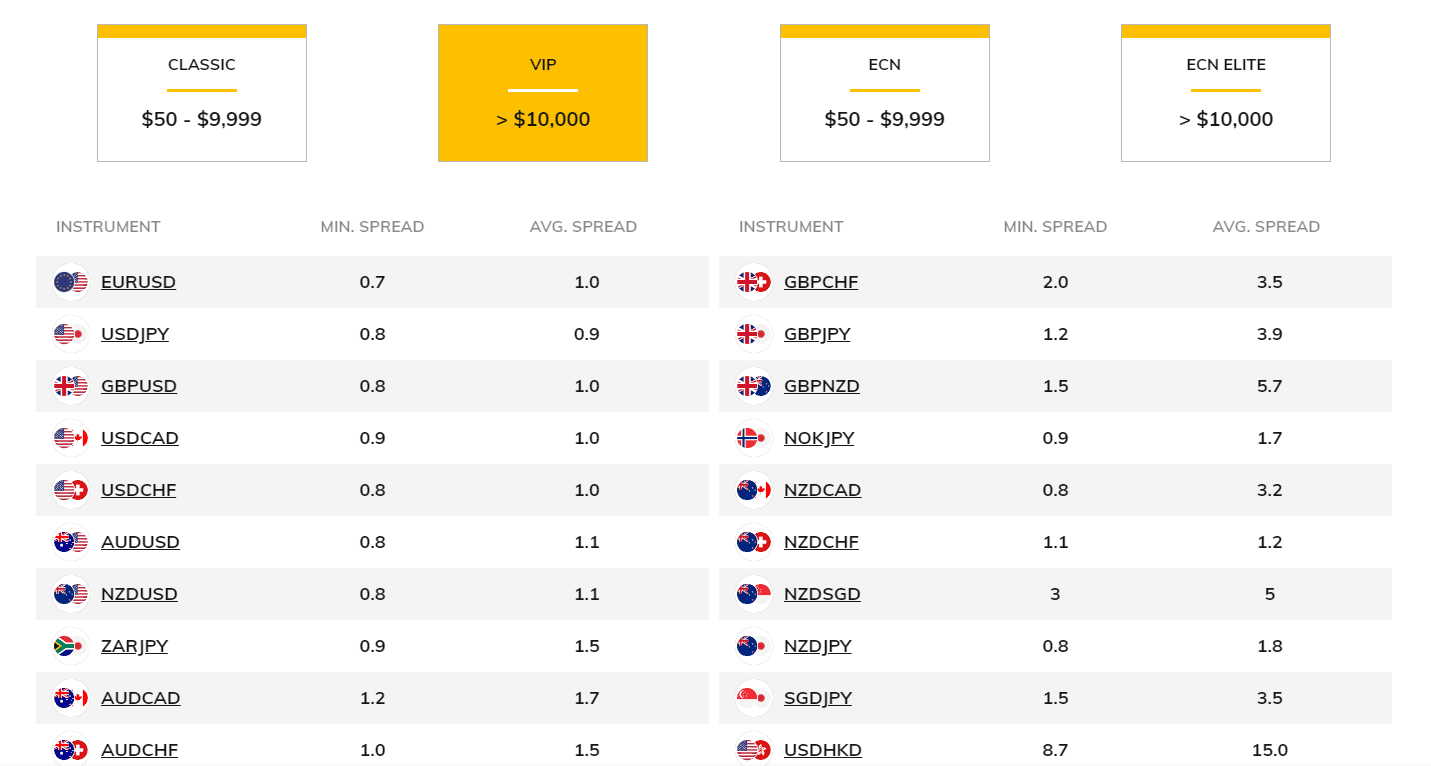
Example 2: OneRoyal (Raw Spread Account)
- Model: Raw spread + commission
- EUR/USD spread: 0.1 pips
- Commission: $7 per lot round turn
- Cost per 10 lots: ($1 + $70) = $71
Example 3: M4 Markets (Hybrid Account)
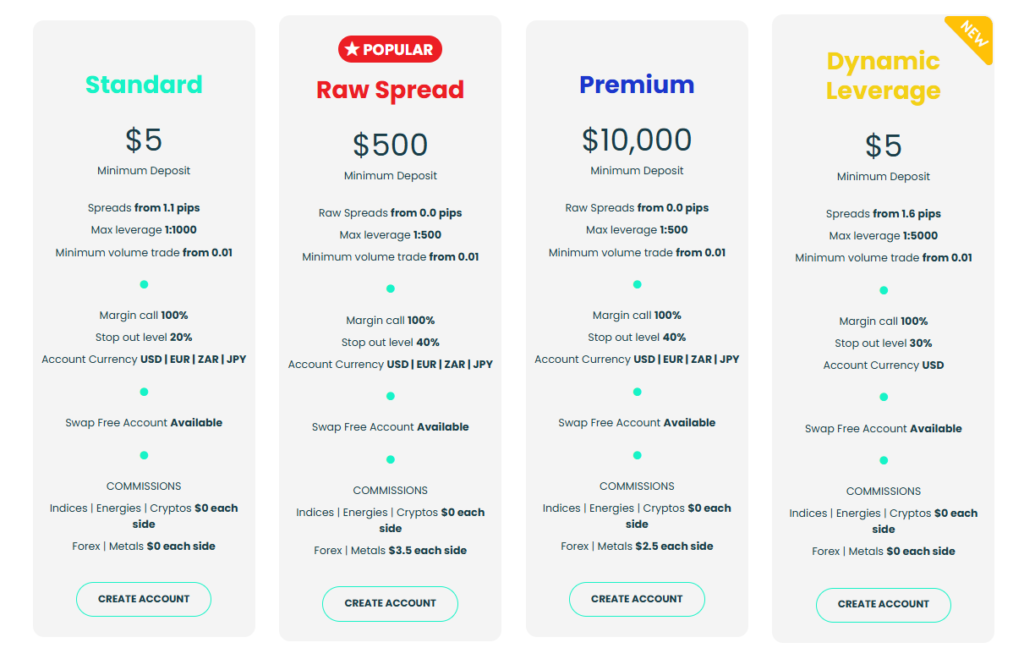
- Model: Hybrid (moderate spread + reduced commission)
- EUR/USD spread: 0.4 pips
- Commission: $3.50 per lot round turn
- Cost per 10 lots: ($4 + $35) = $75
Example 4: Admirals (Zero Account)
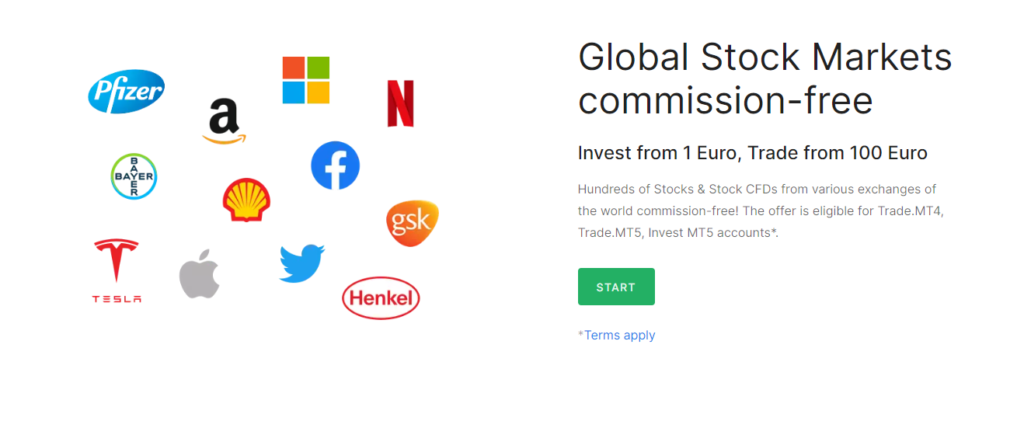
- Model: Raw spread + low commission
- EUR/USD spread: 0.2 pips
- Commission: $4 per lot round turn
- Cost per 10 lots: ($2 + $40) = $60
Summary Table: Cost per 10 Lots
| Broker | Model | Cost per 10 Lots |
|---|---|---|
| TMGM (Standard) | Spread-only APPLY HERE | $110 |
| M4 Markets (Hybrid) | Spread + commission APPLY | $75 |
| OneRoyal (Raw) | Raw + commission APPLY HERE | $71 |
| Admirals (Zero) | Raw + commission | $160 |

Note: These are estimates based on typical spreads during liquid hours. Actual costs may vary with market conditions.
Which Model Costs Less? It Depends on Your Trading Style
There is no one-size-fits-all answer. Use this decision matrix to find your best fit.
If You Are a Scalper (10+ trades per day)
- Priority: Ultra-tight spreads – you need the lowest possible cost per trade.
- Best model: Raw spread + commission.
- Why: Spread costs compound rapidly; even 0.1 pip difference matters. You’ll easily meet minimum volume requirements.
If You Are a Day Trader (1–10 trades per day)
- Priority: Balance of cost and simplicity.
- Best model: Hybrid or Raw account.
- Why: You trade enough that commissions are worth it, but you may not need the absolute tightest spreads. Hybrid accounts can offer a good middle ground.
If You Are a Swing Trader (Fewer than 5 trades per week)
- Priority: Simplicity, avoiding monthly fees.
- Best model: Spread-only or Hybrid with no inactivity fee.
- Why: Your low volume means spread-only costs may be comparable to commission models, and you avoid the complexity of calculating per-trade commissions.
If You Are a Beginner
- Priority: Learning without complex cost calculations.
- Best model: Spread-only with a demo account first.
- Why: Focus on developing your strategy. Once you’re consistently profitable, you can optimize for costs.
Hidden Fees to Watch For
Spreads and commissions aren’t the only costs that eat into your profits. Keep an eye on these:
| Fee Type | What It Is | How to Avoid |
|---|---|---|
| Overnight Financing (Swap) | Interest charged for holding positions past 5 PM ET (broker’s daily close). Triple swap on Wednesday. | Check swap rates in the contract specifications; avoid holding during Wednesday if rates are high. |
| Inactivity Fees | Monthly fee if you don’t trade for a certain period (e.g., 3–6 months). | Choose brokers with no inactivity fees, or make a small trade to stay active. |
| Deposit/Withdrawal Fees | Fees for funding or withdrawing money, especially via credit card or certain payment processors. | Use free methods like bank wire (if free) or e-wallets that the broker doesn’t charge for. |
| Currency Conversion Fees | Fees for depositing in a currency different from your account base currency. | Open an account in your local currency if possible. |
| Platform Fees | Charges for using advanced platforms (rare). | Most platforms like MT4, MT5, cTrader are free; check if any “premium” features cost extra. |
| Minimum Commission | Some brokers have a minimum commission per trade (e.g., $1), which can hurt micro-lot traders. | If you trade very small sizes, look for brokers with no minimum or very low minimum. |

How to Choose the Right Fee Structure for You
Follow this simple checklist before opening an account:
- Estimate your monthly trading volume – How many standard lots do you expect to trade? (1 standard lot = 100,000 units).
- List your top 3 brokers (from TraderFactor’s reviews).
- Calculate total cost for each using the formulas above.
- Check minimum deposit requirements – Raw accounts often need $200–$500.
- Verify spreads during your trading hours – Some brokers have great spreads during London but widen during Asian session.
- Read the fine print – Look for hidden fees like inactivity charges.
- Test with a demo account – See if the platform and execution meet your needs before going live.
FAQs: Spreads and Commissions Questions
What is the difference between spread and commission?
A spread is the difference between the bid and ask price; it’s built into every trade. A commission is a separate, transparent fee charged per lot, usually on raw/ECN accounts.
Which is better: low spreads or low commissions?
It depends on your trading volume. For low-volume traders, a slightly wider spread with no commission may be cheaper. For high-volume traders, paying a commission for ultra-tight spreads almost always results in lower total costs.
Do all brokers charge commissions?
No. Many brokers offer spread-only accounts, especially for beginners. ECN and Raw accounts typically charge commissions.
What is a “raw spread” account?
An account where you get the actual interbank spread (as low as 0.0 pips) and pay a separate commission. Popular with active traders for its transparency and low cost.
How do I calculate my total trading cost?
Add your spread cost (spread in pips × pip value × number of lots) plus any commission (commission per lot × number of lots).
Are there brokers with zero spreads and zero commissions?
No. Brokers must make money somehow. If there’s no spread and no commission, look for hidden fees or worse execution quality.
What is a “round turn” commission?
The total commission for opening and closing a trade. Some brokers charge per side (e.g., $3.50 to open, $3.50 to close = $7 round turn). Always confirm whether the quoted commission is per side or round turn.
Do spreads widen during news?
Yes, especially variable spreads. Even raw spreads can widen during extreme volatility. Check your broker’s spread history before trading high-impact news.

Which brokers have the lowest total costs?
Based on our analysis, brokers with raw spread + commission models (like OneRoyal, IC Markets, Pepperstone, Admirals) tend to have the lowest costs for active traders. However, costs vary by account type and region.
Does a lower spread always mean a better broker?
Not necessarily. Execution quality, platform stability, customer support, and regulation matter just as much. A slightly higher spread from a trusted, well-regulated broker may be worth the peace of mind.
TraderFactor’s Broker Cost Comparisons
At TraderFactor, we don’t just tell you about spreads and commissions—we show you exactly what each broker charges, verified and updated regularly.

Every TraderFactor broker review includes:
- ✅ Current spread data for major pairs (EUR/USD, GBP/USD, USD/JPY, etc.)
- ✅ Commission structure clearly explained (per lot, per side, round turn)
- ✅ Hidden fee warnings – inactivity, withdrawal, swap rates
- ✅ Cost comparison against industry averages
- ✅ “Last Verified” date – so you know the data is fresh
👉 [Browse All Broker Reviews with Cost Data] 👈

Need Help Choosing?
Not sure which fee structure fits your trading style? Subscribe to our free newsletter for:
- Weekly broker cost comparisons
- Alerts on fee changes
- New educational guides

Final Thought: Cost Matters, But It’s Not Everything
Understanding spreads and commissions is essential to becoming a profitable trader. But remember:
- Regulation and safety come first. A cheap broker that loses your funds is no bargain.
- Execution quality matters. Slippage and requotes can erase spread savings.
- Customer support counts. When something goes wrong, you want a broker who responds.
Use the math in this guide to compare costs, but always consider the full picture. At TraderFactor, we’re here to help you do exactly that.
Disclaimer:
TraderFactor or partners have prepared all the information. The information does not contain a record of TraderFactor or partner’s prices or an offer of or solicitation for a transaction in any financial instrument. No representation or warranty is given as to the accuracy or completeness of this information. Any material provided does not regard the specific investment objective and financial situation of any person who may read it. Past performance is not a reliable indicator of future performance.