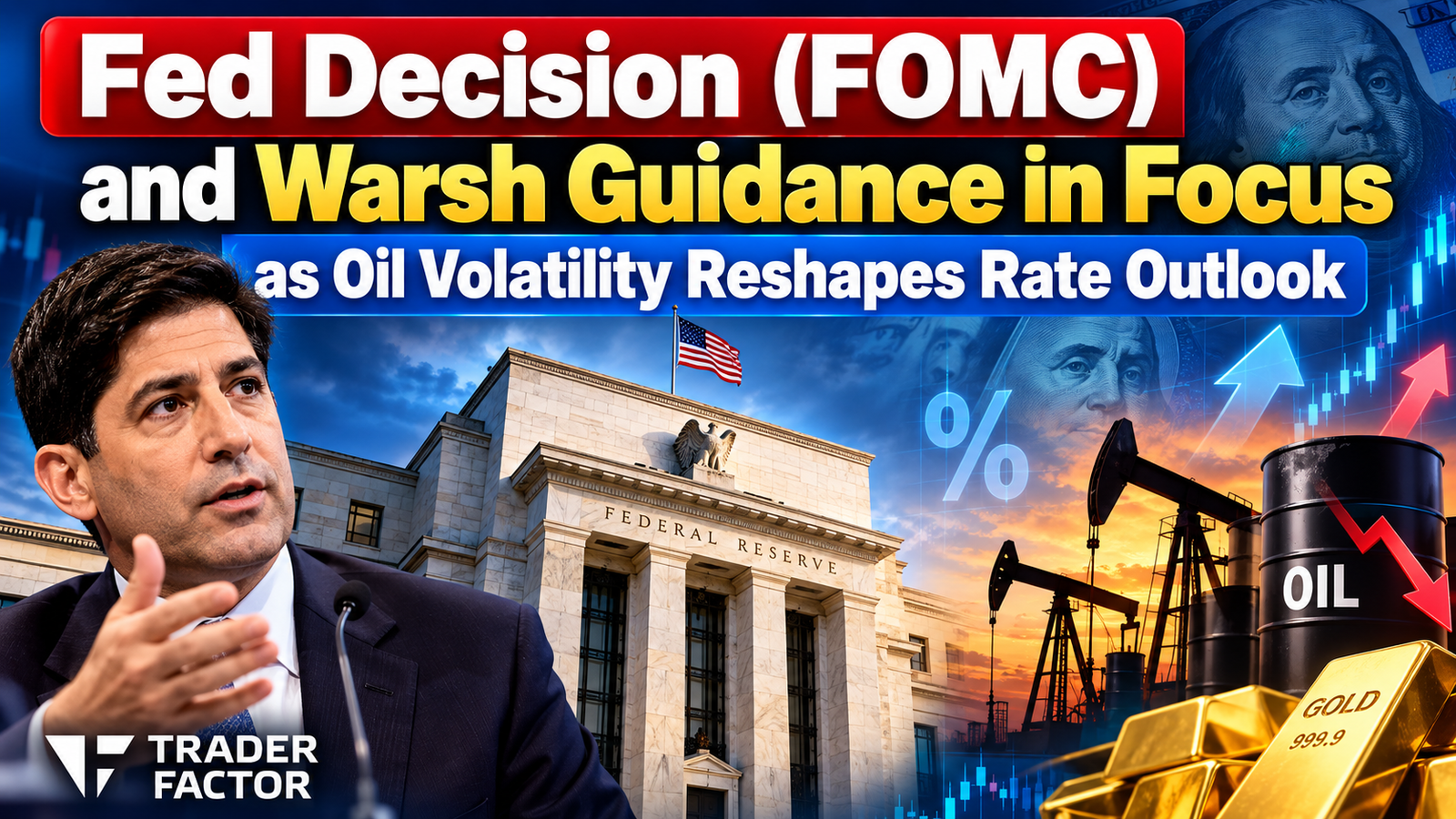

Forex Market Today: Fed Decision (FOMC) and Warsh Guidance in Focus as Oil Volatility Reshapes Rate Outlook
Federal Reserve • Kevin Warsh • Bank of Canada • RBNZ • UK Budget • Gold • Oil • Forex • Stocks • Bitcoin
🌍 TraderFactor at Wiki Finance Expo Cyprus 2026
Zahari Rangelov will represent TraderFactor and participate as a speaker at Wiki Finance Expo Cyprus 2026 on November 6 in Limassol.
Learn more →
⭐ ActivTrades Review 2026
Explore ActivTrades fees, spreads, regulation, platforms, safety and client-fund protection in our latest review.
Fed Decision Day Arrives With the Global Rate Story Splitting Apart
Wednesday begins with global markets confronting several conflicting macro signals at the same time.
The Federal Reserve is widely expected to leave interest rates unchanged after raising them in September.
But the real market event will be what Federal Reserve Chair Kevin Warsh says about inflation, the economy and the possibility of another increase in December.
That question has become more complicated overnight.
Australian inflation accelerated again, strengthening expectations for further Reserve Bank of Australia tightening.
But the Reserve Bank of New Zealand surprised traders by keeping rates unchanged despite widespread expectations for another increase.
The Bank of Canada follows later today, where markets still see a strong possibility of a rate hike.
Britain also delivers its Autumn Budget, putting Sterling and UK government bonds in focus.
Meanwhile, Oil fell sharply on Tuesday as diplomatic efforts reduced part of the Middle East risk premium.
That decline helped Gold recover because cheaper Oil can reduce future inflation pressure and, by extension, reduce some of the pressure for central banks to keep raising rates.
But Oil is rebounding again this morning as geopolitical concerns return.
That leaves traders facing a difficult question: is the world moving toward peak rates, or are energy prices and persistent inflation simply forcing central banks to pause between further hikes?
❓ Question of the Day
Will Kevin Warsh deliver a genuine Fed pause — or a pause that prepares markets for another rate hike?
The answer could determine the next major move in the Dollar, Treasury yields, Gold, Bitcoin and US technology stocks.
📌 Key Market Highlights
- Federal Reserve:
A rate hold is overwhelmingly expected, but December tightening remains firmly in the debate. - Kevin Warsh:
The Fed Chair has avoided prejudging meetings, making today’s press conference particularly important for forward rate expectations. - RBNZ shock:
New Zealand’s central bank unexpectedly held the OCR at 2.75%, triggering a sharp fall in NZD/USD. - Australia:
Annual inflation accelerated to 4.3%, strengthening expectations for another RBA rate increase. - Bank of Canada:
Markets see a strong possibility of a 25-basis-point hike later today. - Gold:
Bullion rebounded strongly Tuesday as falling Oil prices reduced some inflation anxiety. - Oil:
WTI fell below $100 intraday Tuesday as Middle East diplomacy reduced some supply fears, before rebounding early Wednesday. - Dollar:
DXY reached a two-week high around 102.4 ahead of the Fed. - US stocks:
AI and semiconductor shares led another Wall Street advance Tuesday. - Big Tech:
Microsoft and Alphabet report after the Fed decision tonight.
⚠️ TRADER ALERT: DAYLIGHT SAVING TIME
Europe has already moved clocks back while most of the US and Canada change on November 1, so double-check your broker platform and economic-calendar times this week.
What Changed on Tuesday?
🇺🇸 US Data Remained Resilient
September Durable Goods Orders increased 1.8%.
Orders excluding transportation increased 0.5%.
That suggests US corporate investment remains relatively resilient despite restrictive borrowing costs.
New Home Sales came in at an annualized 676,000, only slightly below August’s revised 680,000 pace.
Housing activity therefore remains under pressure from expensive mortgages, but it has not collapsed.
The bigger surprise came from consumer confidence.
The Conference Board index jumped to 91.7 from 84.2.
Consumers reported better assessments of business conditions, employment and future income.
The data give the Fed little evidence of an economy that urgently needs monetary relief.
🛢️ Oil Lost Part of Its Geopolitical Risk Premium
Oil was one of Tuesday’s most important macro moves.
WTI fell roughly 1.8% and settled around $100 per barrel.
Brent also moved lower toward the mid-$110 region.
The decline came as markets focused on diplomatic discussions involving Iran and other regional powers.
This matters well beyond the Oil market.
Energy has been an important contributor to the recent acceleration in inflation across the US, UK, Australia, Canada and New Zealand.
Lower Oil therefore reduces one source of future inflation pressure.
That can lower expectations for how aggressively central banks need to tighten.
But Oil is rebounding early Wednesday, reminding markets that the geopolitical risk premium has not disappeared.
🥇 Why Falling Oil Helped Gold
Gold rose more than 1% on Tuesday and settled around the $4,060 area.
At first glance, that may appear unusual because the Dollar also strengthened.
But the Oil move changed the interest-rate equation.
Lower Oil prices reduce some of the risk that energy costs will continue feeding into inflation.
That can reduce expectations for future rate increases and limit upward pressure on real yields.
Lower expected real interest rates are normally supportive for non-yielding assets such as Gold.
There is an important second side to this relationship.
If Oil rises because geopolitical risk escalates, Gold can also benefit from safe-haven demand.
But if rising Oil pushes inflation expectations and Treasury yields sharply higher, that can eventually become a headwind for bullion.
Gold therefore faces two competing channels today: geopolitical support versus the interest-rate impact of expensive energy.
📈 AI Stocks Extend the Recovery
US equities advanced again Tuesday.
The S&P 500 gained approximately 0.6%.
The Nasdaq Composite rose around 1.2%.
The Nasdaq 100 climbed approximately 1.3%.
The Dow finished almost unchanged.
The rally was again heavily concentrated in artificial-intelligence and semiconductor companies.
That makes tonight’s Microsoft and Alphabet earnings particularly important because investors want evidence that enormous AI spending is generating sufficient revenue growth.
🏦 Federal Reserve: The Rate Decision May Be the Easy Part
The Federal Reserve announces its policy decision at 2:00 p.m. ET.
Kevin Warsh’s press conference begins thirty minutes later.
The federal funds target range currently stands at 3.75%–4.00%.
Markets overwhelmingly expect the Fed to leave that range unchanged.
The challenge is the communication that follows.
September inflation remains too high.
Headline CPI increased 3.7% year-on-year.
Producer prices were even hotter.
US business surveys remain strong.
Durable-goods demand remains resilient.
Consumer confidence improved sharply in October.
Meanwhile, the labour market remains relatively tight.
None of those factors strongly argues for immediate easing.
However, there are also reasons for the Fed to wait.
Housing is under pressure.
Long-term yields remain close to 5%.
Financial conditions are already restrictive.
Oil has also pulled back from its recent highs, potentially reducing one important inflation risk.
The most likely outcome is therefore not simply a “hold.” It is a debate over how hawkish that hold should sound.
🎙️ Kevin Warsh: Watch the Language, Not Just the Rate
Warsh has repeatedly resisted giving markets a guaranteed path for future interest rates.
He has said he does not want to prejudge individual Fed meetings.
That communication style makes today’s press conference more important.
Markets will listen for subtle changes in several areas.
- Does Warsh describe inflation as still moving in the wrong direction?
- Does he emphasize energy-driven inflation?
- Does he say financial conditions remain sufficiently restrictive?
- Does he explicitly keep another rate increase on the table?
- Does he acknowledge the recent deterioration in housing?
- Does he sound comfortable with the labour market?
- Does he push back against expectations for early easing?
The Fed can therefore leave rates unchanged and still deliver a hawkish market outcome.
If Warsh strengthens the case for December tightening, the Dollar and Treasury yields could rise even without a rate increase today.
Three Fed Scenarios for Markets
🔥 Hawkish Hold
The Fed keeps rates unchanged but signals that inflation remains unacceptable and another increase may be required.
Likely initial reaction: Dollar and yields higher; Gold and Bitcoin under pressure; high-valuation technology shares vulnerable.
⚖️ Neutral Hold
Warsh acknowledges inflation risks but stresses that the Fed can wait for more data before December.
Likely initial reaction: Two-way volatility as markets immediately turn toward Thursday’s GDP and PCE numbers.
🌿 Dovish Hold
Warsh puts greater emphasis on housing weakness, tighter financial conditions and the recent fall in Oil.
Likely initial reaction: Yields and Dollar lower; Gold and Bitcoin supported; technology shares could extend gains.
🇦🇺 Australian Inflation Delivers Another Hawkish Signal
Australia has already delivered one of today’s biggest inflation surprises.
Headline CPI increased 0.8% in September.
Annual inflation accelerated from 4.0% to 4.3%.
Underlying trimmed-mean inflation remained around 3.6%.
Housing costs increased 5.2% over the year.
Transport costs rose 8.7%, partly reflecting higher fuel prices.
The report reinforces concerns that inflation remains too persistent for the Reserve Bank of Australia.
AUD/USD jumped toward the 0.7050 area following the release.
The Australian Dollar now has a stronger domestic rate argument, although today’s Fed decision can still overwhelm that move through the US Dollar side of the pair.
🇳🇿 RBNZ Shocks Markets With a Rate Hold
The Reserve Bank of New Zealand delivered the first major central-bank surprise of the day.
Markets had widely expected another 25-basis-point increase.
Instead, the RBNZ kept the Official Cash Rate unchanged at 2.75%.
The decision was extremely close.
Four policymakers voted to hold.
Three preferred an immediate increase to 3.00%.
The Bank acknowledged that inflation remains above target and that core inflation has become broader.
But policymakers also noted subdued household demand, stable medium-term inflation expectations and the risk that tighter global financial conditions could weaken the economy.
Importantly, the RBNZ did not close the door on further increases.
It said tighter monetary policy is still likely to be required if inflation pressure fails to moderate.
NZD/USD dropped sharply below the 0.5600 region after the surprise.
The message is therefore not dovish in the traditional sense: the RBNZ delayed tightening rather than declaring that its tightening cycle is finished.
🇨🇦 Bank of Canada: Will Falling Oil Change the Decision?
The Bank of Canada announces its decision at 9:45 a.m. ET.
Markets see roughly a three-in-four probability of a 25-basis-point increase to 2.50%.
The case for tightening is heavily connected to energy.
Canadian headline inflation recently accelerated to 3.1%.
High Oil and refined-product prices have raised concerns that energy inflation could spread into broader consumer prices.
However, excluding gasoline, Canadian inflation recently slowed.
Tuesday’s Oil decline therefore creates an interesting complication.
If crude continues falling, the Bank may see less urgency to react immediately to energy-driven inflation.
But one day of lower Oil does not eliminate the risk.
Crude remains historically elevated and has rebounded again this morning.
A rate hike would support the Canadian Dollar initially, but Macklem’s guidance on whether more increases are coming may matter even more.
🇬🇧 UK Budget: Sterling Traders Must Also Watch Gilts
Britain’s Autumn Budget arrives today against a difficult fiscal backdrop.
UK borrowing costs have risen sharply this year.
Inflation recently accelerated to 3.5%.
Energy prices remain high.
And the government has less fiscal headroom because higher gilt yields increase debt-servicing costs.
Markets will focus on fiscal credibility, spending commitments, tax measures and the Office for Budget Responsibility’s new forecasts.
For Sterling, the most important reaction may initially come from the gilt market.
A fiscally conservative Budget that reassures bond investors could help lower UK yields and support confidence in Sterling.
An unexpectedly expansionary package could push gilt yields higher and create a more complicated reaction for GBP/USD.
GBP/USD therefore faces two major risks today: the UK Budget first and the Federal Reserve later.
📊 Forex Market Today: Current Snapshot
Approximate early-Wednesday reference levels. FX, commodities and crypto trade continuously and prices can change rapidly.
| Market | Reference | Main Driver |
|---|---|---|
| DXY | ~102.4 | Fed / Warsh |
| EUR/USD | ~1.113 | Fed / ECB |
| GBP/USD | ~1.331 | UK Budget / Fed |
| AUD/USD | ~0.705 | Hot CPI / RBA |
| NZD/USD | Below 0.560 | RBNZ surprise |
| USD/CAD | ~1.405 | BoC / Oil |
| USD/JPY | ~158.0 | Fed / BoJ |
| Gold | ~$4,060 | Fed / Oil / yields |
| Silver | ~$54.3 | Fed / Dollar |
| Bitcoin | ~$80.7K | Fed / liquidity |
| WTI | ~$101+ | Middle East / inventories |
| US 10Y | ~5.00% | Fed / inflation |
| Nasdaq 100 | 29,651 | Fed / Microsoft / Alphabet |
| S&P 500 | 7,723 | Fed / earnings |
| Dow Jones | 52,378 | Rates / industrial earnings |
💵 Dollar Index: Two-Week High Before the Fed
The Dollar Index climbed toward 102.4 on Tuesday, its strongest area in roughly two weeks.
That move reflects several factors.
US economic data remain resilient.
Treasury yields remain close to 5%.
Inflation is still too high for the Fed to consider aggressive easing.
And traders are reluctant to remain heavily short the Dollar immediately before a major Fed communication event.
However, much of today’s Dollar move will depend on how Warsh frames December.
If the Fed explicitly leaves another hike open, DXY could test higher resistance.
If Warsh emphasizes patience and falling energy prices, recent Dollar gains could unwind.
Dollar levels:
Support: 102.00 / 101.60 | Resistance: 102.60 / 103.00
🇪🇺 EUR/USD: Dollar Strength Dominates Before the ECB
EUR/USD has fallen toward the 1.11 region as the Dollar strengthens.
The Euro faces another major event tomorrow when the European Central Bank announces its policy decision.
The ECB is expected to hold rates after September’s increase.
But the economic backdrop remains challenging.
Eurozone growth has slowed.
Energy costs remain elevated.
And inflation risks have increased again.
Support: 1.1100 / 1.1060 | Resistance: 1.1170 / 1.1220
🇬🇧 GBP/USD: Budget First, Fed Second
Sterling remains around the low-1.33 region.
Today may produce two completely different Sterling catalysts.
The UK Budget can move Sterling through gilt yields and confidence in Britain’s fiscal outlook.
The Fed can then move GBP/USD through the Dollar side of the equation.
This makes the pair especially vulnerable to reversals during the day.
Support: 1.3260 / 1.3200 | Resistance: 1.3360 / 1.3420
🇦🇺 AUD/USD: Hot Inflation Strengthens the Aussie
AUD/USD has pushed toward its strongest level in roughly a month.
Australia’s 4.3% annual CPI reinforces expectations for further RBA tightening.
The problem for Aussie bulls is that the Fed can still dominate the US Dollar side of the pair later today.
Support: 0.7025 / 0.6980 | Resistance: 0.7065 / 0.7105
🇳🇿 NZD/USD: RBNZ Surprise Changes the Picture
The Kiwi is today’s standout FX loser.
NZD/USD dropped below 0.5600 after the unexpected RBNZ hold.
The close 4–3 vote means the Bank remains hawkish underneath the headline decision.
But markets had priced an immediate increase.
That expectation has now been pushed forward.
Support: 0.5560 / 0.5520 | Resistance: 0.5630 / 0.5670
🇨🇦 USD/CAD: Bank of Canada and Oil Collide
USD/CAD sits around the 1.40 region after the Canadian Dollar weakened Tuesday.
Falling Oil prices reduced one source of support for Canada’s currency.
But the Bank of Canada may raise rates today.
A hike combined with hawkish guidance could pull USD/CAD lower.
A surprise hold could produce the opposite reaction quickly.
Support: 1.4000 / 1.3965 | Resistance: 1.4100 / 1.4150
🇯🇵 USD/JPY: 158 Back in Focus
USD/JPY has returned toward the 158 region.
The combination of a firmer Dollar and US yields close to 5% continues to pressure the Yen.
However, Friday’s Bank of Japan meeting remains a major risk.
Japanese inflation is above target, and markets continue to debate when the BoJ will tighten again.
Support: 157.30 / 156.50 | Resistance: 158.50 / 159.20
🇨🇭 USD/CHF
The Swiss Franc remains sensitive to geopolitical developments.
Diplomatic progress reduced some safe-haven demand Tuesday.
Any renewed escalation in the Middle East could quickly reverse that move.
Support: 0.8240 / 0.8200 | Resistance: 0.8330 / 0.8370
🥇 Gold: Oil, the Fed and Real Yields Are Pulling in Different Directions
Gold enters Fed day around the $4,060 region after Tuesday’s strong rebound.
The move is important because Gold managed to rise even as the Dollar strengthened.
Part of the explanation lies in Oil.
Tuesday’s decline in crude reduced inflation expectations and therefore reduced some pressure for future monetary tightening.
Today, however, the Fed becomes the dominant driver.
A hawkish Warsh press conference could push the Dollar and real yields higher.
That would normally pressure Gold.
A more patient Fed could allow Gold to challenge $4,100 again.
Geopolitical developments remain an additional support mechanism.
Support: $4,020 / $4,000 / $3,975 | Resistance: $4,100 / $4,140
🥈 Silver
Silver also recovered Tuesday and remains close to $54.
The metal has the same monetary-policy sensitivity as Gold but carries additional exposure to industrial demand.
Support: $53 / $52 | Resistance: $55.50 / $57
🛢️ Oil: Yesterday’s Fall Matters, But Today’s Rebound Matters Too
WTI briefly fell below $100 Tuesday as traders reacted to diplomatic efforts in the Middle East.
The decline removed part of the geopolitical risk premium that had pushed Oil to six-month highs.
Today, crude is rebounding again as concerns about renewed military escalation return.
This volatility has major implications for monetary policy.
If Oil continues falling, central banks gain more flexibility because future headline inflation should face less energy pressure.
If Oil returns toward recent highs, the opposite is true.
Today’s EIA inventory report therefore arrives at an unusually important moment.
US commercial crude inventories fell more than 3 million barrels in the previous report.
Another large draw could reinforce physical-market concerns.
WTI Support: $99.50 / $97.50 | Resistance: $103 / $105
₿ Bitcoin: Fed Liquidity Test Arrives
Bitcoin is holding near $80,000 after rising modestly Tuesday alongside technology shares.
BTC continues to behave primarily as a liquidity-sensitive risk asset.
That makes Treasury yields and the Fed highly important.
A hawkish Fed would raise the risk that Bitcoin retests recent support.
A softer message and falling yields could help crypto participate more strongly in the equity recovery.
Support: $79K / $77K | Resistance: $82.5K / $84K
📉 Treasury Yields: 5% Remains the Market’s Pressure Point
The US 10-year Treasury yield remains almost exactly around 5%.
That is important because 5% has become a major cross-asset threshold.
A move substantially above 5% would increase financing costs and pressure high-duration assets.
Technology valuations, Gold and Bitcoin would all have to absorb a higher discount rate.
A move materially below 5% could ease financial conditions.
But the reason for the decline would matter.
Falling yields because inflation is cooling would generally be supportive.
Falling yields because growth is deteriorating could be more complicated.
Today, Warsh’s comments may matter more for Treasury yields than the unchanged policy rate itself.
📈 Stocks: The Fed and AI Earnings Collide Tonight
💻 Nasdaq 100
The Nasdaq 100 surged around 1.3% Tuesday to approximately 29,651.
Semiconductors and AI-related companies led the move.
But tonight may be the real test.
Microsoft and Alphabet report after the closing bell only hours after the Fed decision.
Investors will focus on AI revenue, cloud growth, data-centre spending, capital expenditure and margins.
Support: 29,340 / 29,000 | Resistance: 29,720 / 30,000
📊 S&P 500
The S&P 500 gained 0.6% Tuesday to approximately 7,723.
The headline index was stronger than the underlying breadth because large AI-linked companies contributed heavily to the advance.
The combination of the Fed and mega-cap earnings means index volatility could increase substantially after the US close.
Support: 7,680 / 7,620 | Resistance: 7,760 / 7,800
🏭 Dow Jones
The Dow finished Tuesday almost unchanged near 52,378.
That divergence reflects the current concentration of market momentum in technology and AI.
Support: 52,000 / 51,600 | Resistance: 52,600 / 53,000
📅 Economic Calendar — Wednesday, October 28
✅ Australia CPI — Released
Annual CPI accelerated to 4.3%, strengthening RBA tightening expectations.
✅ RBNZ — Released
OCR unexpectedly held at 2.75% in a close 4–3 vote.
UK Autumn Budget — European Session
Fiscal credibility, borrowing plans, taxation, spending and gilt-market reaction will drive Sterling risk.
Bank of Canada — 9:45 a.m. ET
Markets lean toward a 25-basis-point increase, followed by Governor Macklem’s press conference.
US Advance Goods Trade & Inventories — 8:30 a.m. ET
The trade numbers will provide another input into tomorrow’s advance Q3 GDP release.
EIA Crude Oil Inventories — 10:30 a.m. ET
Oil inventories will be closely watched after Tuesday’s large geopolitical-driven price reversal.
Federal Reserve Decision — 2:00 p.m. ET
Rates are widely expected to remain at 3.75%–4.00%.
Kevin Warsh Press Conference — 2:30 p.m. ET
The main question is whether Warsh strengthens or weakens expectations for another rate increase in December.
💼 Big Tech Earnings Tonight
Microsoft
Microsoft reports after the US closing bell.
Investors will focus heavily on Azure cloud growth, AI demand and capital expenditure.
The key question is whether enormous infrastructure investment is translating into enough additional revenue.
Alphabet
Alphabet also reports after the close.
Markets will watch Google Cloud, advertising growth, AI-related monetisation and spending on data centres.
The two reports arrive only hours after the Fed, creating one of the most important combined macro-and-earnings sessions of the quarter for the Nasdaq.
🔭 Tomorrow: GDP and PCE Take Over From the Fed
Markets will have very little time to digest today’s Fed decision.
Thursday brings another enormous macro session.
- US Q3 Advance GDP
- September PCE inflation
- Core PCE inflation
- Personal Income and Spending
- Initial Jobless Claims
- European Central Bank decision
- ECB press conference
- Amazon earnings after the US close
PCE may be particularly important because a hot inflation report could immediately revive December Fed-hike expectations even if Warsh sounds relatively balanced today.
TraderFactor Support & Resistance Map
Approximate technical reference zones only. Central-bank decisions can produce rapid moves through normal support and resistance.
| Asset | Reference | Support | Resistance | Main Catalyst |
|---|---|---|---|---|
| DXY | 102.4 | 102.00 / 101.60 | 102.60 / 103.00 | Fed / Warsh |
| Gold | ~4060 | 4020 / 4000 / 3975 | 4100 / 4140 | Fed / Oil / yields |
| Silver | ~54.3 | 53 / 52 | 55.5 / 57 | Fed / Dollar |
| EUR/USD | 1.113 | 1.1100 / 1.1060 | 1.1170 / 1.1220 | Fed / ECB |
| GBP/USD | 1.331 | 1.3260 / 1.3200 | 1.3360 / 1.3420 | UK Budget / Fed |
| AUD/USD | 0.705 | 0.7025 / 0.6980 | 0.7065 / 0.7105 | CPI / RBA / Fed |
| NZD/USD | Below .560 | 0.5560 / 0.5520 | 0.5630 / 0.5670 | RBNZ |
| USD/CAD | 1.405 | 1.4000 / 1.3965 | 1.4100 / 1.4150 | BoC / Oil |
| USD/JPY | 158.0 | 157.30 / 156.50 | 158.50 / 159.20 | Fed / BoJ |
| USD/CHF | ~0.829 | 0.824 / 0.820 | 0.833 / 0.837 | Risk sentiment |
| Bitcoin | ~80.7K | 79K / 77K | 82.5K / 84K | Fed / yields |
| WTI | ~101+ | 99.5 / 97.5 | 103 / 105 | Geopolitics / EIA |
| Nasdaq 100 | 29,651 | 29,340 / 29,000 | 29,720 / 30,000 | Fed / Big Tech |
| S&P 500 | 7,723 | 7,680 / 7,620 | 7,760 / 7,800 | Fed / earnings |
| US30 | 52,378 | 52,000 / 51,600 | 52,600 / 53,000 | Fed / earnings |
🔗 Continue Your Market Research
Final Market Outlook
Today may become the defining session of the week.
But the important point is that global monetary policy is no longer moving in one direction.
Australia’s inflation data argue for tighter policy.
The RBNZ has chosen to wait.
The Bank of Canada may hike.
The Fed is expected to hold.
The ECB is likely to hold tomorrow.
The Bank of Japan must decide how quickly it can continue policy normalization.
Oil is adding another layer of uncertainty.
Tuesday’s decline reduced one source of global inflation pressure.
But today’s rebound shows how quickly that story can reverse.
That is particularly important for Gold.
Cheaper Oil can support Gold by reducing expected interest rates.
More expensive Oil can support Gold through geopolitical demand but simultaneously hurt it by keeping rates and real yields higher.
The Dollar enters the Fed decision from a position of strength.
Treasury yields remain close to 5%.
US stocks have recovered on renewed AI optimism.
Bitcoin remains near $80,000.
And Microsoft and Alphabet will report only hours after Warsh finishes speaking.
The real market question today is not whether the Fed changes rates. It is whether Kevin Warsh changes the market’s view of where rates are going next.
🎯 TraderFactor Bottom Line
Fed:
Hold expected, but December guidance is the real market event.
Warsh:
Watch inflation language, financial conditions and whether another hike remains explicitly open.
RBNZ:
Surprise hold has sent the Kiwi sharply lower.
Australia:
Hot CPI strengthens the case for another RBA hike.
Canada:
BoC faces a genuine hike decision while Oil remains volatile.
Gold:
Oil’s decline helped Tuesday’s rebound, but Fed guidance now takes control.
Oil:
Peace hopes reduced the risk premium yesterday, but geopolitical uncertainty remains high.
Bitcoin:
Still highly sensitive to liquidity and Treasury yields.
Stocks:
Fed policy and Microsoft/Alphabet earnings arrive within hours of one another.
Expect the highest volatility around the Bank of Canada decision, the Fed statement, Warsh’s press conference and tonight’s Big Tech earnings.
💼 Compare Forex Brokers With TraderFactor
Compare regulation, fees, platforms, account types and broker features before choosing a provider.
About the Author

Zahari Rangelov
Head of Business Development, TraderFactor
Zahari specializes in broker analysis, regulatory research, market analysis and trading education.
With over a decade of experience, he helps traders understand brokers, technical and fundamental analysis, risk management and trading psychology.
Reviewed By:
Alex Kanyi, Head of Compliance at TraderFactor
Last Updated: October 28, 2026
Risk Disclaimer:
This report is for general information and educational purposes only and does not constitute financial advice. Forex, commodities, cryptocurrencies, bonds and equity indices can move rapidly following central-bank decisions, economic data, earnings and geopolitical developments. Seek independent advice before acting on any content.