
Day trading or swing trading compare time commitment, risk, profitability, and find out which style suits you. Updated March 2026.
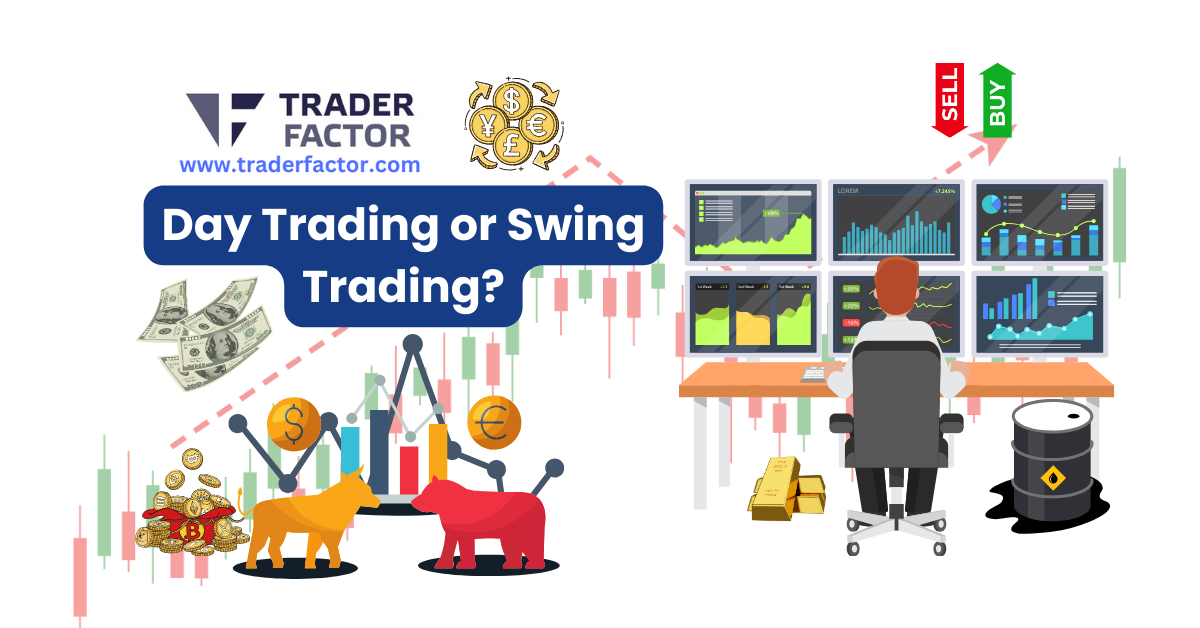
Day Trading or Swing Trading: Which Is Better in 2026?
Imagine you’ve just watched the market close, and your portfolio’s performance has left you smiling. This could be your everyday reality. But the question is: how do you want to play the game?
You’ve got two main strategies to choose from: day trading or swing trading.
Day trading is a full-time job requiring constant attention and quick decisions. You open and close positions within the same trading day, avoiding overnight risk.
Swing trading allows for a more relaxed pace. You hold positions from a couple of days to a few weeks, aiming to capture short-to-medium term trends.
Each has its own perks and quirks, challenges and rewards. But which one aligns with your financial goals, lifestyle, and risk tolerance?
This guide provides a complete, data-driven comparison to help you make that critical choice. We’ll break down the time commitment, capital needs, stress levels, and profit potential of each style. And we’ll recommend the best brokers for each approach.
What You’ll Learn in This Guide
- The key differences between day trading and swing trading
- A quick comparison table to decide at a glance
- Detailed pros and cons of each style
- Which trading style suits your lifestyle, personality, and goals
- Capital requirements and risk considerations
- Tax implications for each approach
- Best brokers for day trading and swing trading
- Answers to the most common questions
📅 Last updated: March 15, 2026

Day Trading vs Swing Trading: At a Glance
| Factor | Day Trading | Swing Trading |
|---|---|---|
| Holding Period | Minutes to hours | Days to weeks |
| Time Commitment | Full-time (5+ hours/day) | Part-time (1-2 hours/day) |
| Capital Needed | Higher ($5,000+ recommended) | Lower ($500+ can work) |
| Stress Level | High (constant decisions) | Moderate (overnight risk) |
| Key Skills | Quick reflexes, discipline | Patience, trend analysis |
| Overnight Risk | None | Yes – gaps can happen |
| Number of Trades | Many per day | Few per week |
| Best For | Full-time traders | Those with day jobs |
| Tax Treatment (US) | Mark-to-market (Section 1256) | Capital gains rates |
| Our Rating | ⭐⭐⭐ for full-time | ⭐⭐⭐⭐ for most |
How We Compared Day Trading vs Swing Trading
We evaluated both trading styles using 5 core criteria to give you an unbiased, practical comparison.
| Criterion | What We Looked For |
|---|---|
| Time Commitment | Hours per day needed to trade effectively |
| Capital Required | Minimum recommended account size |
| Stress Level | Mental and emotional demands |
| Profit Potential | Realistic expectations based on data |
| Lifestyle Fit | Which style suits which type of trader |
📅 Data verified: March 2026

Day Trading Explained
Day trading involves buying and selling financial instruments within the same trading day. You close all positions before the market closes, so you have no overnight exposure to price gaps or news events.
What Day Trading Looks Like
- You’re glued to charts for 5-6 hours during market hours.
- You make dozens of trades, capturing small price movements.
- Decisions are measured in seconds and minutes.
- You need fast execution, reliable platforms, and strong discipline.
✅ Pros of Day Trading
| Advantage | Why It Matters |
|---|---|
| No Overnight Risk | You sleep soundly – no gaps or news surprises. |
| More Opportunities | Hundreds of trades possible each day. |
| Leverage Available | Brokers offer high leverage for intraday. |
| Instant Feedback | You know immediately if a strategy works. |
| Compounding | Small gains add up quickly with many trades. |
❌ Cons of Day Trading
| Disadvantage | Why It Hurts |
|---|---|
| High Stress | Constant decisions can lead to burnout. |
| Large Capital Needed | PDT rule (US) requires $25,000 minimum for stocks. |
| Full-Time Commitment | You can’t have another job. |
| Transaction Costs | Commissions and spreads eat into profits. |
| Steep Learning Curve | Most day traders lose money initially. |

Swing Trading Explained
Swing trading involves holding positions for several days to weeks. You aim to capture “swings” in the market – the up-and-down movements that occur within a larger trend.
What Swing Trading Looks Like
- You spend 1-2 hours per day on analysis.
- You hold trades through multiple sessions.
- Decisions are based on daily or 4-hour charts.
- You need patience and trend analysis skills.
✅ Pros of Swing Trading
| Advantage | Why It Matters |
|---|---|
| Part-Time Friendly | You can keep a day job. |
| Lower Capital Needed | Start with $500-$1,000. |
| Less Stress | You’re not glued to screens. |
| More Time for Analysis | You can research thoroughly. |
| Fewer Trades, Lower Costs | Less eaten by commissions. |
❌ Cons of Swing Trading
| Disadvantage | Why It Hurts |
|---|---|
| Overnight Risk | Gaps and news can hit your positions. |
| Ties Up Capital | Money is locked in trades for days/weeks. |
| Fewer Opportunities | Only a few setups per week. |
| Patience Required | Trades take time to develop. |
| Emotional Holding | Watching a profit turn to loss is hard. |
Which Is More Profitable?
This is the million-dollar question. The honest answer: neither is inherently more profitable. Success depends on your skills, discipline, and market conditions.
| Factor | Day Trading | Swing Trading |
|---|---|---|
| Win Rate | Can be higher (60%+) | Often lower (40-50%) |
| Risk/Reward | Usually smaller (1:1 to 1:2) | Can be larger (1:3 to 1:5) |
| Consistency | Daily small gains | Bigger wins, bigger losses |
| Learning Curve | Steeper | More gradual |
Key takeaway: Day trading offers more frequent, smaller wins. Swing trading offers fewer, larger wins. Choose based on your psychology, not just profit potential.

Which Style Fits Your Personality?
| Personality Trait | Day Trading | Swing Trading |
|---|---|---|
| Patience Level | Low – want action now | High – can wait for setups |
| Risk Tolerance | High (intraday volatility) | Moderate (overnight risk) |
| Decision Style | Quick, instinctive | Analytical, deliberate |
| Stress Management | Must handle pressure | More relaxed |
| Time Available | Full-time | Part-time |

Capital Requirements
| Style | Minimum Recommended | Pattern Day Trader Rule (US) |
|---|---|---|
| Day Trading (Stocks) | $30,000+ | $25,000 minimum |
| Day Trading (Forex) | $5,000+ | No PDT rule |
| Day Trading (Futures) | $10,000+ | No PDT rule |
| Swing Trading (Any) | $500-$1,000 | No restriction |
Note: You can day trade forex with much less capital, but risk management becomes even more critical.
Tax Implications (US Focus)
| Factor | Day Trading | Swing Trading |
|---|---|---|
| Tax Status | Can elect Mark-to-Market (MTM) | Capital gains/losses |
| Loss Deductions | Unlimited (MTM election) | Limited to $3,000/year |
| Holding Period | All short-term | Mixed (short/long-term) |
| Tax Rate | Ordinary income rate | Lower for long-term holds |
| Form | File as business (Schedule C) | Schedule D |
Consult a tax professional. This is a simplified overview.

Best Brokers for Day Trading & Swing Trading
We’ve reviewed the top brokers on TraderFactor and matched them to each trading style.
| Broker | Best For | Style | Min Deposit | Key Feature | Review |
|---|---|---|---|---|---|
| FXPro | Platform choice | Day trading | $100 | MT4, MT5, cTrader | [Read Review] |
| IronFX | Education & copy | Both | $50 | IronFX Academy | [Read Review] |
| Admirals | Strong regulation | Swing trading | $50 | Premium analytics | [Read Review] |
| OneRoyal | High leverage | Swing trading | $50 | AI tools | [Read Review] |
| NAGA | Social trading | Both | $50 | Copy trading | [Read Review] |
| Interactive Brokers | Professionals | Both | $0 | Low margins | [Read Review] |
Real-World Examples
Day Trading Example (EUR/USD)
- 9:30 AM: You see a breakout above resistance on the 5-minute chart.
- 9:31 AM: You enter a long position with a 10-pip stop loss.
- 9:45 AM: Price hits your 20-pip target. Trade closed in 15 minutes.
- Profit: 20 pips × $10/pip (standard lot) = $200
Swing Trading Example (Gold)
- Monday: Gold forms a bullish flag pattern on the daily chart.
- Tuesday: You enter a long position at $4,350, stop at $4,300.
- Friday: Gold reaches your target at $4,500.
- Profit: $150 move = 15,000 pips × $1/pip = $1,500

Frequently Asked Questions

Can you do both day trading and swing trading?
Yes, many traders maintain a swing portfolio while day trading smaller amounts. However, it requires good organization and clear rules for each style.
How much money do I need to start day trading?
For US stocks, you need $25,000 minimum due to the Pattern Day Trader rule. For forex, you can start with $500-$1,000, though $5,000+ is recommended.
Is swing trading safer than day trading?
Swing trading carries overnight risk (gaps, news), while day trading carries intraday volatility risk. Neither is “safer” – it depends on your risk management.
Which is better for beginners?
Most experts recommend starting with swing trading. It gives you time to analyze, learn, and make deliberate decisions without the pressure of seconds.
What brokers allow day trading?
Most brokers allow day trading. For US stocks, you need a margin account. For forex, standard accounts are fine. See our table above for recommendations.
Do I need a special account for day trading?
For US stocks, you need a margin account. For forex and futures, standard accounts work, but you’ll need enough margin for intraday leverage.
How are taxes different for day traders?
In the US, day traders can elect Mark-to-Market (MTM) accounting, which allows unlimited loss deductions. Swing traders are subject to standard capital gains rules.
Can I swing trade with a full-time job?
Absolutely. Swing trading is perfect for those with day jobs. You can analyze charts in the evening and set alerts during the day.
What indicators are best for day trading?
Moving averages, RSI, VWAP, and volume indicators are popular. Scalpers also use order flow and tape reading.
What indicators are best for swing trading?
MACD, Fibonacci retracements, support/resistance, and chart patterns (flags, head and shoulders) are commonly used.
Which has a higher success rate?
Neither. Success depends entirely on your skills, discipline, and risk management. Most day traders fail because they’re unprepared for the stress and capital requirements.
What Are the Key Psychological Traits Required for Successful Day Trading and Swing Trading?”
You’ll need emotional resilience, high-risk tolerance, effective stress management, swift decision-making skills, and a disciplined approach to trading. These traits are essential for successfully handling the unpredictable nature of the markets.
How Does Taxation Differ for Day Traders and Swing Traders?”
You’ll face different taxation strategies as a trader. Capital gains and loss deductions vary based on your trader status. It’s crucial to understand IRS guidelines to navigate these differences efficiently and maximize your returns.
What Are Some Software and Tools Recommended for Both Day Trading and Swing Trading?”
You’d benefit from automated trading platforms, forex trading software, and stock screening tools. Charting software advantages include real-time data analysis. For crypto, consider trading bots. Remember, each tool has its strengths and weaknesses.
Are Specific Industries or Sectors More Conducive to Day Trading or Swing Trading?”
Yes, sector volatility impacts both day and swing trading. Day trading in fast-paced sectors like tech is common. Swing trading often suits industries like pharma, where trends develop over time. Energy sector fluctuations can suit both.
How Does One Transition From Being a Day Trader to a Swing Trader, or Vice Versa?”
You’ll need strategy adaptation, enhanced risk management, and possibly more time commitment to transition between trading styles. Your trading education should guide this shift, and be aware that capital requirements may also change.
Conclusion
So, is it day trading or swing trading for you? That depends on your lifestyle, risk tolerance, and financial goals. Remember, day trading demands more time and capital, while swing trading allows lower-frequency trades. Whichever path you choose, equip yourself with the right strategies and tools. Trading is a journey, not a sprint. So, take your time, learn, and, most importantly, enjoy the process. Your financial future is in your hands.
More Reading on TraderFactor
| Article | What You’ll Learn |
|---|---|
| [Forex Broker Regulation Tier List] | Understand safety tiers for any broker |
| [What to Do If a Broker Delays Your Withdrawal] | Essential guide for protecting your funds |
| [Forex Spreads vs. Commissions] | Trading costs and how to minimize them |
| [Candle Range Theory Strategy] | A powerful strategy for beginners to master |
Stay Updated
Get our latest broker reviews and trading guides delivered straight to your inbox.
[Subscribe to the TraderFactor Newsletter]
About the Author
This guide was prepared by Phyllis Wangui, Market Analyst at TraderFactor. Phyllis specializes in broker research, trading education, and helping beginners navigate the complex world of forex trading. She combines meticulous data analysis with a passion for making trading accessible to everyone.
Disclaimer:
All information has been prepared by TraderFactor or partners. The information does not contain a record of TraderFactor or partner’s prices or an offer of or solicitation for a transaction in any financial instrument. No representation or warranty is given as to the accuracy or completeness of this information. Any material provided does not have regard to the specific investment objective and financial situation of any person who may read it. Past performance is not a reliable indicator of future performance.