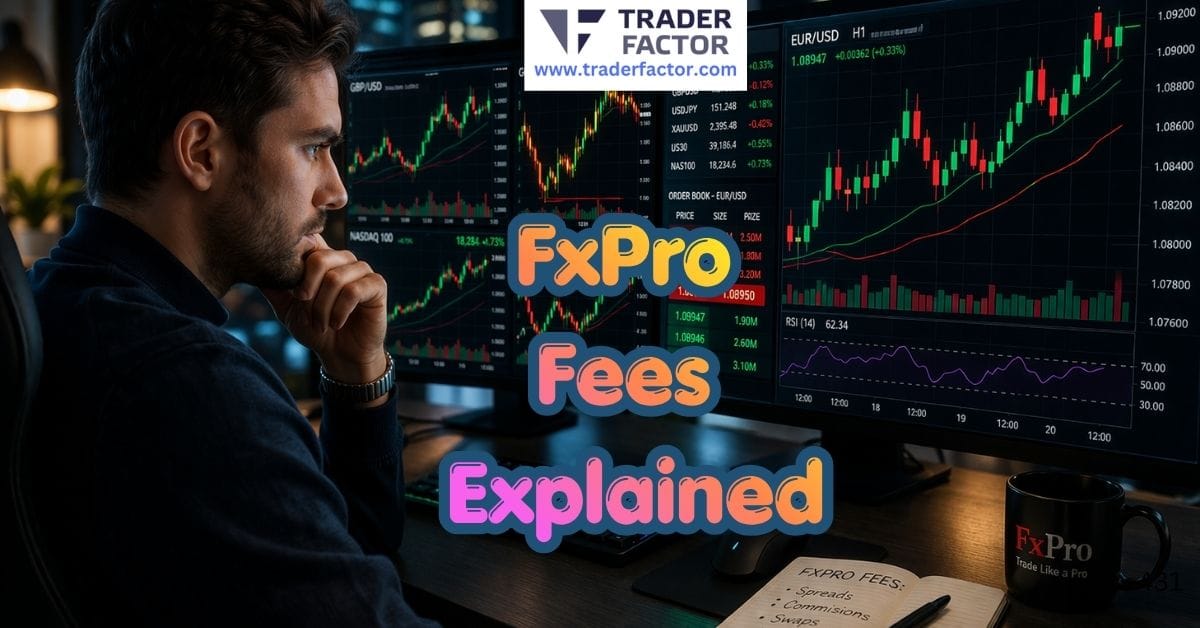

Discover FxPro fees in 2026: Understand spreads, commissions, and potential hidden costs to make informed trading decisions with this detailed guide.
FxPro Fees Explained (2026): Spreads, Commissions & Hidden Costs
Updated March 2026
FxPro fees are generally competitive, but not the cheapest in the market. Traders pay through spreads, commissions (on certain accounts), and additional costs like overnight swaps. While the broker is transparent about its pricing structure, some costs can add up significantly depending on your trading style and holding periods.
👉 If you’re a high-frequency or cost-sensitive trader, it’s important to fully understand FxPro’s pricing before opening an account. Unlike zero-commission competitors who may hide costs in wider spreads, FxPro offers a mix of account types that cater to both retail beginners and institutional veterans. Knowing which account aligns with your strategy is the difference between profitability and erosion of capital.
Table of Contents
ToggleFxPro Fees Overview (2026)
| Fee Type | Cost Level | Notes |
|---|---|---|
| Spreads | Medium | Competitive for major pairs, but not the lowest in the industry. |
| Commissions | Low–Medium | Depends entirely on account type (Zero on Standard, charged on Raw). |
| Deposit Fees | None | Free in most cases, though payment providers may charge separately. |
| Withdrawal Fees | None | Generally free, but may vary by method or currency. |
| Inactivity Fee | Yes | Charged after prolonged inactivity (usually 12+ months). |
| Swap Fees | Yes | Applied for overnight positions; varies by instrument and direction. |
👉 Overall: ⭐⭐⭐⭐☆ (4.0 / 5) on pricing – Reliable execution justifies the slightly higher cost compared to discount brokers.
For a comprehensive analysis, click here to Access our main FxPro Review
How FxPro Makes Money
To truly understand if a broker is “expensive,” you need to understand their business model. Unlike “no commission” brokers that route trades through dealing desks (and take the opposite side of your trade), FxPro operates primarily as a market maker and agency model broker depending on the account type.
FxPro earns revenue through three primary channels:
- Spreads – The difference between the buy (ask) and sell (bid) price. This is their primary revenue source for Standard accounts.
- Commissions – Charged explicitly on Raw Spread accounts to offer ultra-tight spreads.
- Swap fees – Interest rate differentials for holding positions past 5 PM EST.
👉 Understanding these mechanics is key to avoiding unexpected costs. For example, a “free” account with a 2.0 pip spread might be more expensive than a “commission” account with a 0.2 pip spread plus $7 round turn.
FxPro Spreads Explained (Deep Dive)
What Are Spreads?
A spread is the difference between:
- Buy price (ask) – The price you pay to go long.
- Sell price (bid) – The price you receive to go short.
👉 This is the main cost for most traders, particularly those using the FxPro Standard Account. Wider spreads increase the cost of entry and exit, meaning the market must move further in your favor just to break even.
FxPro Typical Spreads (2026 Data)
Based on live market analysis during peak trading hours (London/New York overlap):
| Instrument | Standard Account Spread (Avg) | Raw Account Spread (Avg) |
|---|---|---|
| EUR/USD | 1.2 – 1.5 pips | 0.1 – 0.3 pips (+ commission) |
| GBP/USD | 1.5 – 1.8 pips | 0.2 – 0.4 pips (+ commission) |
| USD/JPY | 1.3 – 1.6 pips | 0.2 – 0.3 pips (+ commission) |
| Gold (XAU/USD) | 25 – 35 cents | 15 – 20 cents (+ commission) |
| BTC/USD | Variable (high) | Variable (high) |
Are FxPro Spreads Competitive?
👉 Yes — but not the lowest. FxPro sits in the “premium discount” tier.
- Vs. IC Markets/Pepperstone: FxPro is slightly higher on Standard accounts.
- Vs. eToro/Plus500: FxPro is generally tighter and more transparent.
- Vs. Institutional (CQG/Currenex): FxPro is retail-focused, so spreads are wider.
Key Insight: FxPro spreads are optimized for reliability and fast execution rather than being the absolute cheapest. You are paying for order execution quality, which means less slippage during high-impact news events.
FxPro Commissions (When You Pay)
Many traders mistakenly believe “commissions are bad.” In reality, commission-based accounts are usually cheaper for active traders.
When Do You Pay Commissions?
Commissions apply only on:
- Raw Spread Accounts
- FxPro MT5 Raw and cTrader account types
Typical Commission Structure
FxPro charges a standard $3.50 per lot per side (or $7.00 round turn) for major forex pairs. This may vary slightly based on your base currency (e.g., EUR or GBP accounts will see a converted equivalent).
- 1 Lot (100,000 units) = $7 round turn commission.
- 0.1 Lot (10,000 units) = $0.70 round turn.
👉 This is considered industry standard (most ECN brokers charge between $6 and $8 per round turn).
Commission Verdict
✔ Fair pricing – Aligned with top-tier competitors.
✔ Transparent structure – You see the cost immediately in the trading platform.
⚠️ Can add up for high-frequency traders – If you trade 50 lots per day, you are paying $350 daily in commissions. A spread-only account might be cheaper in this rare scenario (though unlikely).
Swap Fees (Overnight Costs)
Swap fees are the most misunderstood cost in retail trading. They are neither a spread nor a commission, but an interest adjustment.
What Are Swap Fees?
Swap fees apply when you hold positions past 5:00 PM EST (New York close). You are essentially borrowing one currency to buy another. You pay interest on the currency you borrowed and earn interest on the currency you bought.
FxPro Swap Costs (2026)
FxPro does not publish static swap rates because they fluctuate with global interest rates. However, as of 2026:
- Major Pairs (Long positions): If you buy a currency with a higher interest rate than the one you sell, you earn swap. If the opposite, you pay.
- Triple Swap Wednesday: FxPro, like all brokers, charges triple swap on Wednesday to account for weekend settlement.
Important: 👉 These fees can significantly impact:
- Swing traders (holding 2-10 days)
- Position traders (holding weeks/months)
- Carry trade strategies
🔥 Pro Tip: Always check the “Specification” tab for the specific instrument inside your FxPro MetaTrader or cTrader platform before holding trades overnight. Swap rates for exotic pairs (USD/ZAR, USD/TRY) can be extremely high (up to $50 per night per lot).
Hidden Fees You Should Know
While FxPro is more transparent than most, three specific costs catch traders off guard.
❌ Inactivity Fee
FxPro charges an inactivity fee after 12 consecutive months of no login or trading activity. The fee is typically $5 per month (or currency equivalent) until you either log in or the account balance reaches zero.
👉 Avoid by:
- Logging into the dashboard once every few months.
- Placing a small demo trade (activity resets the clock).
❌ Currency Conversion Fees
If your trading account is denominated in EUR or GBP but you trade USD-denominated assets (like Gold or US Stocks), FxPro will automatically convert your profits/losses. The conversion fee is baked into the exchange rate (usually 0.5% – 1.0%).
- Example: You deposit €10,000. FxPro converts to $10,800. When you withdraw, they convert back. You lose ~$50-100 on conversion alone.
❌ Slippage (Indirect Cost)
Slippage is not a fee, but it is a cost. During high volatility (NFP, CPI, FOMC), your order may be filled at a worse price than requested.
- FxPro’s Advantage: Due to their deep liquidity providers, slippage at FxPro is generally lower than at discount brokers.
- Reality: It still happens. It is common across all brokers—not unique to FxPro.
Deposit & Withdrawal Fees
Cash management fees are where many brokers hide nasty surprises. FxPro performs well here, but vigilance is required.
Deposits
✔ Usually free via credit/debit cards, Bank Wire, Skrill, Neteller, and PayPal.
⚠️ Exception: Some issuing banks charge “cash advance” fees for credit card deposits. FxPro does not charge this; your bank does.
Withdrawals
✔ Generally free for the first withdrawal per month.
⚠️ Method Dependency: Withdrawals via Skrill/Neteller are free. Bank wires may incur a $10-20 intermediary bank fee (not FxPro’s fee).
⏱️ Processing Time: Same-day processing (12-24 hours) for most methods.
👉 Compared to many brokers, FxPro performs well here, though they lack the “instant free withdrawals” of some crypto-focused competitors.
FxPro Fees vs Other Brokers (2026)
To determine if FxPro is “expensive,” you must benchmark it.
FxPro vs Low-Cost Brokers (IC Markets, Pepperstone)
- Spreads: Low-cost brokers win (0.0 pips vs 0.2 pips).
- Execution: FxPro wins for stability during news.
- Verdict: If you scalp 1-2 pips, go with the low-cost broker. If you hold for hours/days, FxPro is equivalent.
FxPro vs Beginner Platforms (eToro, Trading 212)
- Spreads: FxPro is lower (eToro EUR/USD is often 1.0 pip but with higher volatility).
- Commissions: eToro has zero commissions but wider spreads on exotics.
- Verdict: FxPro is more professional and generally cheaper for active traders.
Key Takeaway: 👉 FxPro sits in the middle of the pricing spectrum. You are not getting “dirt cheap” fees, but you are also not getting ripped off. You are paying for a regulated, FCA/CySEC broker with institutional-grade infrastructure.
Real Cost Example (IMPORTANT for Math)
Let’s break down a real-world trade to see the total cost.
Scenario:
- Instrument: EUR/USD
- Size: 1 Standard Lot (100,000 units)
- Account: Standard Account (Spread only)
- Spread: 1.4 pips
- Holding Period: Intraday (no swap)
Cost Calculation:
- Value of 1 pip for 1 lot = $10
- Spread Cost = 1.4 pips × $10 = $14
- Total Cost = $14
Scenario 2 (Raw Account):
- Spread: 0.2 pips
- Spread Cost = 0.2 × $10 = $2
- Commission = $7 round turn
- Total Cost = $9
👉 The Raw account is cheaper by $5 per trade.
Why This Matters for Different Traders
- Small traders (0.01 lots): Costs are negligible ($0.14 per trade). FxPro is fine.
- High-frequency traders (20 lots/day): Cost difference matters.
- Standard Account: 20 × $14 = $280 daily cost.
- Raw Account: 20 × $9 = $180 daily cost.
- Savings of $100/day (or $24,000/year).
Is FxPro Expensive? (The Final Math)
👉 Short Answer: No—but not the cheapest.
👉 Detailed Answer:
FxPro offers:
✔ Fair pricing – No 3-pip spreads on majors.
✔ Good execution – Low rejection rates.
✔ Reliable spreads – No “spread widening” games during news.
However:
⚠️ Some brokers (IC Markets, FP Markets, Tickmill) offer lower costs by $2-3 per lot.
The Verdict: If you trade less than 50 lots per month, the fee difference between FxPro and the cheapest broker is less than a cup of coffee per day. If you trade 500 lots per month, you should switch to a pure ECN broker.
Important: Compare Before You Trade
Before choosing FxPro, you should also check:
👉 Full FxPro review (features & platforms) – Does their web trader or MT5 suit your style?
👉 FxPro alternatives (lower-cost brokers) – For scalping, look at IC Markets.
👉 Compare FxPro with other brokers – Specifically regarding withdrawal speeds and regulation.
👉 This helps you make a smarter decision based on your specific trading frequency, not just the headline spread.
Who Should Use FxPro Based on Fees?
✔ Good for:
- Beginner traders – Transparency means you learn real costs.
- Intermediate traders – A balance of cost and safety.
- Swing traders – Swap rates are competitive.
- Traders prioritizing reliability – No dealing desk intervention.
❌ Not ideal for:
- Scalpers (5+ trades per hour) – The spread/commission combo is slightly too high vs dedicated ECNs.
- High-frequency algorithmic traders – Lower latency brokers exist.
- Extreme cost-sensitive traders – Go with a zero-spread, high-commission broker.
Final Verdict on FxPro Fees
FxPro offers competitive and transparent pricing, but it is not the cheapest broker available. It provides a balance between cost, execution quality, and platform reliability.
In a market flooded with “zero commission” traps (where the spread is doubled), FxPro’s honesty is a feature. You know exactly what you pay: a moderate spread or a low spread plus a moderate commission.
The 2026 landscape: With interest rates remaining volatile, swap fees are higher across all brokers. FxPro’s swap rates are middle-of-the-pack—not predatory, not free.
Summary
✔ Transparent pricing – No hidden backdoor fees.
✔ Competitive spreads – 1.2 pips on EUR/USD (Standard).
✔ Reliable execution – Less slippage than discount brokers.
⚠️ Slightly higher than low-cost brokers – You pay a premium for regulation and stability.
Frequently Asked Questions (FAQ)
Does FxPro charge commissions?
Yes, but only on Raw Spread accounts (MT5 Raw, cTrader). The Standard account is commission-free but has wider spreads.
Are FxPro spreads high?
They are competitive but not the lowest. For EUR/USD, 1.2 pips is roughly average for a regulated European broker. Discount brokers offer 0.0-0.6 pips (plus commission).
Does FxPro charge withdrawal fees?
Generally no, but your bank or payment provider (e.g., intermediary bank for wires) might. FxPro itself does not charge for processing withdrawals.
Is FxPro good for scalping?
Not ideal. While they allow scalping, the slightly higher spread compared to ultra-low-cost brokers (like IC Markets) eats into very tight profit targets. Use a Raw account if you must scalp on FxPro.
Are there hidden fees in FxPro?
No major hidden fees, but traders should be aware of:
- Inactivity fees ($5/mo after 12 months).
- Overnight swaps (vary by direction).
- Currency conversion costs (if your base currency differs from the instrument).
Does FxPro offer swap-free (Islamic) accounts?
Yes. FxPro offers swap-free accounts for Muslim traders. You must apply for Islamic status, and there is typically a small admin fee if held for extremely long periods (to prevent abuse).
How do I check current FxPro fees?
Log into your FxPro cTrader or MT5 and look at the “Market Watch” window. Right-click on a pair > “Specification” to see current spreads, commission rates, and swap values in points.
Final Takeaway (Actionable Advice)
FxPro is a solid, well-balanced broker when it comes to fees.
👉 Not the cheapest – You will pay $1-3 more per lot than a pure discount ECN.
👉 Not overpriced – You are not paying $5-10 per lot like a market maker.
👉 Just reliable and consistent – For 90% of retail traders, the difference between FxPro and the absolute cheapest broker is negligible compared to the value of stable execution and regulatory safety.
Your Action Plan:
- Open a Demo Account on both Standard and Raw spreads.
- Trade 10 simulated lots.
- Compare the total cost (spread + commission) vs. a competitor’s demo.
- Choose based on your frequency: Raw for >10 lots/month; Standard for <5 lots/month.
More Reading on TraderFactor
| Article | What You’ll Learn |
|---|---|
| [Forex Broker Regulation Tier List] | Understand safety tiers for any broker |
| [What to Do If a Broker Delays Your Withdrawal] | Essential guide for protecting your funds |
| [Forex Spreads vs. Commissions] | Trading costs and how to minimize them |
| [Best Forex Brokers for Beginners] | Top beginner-friendly brokers compared |
| [FxPro Review 2026] | Compare with a leading social trading platform |
| [Skilling Review 2026] | In-depth look at a low-minimum broker |
About the Author – Zahari Rangelov
Zahari Rangelov is a financial content strategist and broker analyst with over a decade of experience in the online trading industry. He specializes in translating complex broker features, regulation, and user sentiment into actionable insights for traders of all levels. His work has been featured on leading financial comparison platforms, and he is a regular contributor to TraderFactor, where he focuses on broker reviews, market analysis, and trader education.
[Subscribe to the TraderFactor Newsletter]
Last Updated: March 2026
Disclaimer:
All information has been prepared by TraderFactor or partners. The information does not contain a record of TraderFactor or partner’s prices or an offer of or solicitation for a transaction in any financial instrument. No representation or warranty is given as to the accuracy or completeness of this information. Any material provided does not have regard to the specific investment objective and financial situation of any person who may read it. Past performance is not a reliable indicator of future performance.