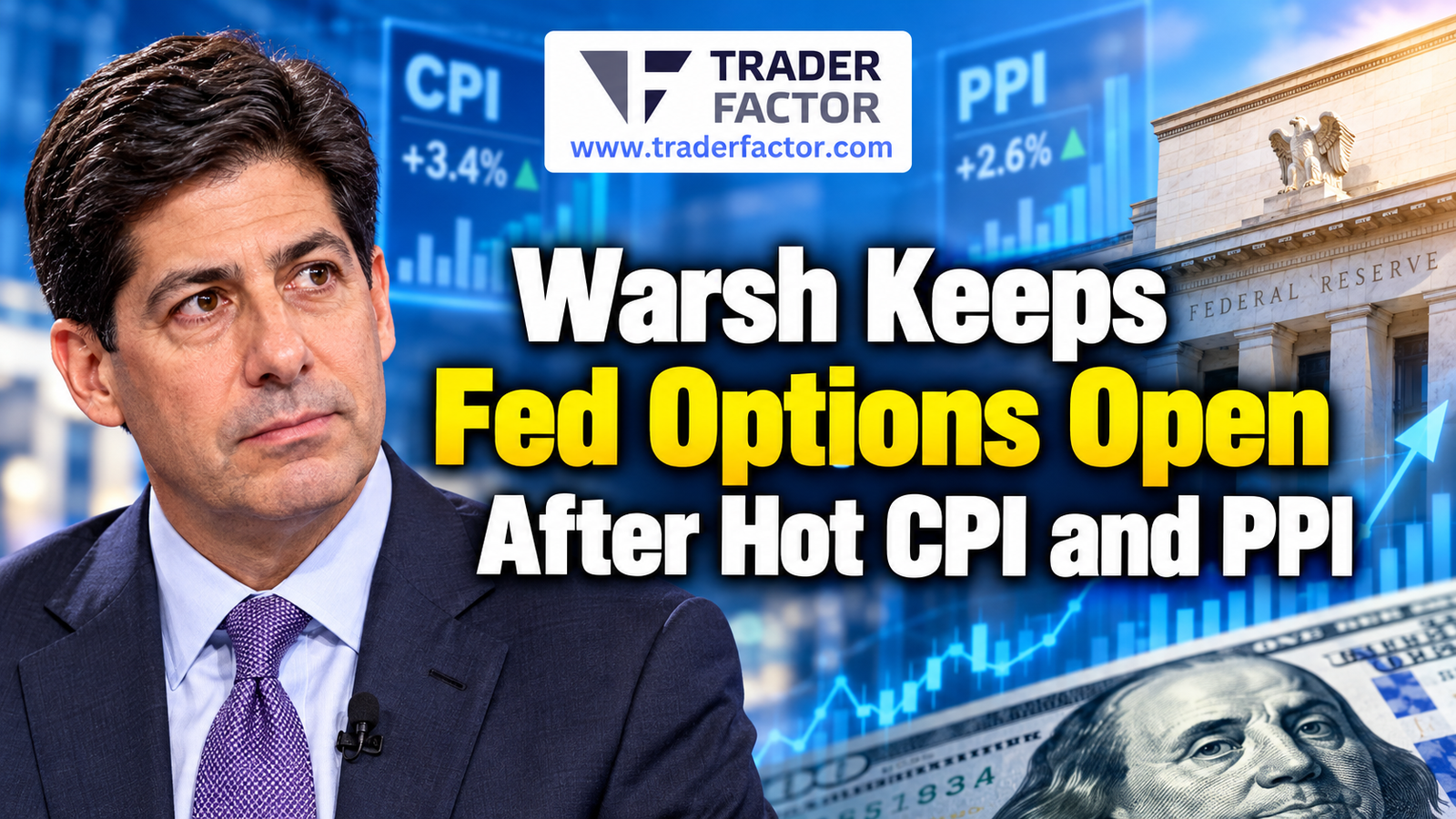

Forex Market Today: Warsh Keeps Fed Options Open After Hot CPI and PPI
Friday, October 16, 2026 | Dollar, Gold, Oil, Bitcoin, Treasury Yields & Fed Outlook
The Week Changed in Three Major Steps
🔥 CPI Comes in Hot
Headline inflation accelerated to
3.7%,
while core CPI increased to
2.6%.
🏭 PPI Delivers Another Shock
Producer prices surged
1.3% monthly
and
6.3% annually.
🎙️ Warsh Keeps His Options Open
Price stability remains a priority, but Warsh says every Fed meeting must be judged on its own merits.
The Fed Story Is No Longer Simply “Hot Inflation Means Another Hike”
This has been one of the most important weeks for US monetary policy in months.
First came hotter consumer inflation.
Then came an even stronger producer inflation report.
Retail Sales showed American consumers are still spending, while Jobless Claims remained relatively low.
On the surface, that combination appears to give the Federal Reserve a strong argument for another interest-rate increase.
But Kevin Warsh has now added another dimension to the discussion.
Price stability remains firmly on the table — but so do financial stability, downside risks and the condition of markets.
📌 Key Takeaways
- CPI:
Headline inflation reached 3.7% YoY and core CPI 2.6%. - PPI:
Producer prices surged 1.3% MoM and 6.3% YoY. - Retail Sales:
Consumer spending remained resilient. - Jobless Claims:
The labour market continues to show relatively limited layoffs. - Warsh:
Price stability remains a clear Fed commitment. - Fed Policy:
Warsh refused to pre-judge individual meetings and said each decision must stand on its own merits. - Financial Stability:
Warsh also emphasized evaluating risks to the financial system. - Tail Risks:
Policymakers should consider whether downside tail risks can be mitigated. - Market Question:
Does the Fed respond to hot inflation immediately, or wait because financial conditions are already becoming tighter?
🔥 Wednesday: CPI Reopened the Inflation Debate
September’s consumer inflation report immediately changed the tone of the week.
Headline CPI increased 0.6% month-on-month and accelerated to 3.7% year-on-year.
Core CPI increased 0.3% during September and 2.6% over the previous 12 months.
Energy was a major driver.
Gasoline prices surged 9.1%, while the broader energy index increased 5.2%.
However, core inflation also exceeded expectations.
That made it difficult for markets to dismiss the report simply as an energy-price shock.
Why CPI Mattered
The monthly headline reading matched forecasts, but annual headline CPI and both important core readings came in above expectations. That strengthened the argument that underlying inflation remains sticky.
📘 Read the CPI analysis
See TraderFactor’s full breakdown of the inflation report and its impact on the Dollar, Gold and Fed expectations.
🏭 Thursday: PPI Made the Inflation Story Harder to Ignore
If Wednesday’s CPI created concern, Thursday’s producer inflation report strengthened it.
The Producer Price Index for final demand jumped 1.3% in September.
Annual PPI accelerated to 6.3%.
The measure excluding food, energy and trade services also increased 0.5% monthly and 5.0% annually.
The Bigger PPI Message
Energy contributed heavily to the surge.
But underlying producer inflation was also firm.
That increased the risk that businesses could eventually pass some of their higher costs on to consumers.
🎙️ Kevin Warsh Responds: Price Stability Still Matters, But October Is Not Pre-Decided
Kevin Warsh’s appearance at the IMF meetings in Bangkok was always going to attract attention after this week’s CPI and PPI reports.
His comments have now given traders an important clue about how the Fed may approach the October 27–28 meeting.
Warsh’s Main Message
Price stability remains a clear commitment of the Federal Reserve.
But Warsh added that each meeting needs to be evaluated on its own merits.
That is important because it stops markets from treating this week’s hot inflation data as an automatic promise of an October rate hike.
Three Important Messages From Warsh
1. Price Stability Remains Non-Negotiable
Warsh did not retreat from the Fed’s inflation objective despite growing concerns about markets and financial conditions.
2. No Automatic October Hike
By saying every meeting must be judged on its own merits, Warsh kept the Fed’s options open rather than committing to another increase.
3. Financial Stability Matters Too
Warsh emphasized that policymakers need to evaluate financial-stability risks and consider whether downside tail risks can be reduced.
Was Warsh Hawkish or Dovish?
The speech was not cleanly one or the other.
The commitment to price stability is hawkish.
Refusing to pre-commit to the next meeting is neutral and data-dependent.
Highlighting financial stability and downside tail risks introduces a more cautious element.
Overall, Warsh appears to be telling markets: inflation must come down, but the Fed will not blindly raise rates without considering what is happening across the wider financial system.
Why That Matters After CPI and PPI
If Warsh had focused only on price stability following this week’s data, markets could have interpreted the remarks as a much clearer signal toward an October hike.
Instead, he kept optionality.
That means the Fed is likely to weigh several forces together:
🔥 Inflation: CPI and PPI are both running hot.
🛍️ Demand: Retail Sales remain resilient.
👷 Labour: Layoffs remain relatively contained.
📉 Treasury Market: Yields have fallen sharply despite inflation.
💻 Financial Markets: Concerns around highly leveraged technology and AI investment remain important.
🌍 Geopolitics: Elevated Oil prices continue to threaten the inflation outlook.
❓ Question of the Day
Will the Fed prioritize hot inflation — or the downside financial risks Warsh is now highlighting?
That question may determine whether October delivers another rate hike or a pause.
The Strange Part: CPI and PPI Are Hot, But Treasury Yields Fell
This is one of the most important market developments of the week.
Normally, stronger inflation increases expectations for higher policy rates and pushes bond yields higher.
But after Thursday’s PPI report, the US 10-year Treasury yield fell sharply toward the 5.09% region.
Investors moved toward government bonds as concerns over technology valuations and financial-market stress increased.
This Helps Explain Warsh’s Financial-Stability Comments
The Fed does not set interest rates based only on CPI.
It must also consider how tighter monetary conditions affect credit, leverage, investment, employment and the broader financial system.
That makes the latest decline in Treasury yields and the stress appearing in parts of the technology market highly relevant.
💵 Dollar: DXY Struggles to Extend the Inflation Rally
The Dollar has had almost every fundamental reason to strengthen this week.
CPI was hot.
PPI was hotter.
Retail Sales were strong.
Yet the Dollar has struggled to maintain its post-inflation highs.
The main reason is the fall in Treasury yields and uncertainty over whether the Fed will act immediately in October.
- Support: 101.80 / 101.50
- Pivot: 102.00
- Resistance: 102.30 / 102.60
- Major Breakout: 103.00
Gold Finds Support From Falling Yields
Gold initially suffered after the CPI shock as the Dollar and Treasury yields moved higher.
But the decline in yields later allowed the precious metal to recover.
That makes the Warsh comments particularly important.
His commitment to price stability limits the bullish case for Gold because another Fed hike remains possible.
But his concern about financial stability and downside risks helps support demand for defensive assets.
- Support: $4,130 / $4,100
- Deeper Support: $4,075
- Resistance: $4,180 / $4,200
- Major Resistance: $4,250
Gold’s New Driver
CPI and PPI are now known. Gold’s next direction is more likely to depend on Fed expectations, Treasury yields, DXY and financial-risk sentiment.
🛢️ Oil Remains the Biggest Threat to the Inflation Story
Oil remains elevated after geopolitical tensions disrupted energy markets.
That matters because energy has played a significant role in both CPI and PPI.
Higher Oil
→
Higher Input Costs
→
Inflation Pressure
→
Fed Pressure
₿ Bitcoin Remains Sensitive to the Fed and Liquidity
Bitcoin continues to trade in a difficult environment.
Hot inflation increases the risk of higher rates.
But falling Treasury yields provide some relief for speculative and growth-sensitive assets.
- Support: $80,000 / $79,000
- Resistance: $83,000 / $84,500
📊 Stocks: Financial Stability Is Becoming Part of the Fed Debate
Thursday’s market action was unusual.
PPI was significantly hotter than expected, but Treasury yields declined and US stocks recovered.
The Dow gained around 1.1%, the S&P 500 added roughly 0.3%, while the Nasdaq finished only slightly higher.
The difference between technology and the broader market matters.
Investors are becoming more cautious about highly leveraged AI and technology investment while rotating toward other sectors.
That helps explain why Warsh explicitly brought financial stability into the policy discussion.
What Warsh’s Comments Mean for the October Fed Meeting
🔴 Case for Another Hike
- CPI is above expectations.
- Core CPI remains sticky.
- PPI surged sharply.
- Underlying PPI remains strong.
- Retail spending remains resilient.
- Layoffs remain relatively low.
- Oil remains elevated.
🔵 Case for Waiting
- Treasury yields have already been extremely elevated.
- Parts of the financial system are showing stress.
- AI and technology financing risks are attracting attention.
- Warsh explicitly highlighted downside tail risks.
- Financial conditions can tighten without another policy-rate increase.
- The Fed can reassess the data meeting by meeting.
TraderFactor Interpretation
Warsh did not close the door on another rate increase.
But he also did not walk through that door.
Instead, he reinforced the Fed’s inflation credibility while preserving maximum flexibility before the October meeting.
That makes incoming data and financial conditions — rather than one speech — the deciding factors.
Current Market Focus
| Market | Key Area | Main Driver |
|---|---|---|
| DXY | Around 102 | Fed expectations / yields |
| Gold | $4,100–$4,200 zone | Yields / safe haven demand |
| EUR/USD | 1.12 area | Dollar direction |
| GBP/USD | 1.32–1.33 | Dollar / UK outlook |
| USD/JPY | Around 158 | Treasury yields |
| Bitcoin | $80K–$85K | Liquidity / rates |
| WTI Oil | Upper-$90 region | Geopolitics / inflation |
📅 What Else Matters Today?
US Import Prices
Import prices deserve more attention after energy contributed heavily to both CPI and PPI.
US Industrial Production
Industrial Production provides another look at whether the US economy can continue growing despite high interest rates and expensive energy.
Capacity Utilization
Capacity utilization may help indicate how much room producers have before higher demand creates additional pricing pressure.
Final Market Outlook
The story of this week began with inflation.
It is ending with a much broader debate about monetary policy.
CPI confirmed that consumer inflation remains elevated.
PPI showed even stronger inflation pressure at the producer level.
Retail Sales showed consumers remain resilient.
Jobless Claims suggested layoffs remain contained.
Taken alone, those numbers strengthen the argument for another Federal Reserve rate increase.
But Kevin Warsh has made clear that policy is not automatic.
The Fed remains committed to price stability, but every meeting will be evaluated independently.
More importantly, financial-stability risks and downside tail risks are also entering the policy calculation.
That means traders should be careful about reducing the October meeting to a simple question of whether inflation is above target.
The Fed must now judge whether another hike is necessary to control inflation — and whether additional tightening could create unnecessary stress elsewhere in the financial system.
🎯 TraderFactor Bottom Line
CPI:
Inflation remains too high.
PPI:
Producer price pressure is even stronger.
Growth:
Consumer demand remains resilient.
Markets:
Falling yields suggest financial risks are becoming more important.
Warsh:
Price stability remains a firm commitment, but Fed decisions will be made meeting by meeting.
The October Fed meeting is therefore still live — but Warsh has stopped markets from treating another rate hike as a foregone conclusion.
💼 Compare Forex Brokers
Compare regulation, trading platforms, account types, leverage, minimum deposits and broker features.
| 🚀 Top-Rated Forex Broker Reviews Compare brokers, spreads, leverage, platforms & trading conditions. | ||
|---|---|---|
| 🔥 IronFX Trading Conditions | ⭐ PU Prime Spreads & Platforms | 📈 NAGA Social Trading |
| ⚡ TMGM Execution Speed | 💹 M4 Markets Account Types | 💼 RS Prime Broker Overview |
| 👑 OneRoyal Regulation & Safety | 🎯 Skilling Platform Review | 📊 DeltaStock Broker Features |
| 🚀 Eightcap Trading Experience | 🧪 Alchemy Markets Broker Analysis | ✅ ActivTrades Expert Review |
| 💰 VS Capital Broker Rating | ⚖️ High Leverage Compare Leverage | 📉 Low Spreads Trading Costs |
| Compare Broker Features, Costs, Regulation, Platforms & Leverage Explore our independent broker reviews before choosing your next trading account. | ||
About the Author

Zahari Rangelov
Head of Business Development, TraderFactor
Zahari specializes in
broker analysis
,
regulatory research, and
trading education
.
With over a decade of experience, he helps traders navigate online brokers, technical and fundamental analysis, medium-term strategies, risk management and trading psychology.
A respected mentor and speaker, Zahari regularly leads webinars and seminars covering market sentiment, speculative instruments and automated trading systems.
Reviewed By
Alex Kanyi, Head of Compliance at TraderFactor
“This report is for general information only. Trading involves significant risk. Seek independent advice before acting on any content.”
Last Updated:
October 2026
Risk Disclaimer:
This report is for educational and informational purposes only and does not constitute financial advice. Forex, commodities, cryptocurrencies and equity indices can move rapidly following economic data, Federal Reserve communication and geopolitical developments.