
Compare all PU Prime account types; Cent, Standard, Prime, ECN. Minimum deposits, spreads, commissions, and which account suits beginners, scalpers, and pros.
Cent Account – $20 Min
Beginners. Micro-risk. Real market reps. Start here.
Standard Account – $50 Min
Commission-free. One spread cost. Simple & easy.
Prime Account – $1,000 Min
Tighter spreads. Active day traders’ sweet spot.
ECN Account – $10,000 Min
Raw 0.0 spreads. $7/lot. For pros & scalpers.
Islamic Swap-Free
No overnight interest. Sharia-compliant. On request.
Free Demo Account
$100K virtual cash. Practice risk-free before going live.
Leverage Up to 1:1000
Available on Cent & Standard. Use wisely.
Upgrade Anytime
Start small. Scale up when you’re ready. No lock-in.
PU Prime Account Types Explained (2026): Which Account Is Best for You?
TraderFactor Review: May 12, 2026
Choosing the right trading account is one of the most important decisions any trader can make. It’s not just about how much money you deposit — it’s about how you trade, how often you trade, and what costs you’ll face every time you click the buy or sell button.
Whether you are a complete beginner testing the markets for the first time or an experienced scalper hunting for raw spreads and institutional execution, your account type directly shapes your trading costs, flexibility, and overall experience.
PU Prime offers multiple account types designed for different categories of traders. From beginner-friendly low-deposit accounts to advanced ECN-style setups, the broker provides several pathways depending on your trading style, capital, and ambition.
In this guide, we break down all PU Prime account types, compare spreads and commissions, explain minimum deposits, and help you determine which account may suit your trading goals best.
💡 What Account Type Is Best on PU Prime?
The best PU Prime account depends on your trading experience and strategy.
PU Prime Account Types
📋 What Account Types Does PU Prime Offer?
Each Account Differs In:
- Minimum deposit requirements
- Spread structure (markup vs raw)
- Commission fees (none vs per-lot)
- Execution model (instant vs market/ECN)
- Target user type (beginner vs professional)
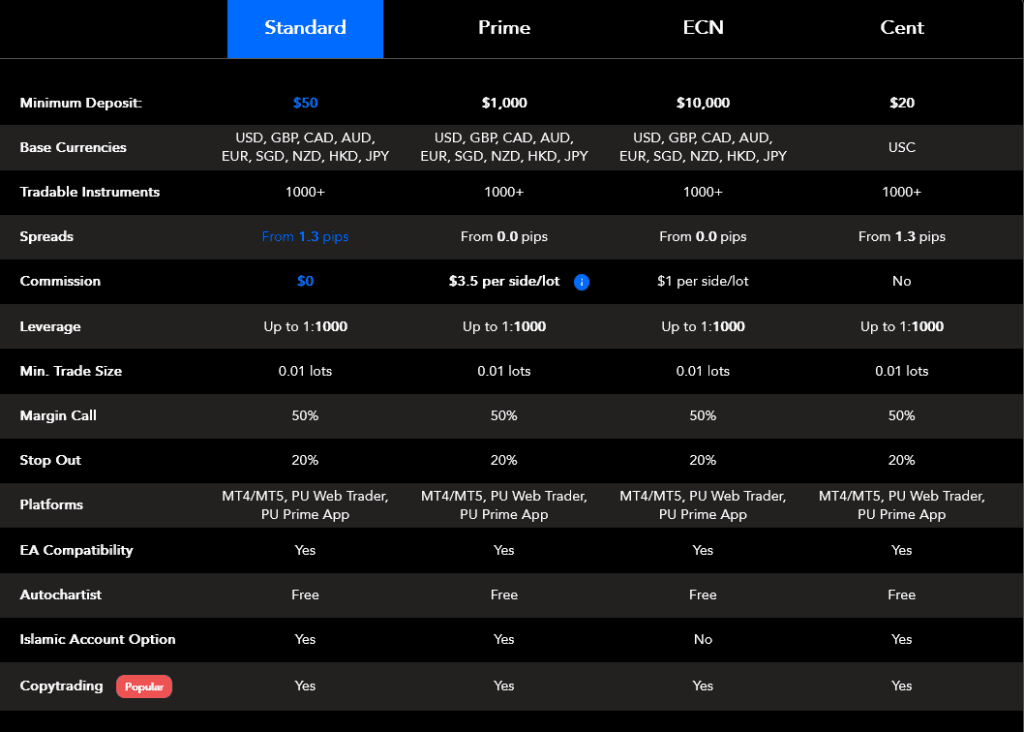
PU ACCOUNT COMPARISON TABLE
📊 PU Prime Account Comparison Table
| Feature | Cent | Standard | Prime | ECN |
|---|---|---|---|---|
| Minimum Deposit | $20 | $50 | $1,000 | $10,000 |
| Spreads (EUR/USD) | ~1.7 pips | ~1.2–1.8 pips | ~0.8 pips | 0.0–0.3 pips |
| Commission | No | No | Sometimes | $7/lot RT |
| Execution | Instant | Market | Market | ECN/Market |
| Max Leverage | 1:1000 | 1:1000 | 1:500 | 1:500 |
| Scalping Allowed | ✔️ Yes | ✔️ Yes | ✔️ Yes | ✔️ Yes (optimal) |
| Best For | Beginners | Retail Traders | Active Day Traders | Pros & Algo |
| Risk Level | Low | Moderate | Moderate | High |
PU Prime Standard Account Explained
The Standard Account is designed for everyday retail traders who want straightforward market access with relatively low entry requirements. It’s the most popular account type among casual traders.

Key Features
- ✔️ Beginner-friendly structure
- ✔️ Lower minimum deposit requirement
- ✔️ Commission-free trading
- ✔️ Access to MT4 and MT5
- ✔️ Suitable for forex, commodities, indices, and share CFDs
Standard Account Minimum Deposit
- ✔️ Minimum Deposit: $50
This low requirement makes it accessible for traders who want to begin with smaller capital without overcommitting.
Spreads on the Standard Account
The Standard Account uses a spread-only pricing structure. There is no separate commission line on your statement.
Typical features:
- ✔️ No direct commission
- ✔️ Slightly wider spreads compared to ECN (approx. 1.2–1.8 pips on EUR/USD)
- ✔️ Simpler fee structure for beginners who don’t want to calculate per-lot costs
Who Is the Standard Account Best For?
The Standard Account suits:
- ✔️ Beginner traders
- ✔️ Casual retail traders
- ✔️ Swing traders holding positions for days
- ✔️ Users starting with small capital (50–500)
Advantages of the Standard Account
- ✔️ Low minimum deposit
- ✔️ Easy to understand — one cost (spread) to track
- ✔️ No commission fees
- ✔️ Flexible trading conditions across all instruments

Potential Limitations
- ✔️ Wider spreads compared to ECN accounts
- ✔️ May not be ideal for scalping or high-frequency trading
- ✔️ Cost per trade is higher for active traders over the long term
PU Prime Prime Account Explained
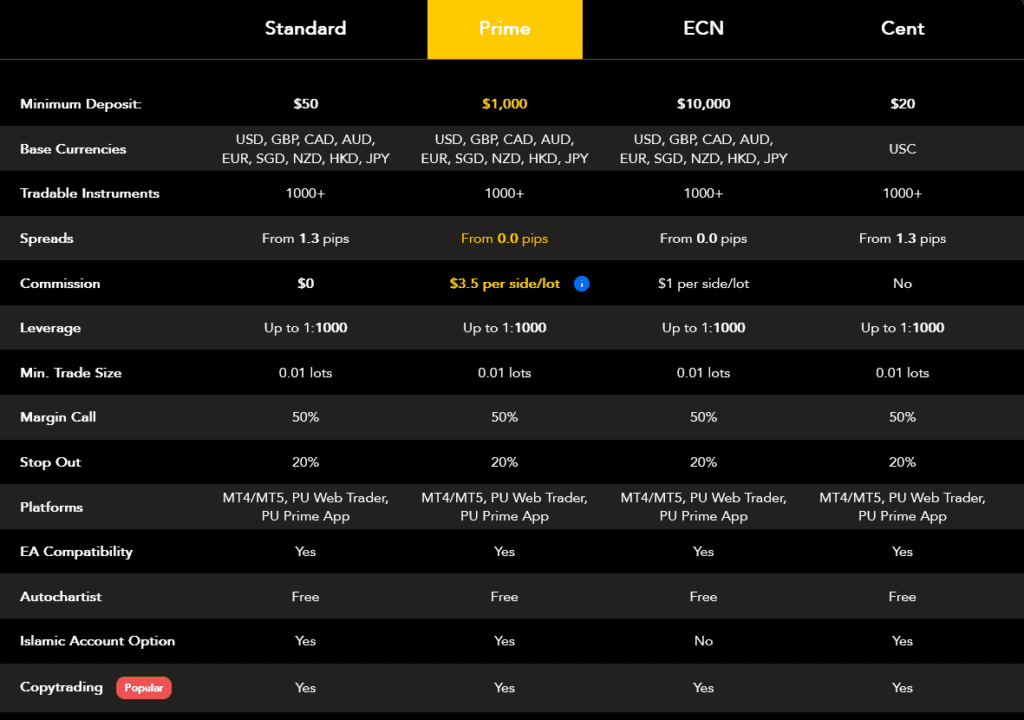
The Prime Account sits between Standard and ECN. It is designed for traders who want tighter spreads than Standard but don’t yet want the full commission structure (or higher minimum deposit) of the ECN account.
Key Features
- ✔️ Lower spreads than Standard
- ✔️ Enhanced execution conditions
- ✔️ More professional trading environment
- ✔️ Better suited for active day traders
Prime Account Minimum Deposit
- ✔️ Minimum Deposit: Around $1,000
This higher requirement targets traders with more capital and trading experience who will benefit from the cost savings on spreads.
Spread Structure
The Prime Account generally offers:
- ✔️ Lower spreads than the Standard Account (approx. 0.8 pips on EUR/USD)
- ✔️ Competitive pricing for active traders
- ✔️ Better cost efficiency for larger trade volumes
- ✔️ Often commission-free, depending on instrument
Who Is the Prime Account Best For?
- ✔️ Intermediate traders
- ✔️ Active day traders executing multiple positions daily
- ✔️ Traders with 1,000–5,000 who want tighter pricing without full ECN commissions

Prime Account Advantages
- ✔️ Lower spreads than Standard
- ✔️ Improved trading conditions
- ✔️ Better suited for active strategies
- ✔️ Good middle ground before upgrading to ECN
Potential Drawbacks
- ✔️ Higher minimum deposit than Standard
- ✔️ Less beginner-friendly
- ✔️ Not the absolute tightest spreads (ECN still beats it)
PU Prime ECN Account Explained
The ECN Account is the flagship offering for advanced traders who prioritize ultra-tight spreads and institutional-style pricing. ECN stands for Electronic Communication Network, a system that aggregates liquidity from multiple top-tier banks and financial institutions.
What Is an ECN Account?
An ECN account connects your trades directly to a network of liquidity providers — major banks, hedge funds, and other institutional players. There is no dealing desk intervention on pricing. You see the raw interbank spread, and the broker charges a transparent commission per trade.
Key Features
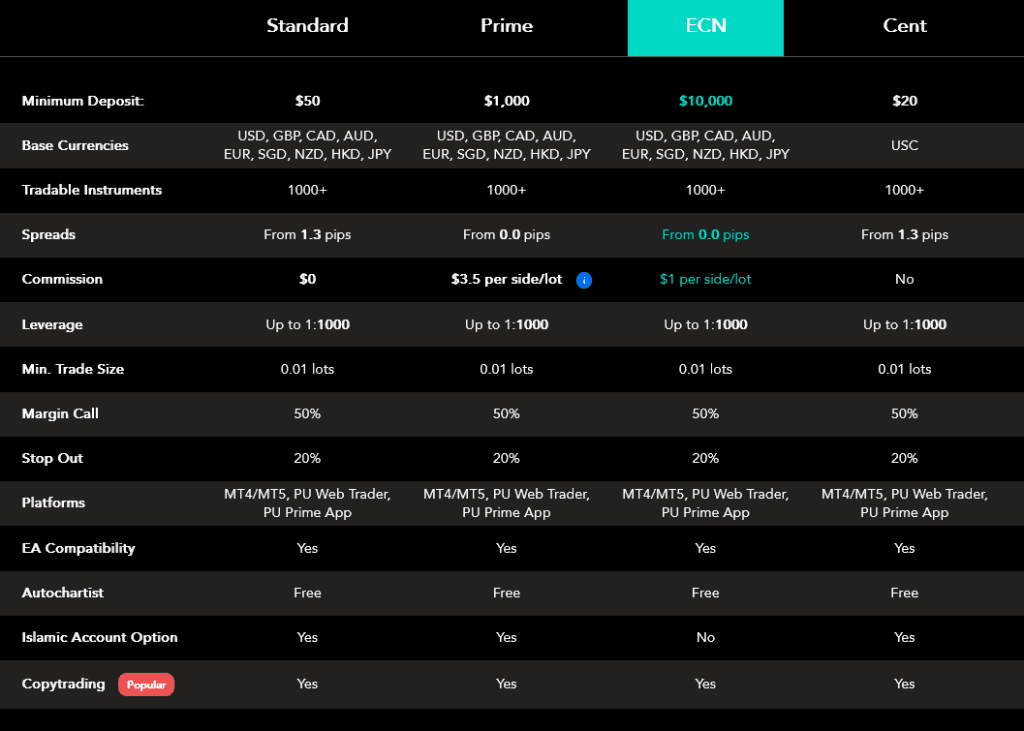
- ✔️ Ultra-low spreads (from 0.0 pips)
- ✔️ Faster execution environment
- ✔️ Commission-based pricing (transparent and fixed)
- ✔️ Better suited for scalping and algorithmic trading
ECN Account Minimum Deposit
- ✔️ Minimum Deposit: Around $10,000

This is the highest-tier retail account available at PU Prime, aimed at serious traders with significant capital.
ECN Spreads & Commissions
Typical ECN features include:
- ✔️ Spreads from 0.0 pips on major forex pairs
- ✔️ Fixed commission of **3.50persideperstandardlot∗∗(7.00 round turn)
- ✔️ Lower overall trading cost for high-volume traders
- ✔️ Gold spreads from 5–15 cents
Who Is the ECN Account Best For?
- ✔️ Professional traders
- ✔️ Scalpers needing precision entries
- ✔️ High-frequency traders
- ✔️ Algorithmic traders running Expert Advisors (EAs)
Advantages of ECN Accounts
- ✔️ Lowest spreads available on the platform
- ✔️ Better for precision entries and tight stop-losses
- ✔️ Improved execution conditions with minimal slippage
- ✔️ Transparent cost structure — you know exactly what you pay
Potential Limitations
- ✔️ High minimum deposit ($10,000)
- ✔️ Commission fees apply to every trade
- ✔️ Less suitable for beginners or micro-lot traders (commission eats into small profits)
PU Prime Cent Account Explained
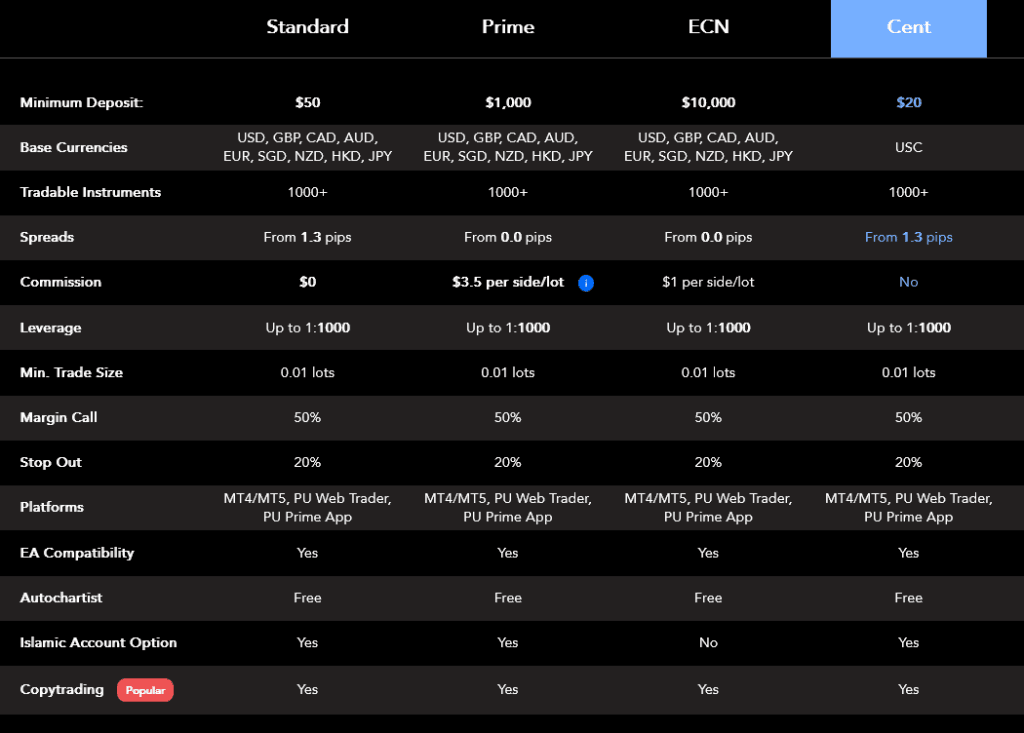
The Cent Account is designed specifically for beginners or traders testing strategies with minimal financial risk. It’s one of the most accessible entry points in the entire CFD brokerage industry.
What Is a Cent Account?
A Cent Account denominates your balance in cents rather than dollars. When you deposit $20, your account shows 2,000 cents. You trade micro-lots where each pip movement equals a few cents, not dollars. This dramatically reduces financial risk while exposing you to real market conditions.
Key Features
- ✔️ Very low minimum deposit
- ✔️ Lower risk exposure per trade
- ✔️ Beginner-focused environment
- ✔️ Ideal for strategy testing in live conditions
Cent Account Minimum Deposit
- ✔️ Minimum Deposit: $20
This makes it one of the most accessible account types on the platform — and in the wider industry.
Who Is the Cent Account Best For?
- ✔️ New traders with zero live experience
- ✔️ Strategy testers who want real execution but tiny risk
- ✔️ Low-risk traders building confidence
- ✔️ Traders learning platform functionality before scaling up
Advantages of the Cent Account
- ✔️ Minimal financial risk per trade
- ✔️ Good learning environment with real emotions (unlike demo)
- ✔️ Affordable entry point — cheaper than a dinner out
- ✔️ Same platform access as larger accounts (MT4/MT5)
Potential Limitations
- ✔️ Limited scalability — not designed for building wealth directly
- ✔️ Not ideal for large-volume trading
- ✔️ Spreads are proportionally wider than ECN
PU Prime Demo Account Explained
A demo account is one of the most powerful, underused tools available to traders of all levels.
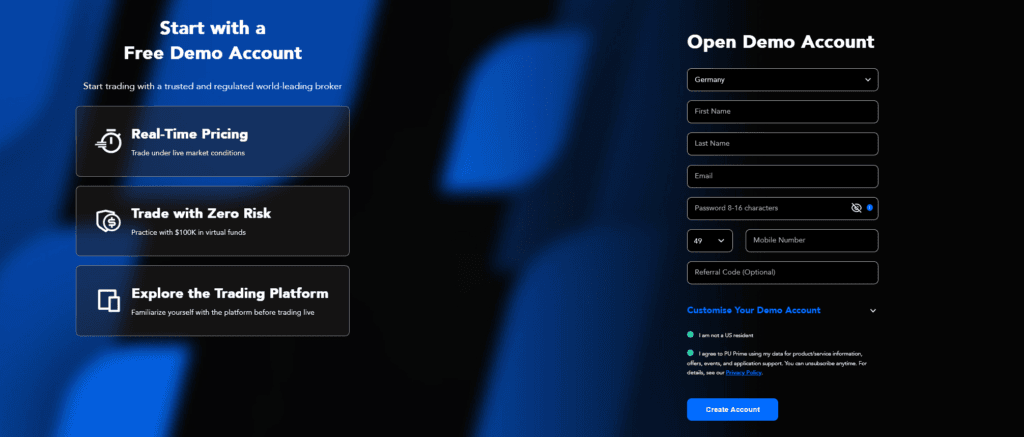
What Is a Demo Account?
A demo account allows traders to practice using virtual funds (typically $100,000 in simulated capital) instead of real money. You access the same live prices, same platforms, and same execution environment — but with zero financial risk.
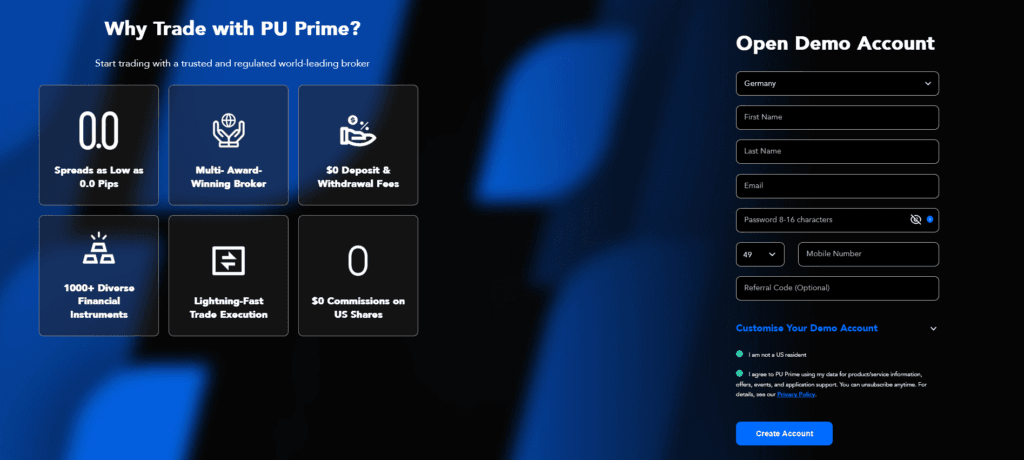
Benefits of the Demo Account
- ✔️ Risk-free learning
- ✔️ Test trading strategies without losing capital
- ✔️ Learn MT4 and MT5 platforms thoroughly
- ✔️ Understand market execution, order types, and spread behavior
- ✔️ Practice risk management in real-time conditions
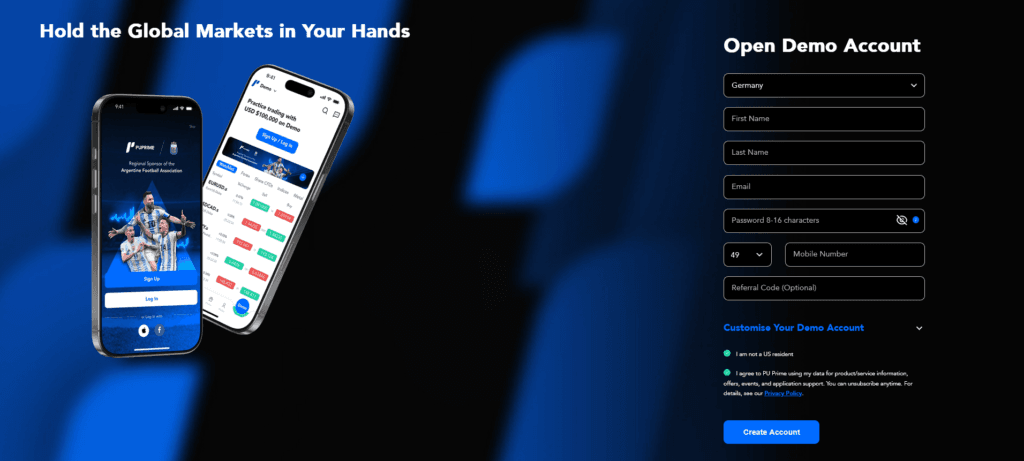
Why Beginners Should Start With a Demo
Using a demo account helps reduce emotional trading mistakes. You learn what a losing streak feels like without the financial damage. It builds confidence and muscle memory before you commit real capital.
Pro Tip: Use the demo account for 2–4 weeks. Once you are consistently profitable (or at least breakeven) on demo, switch to the Cent Account with $20 to test emotional control with real money. Only then scale up to Standard or Prime.
Does PU Prime Offer Islamic Accounts?
Yes, PU Prime offers Islamic or swap-free account options for eligible traders.
What Is an Islamic Account?
An Islamic account removes overnight swap fees (interest) to comply with Sharia principles. Instead of paying or earning interest on positions held overnight, the trader is charged a flat administration fee on positions held for more than 5 consecutive nights.
Key Features
- ✔️ No overnight interest charges
- ✔️ Available on selected account types (Standard and Prime)
- ✔️ Suitable for Muslim traders seeking halal trading conditions
- ✔️ Admin fee replaces swap — transparent and fixed
To request an Islamic account, you typically need to contact PU Prime support after opening a Standard or Prime account and request the swap-free upgrade.
Which PU Prime Account Is Best for Beginners?
For most beginners, the best starting points are:
- ✔️ Cent Account (absolute beginner, tiny capital)
- ✔️ Standard Account (some experience, $50+ deposit)
Why?
- ✔️ Lower deposit requirements remove financial pressure
- ✔️ Lower financial risk while you learn
- ✔️ Easier fee structures (no commission to calculate)
- ✔️ Better learning environment without complex cost models

Start with Cent if you’ve never traded live. Move to Standard once you’re consistently executing your strategy without emotional interference.
Which Account Is Best for Scalping?
Scalpers prioritize:
- ✔️ Ultra-low spreads
- ✔️ Fast execution speeds
- ✔️ Minimal slippage on entries and exits
- ✔️ Transparent commission costs
Because of this, the clear winner is:
- ✔️ ECN Account
Raw spreads from 0.0 pips and fast ECN execution give scalpers the precision they need. The fixed $7/lot commission is predictable and easily factored into risk-reward calculations.
Which Account Is Best for Small Deposits?
The best options for smaller budgets are:
- ✔️ Cent Account ($20 minimum)
- ✔️ Standard Account ($50 minimum)
These accounts allow traders to start without committing large amounts of capital. The Cent Account, in particular, lets you trade real markets with coffee-money risk.
PU Prime Leverage by Account Type
Leverage at PU Prime varies depending on:
- ✔️ Asset class (forex, gold, indices, shares)
- ✔️ Account type (Standard/ECN)
- ✔️ Region and regulations (ASIC retail vs offshore)
PU Prime offers leverage as high as:
- ✔️ 1:1000 (offshore entity, Cent/Standard accounts)
However, higher leverage increases both profit potential and trading risk exponentially. A 1:1000 leverage means a 0.1% adverse move wipes out your entire margin. Use with extreme caution.
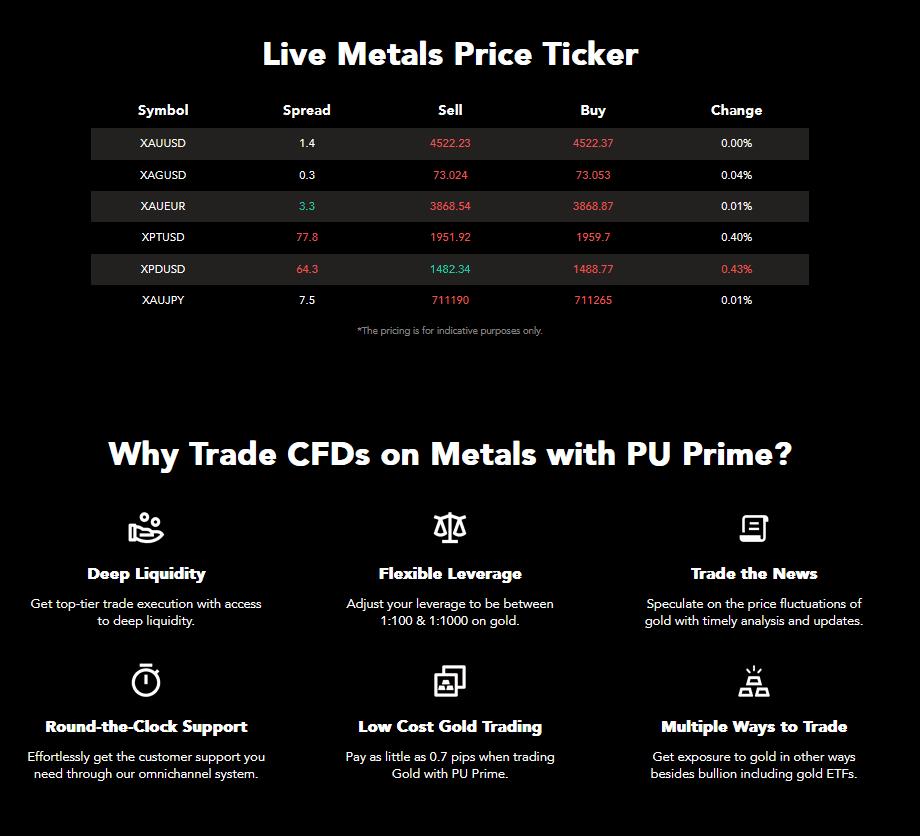
Fees, Spreads & Commissions Explained
Understanding account costs is critical to profitability.
Standard Account
- ✔️ No direct commission
- ✔️ Wider spreads (1.2–1.8 pips EUR/USD)
- ✔️ Cost hidden in the spread
Prime Account
- ✔️ Lower spreads (~0.8 pips EUR/USD)
- ✔️ More competitive pricing
- ✔️ Often commission-free
ECN Account
- ✔️ Ultra-tight spreads (0.0 pips)
- ✔️ Commission per trade ($7/lot RT)
- ✔️ Most transparent cost model
Which PU Prime Account Is Cheapest?
For casual, low-frequency traders: The Standard Account feels cheaper because there is no visible commission deducted per trade.
For active, high-volume traders: The ECN Account becomes significantly more cost-efficient due to tighter spreads. The savings on spread alone can outpace commission costs once you exceed 15–20 lots per month.

Example (EUR/USD, 1 Lot):
- Standard: 1.5 pip spread = $15.00 cost
- ECN: 0.2 pip spread (2.00)+7.00 commission = $9.00 total
Over 100 lots a month, ECN saves $600.
Common Mistakes When Choosing an Account
Many traders choose the wrong account type because they focus only on one factor — usually leverage or the headline “0.0 pip” spread — without understanding the full picture.
Mistakes to Avoid
- ❌ Choosing ECN without sufficient capital (commission on micro-lots eats profits)
- ❌ Starting with maximum leverage on a small account
- ❌ Ignoring commission structure and focusing only on spreads
- ❌ Depositing more than you can afford to lose just to qualify for Prime/ECN
- ❌ Skipping the demo stage entirely
- ❌ Not checking swap rates before holding positions overnight

Is PU Prime Good for Beginners?
Yes, PU Prime is beginner-friendly because it offers:
- ✔️ Low deposit options ($20 Cent Account)
- ✔️ Free demo accounts with $100k virtual funds
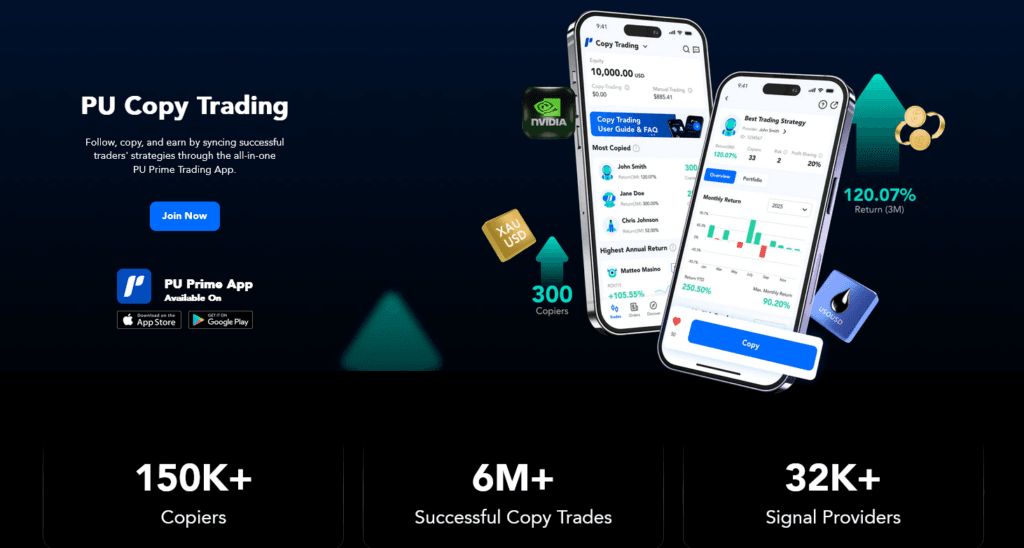
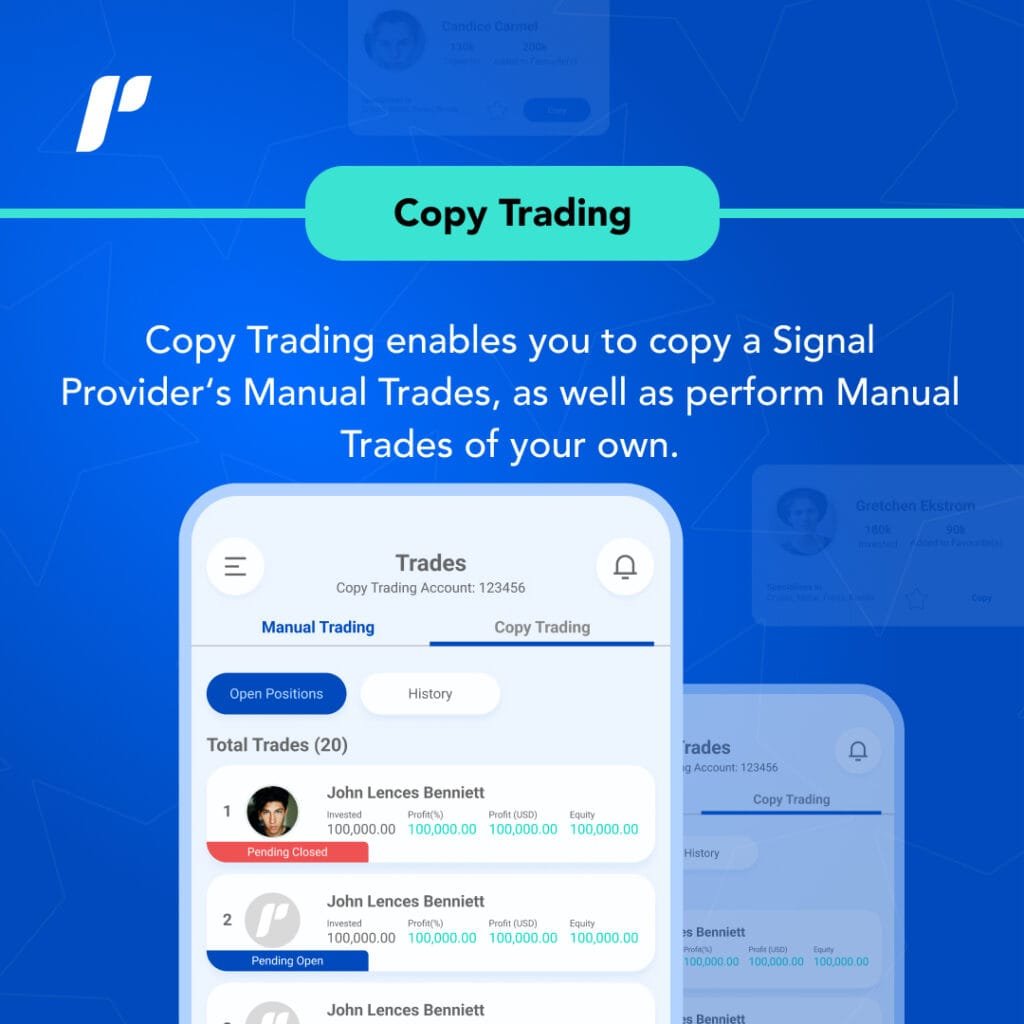
- ✔️ Copy trading (mirror professional traders)
- ✔️ Multiple platforms (MT4, MT5, Proprietary App)
- ✔️ Educational resources through PU Prime Academy
However, beginners must still understand the risks associated with leveraged CFD trading. The low entry barrier is a feature, not a license to skip risk management.
Frequently Asked Questions

What account types does PU Prime offer?
PU Prime offers Cent, Standard, Prime, and ECN accounts, plus demo and Islamic swap-free options.
Which PU Prime account is best for beginners?
The Cent and Standard accounts are generally best for beginners due to lower deposits and simpler fee structures.
What is the minimum deposit on PU Prime?
The minimum deposit starts from $20 on the Cent Account.
Does PU Prime charge commissions?
Commissions apply mainly to ECN accounts ($7 per lot round turn). Standard, Cent, and Prime accounts are generally commission-free.

Is the ECN account worth it?
The ECN account is worth it for advanced traders who trade high volume and need tighter spreads and faster execution. It’s not ideal for micro-lot beginners.
Can I change my account type later?
Yes, PU Prime allows you to upgrade or switch account types by contacting support or opening an additional account from the client portal.
Does PU Prime offer a no-deposit bonus?
As of 2026, PU Prime typically offers deposit match bonuses rather than no-deposit bonuses. Bonus credit comes with volume-based trading requirements before withdrawal.
Final Verdict: Which PU Prime Account Should You Choose?
Choosing the best PU Prime account depends entirely on your trading experience, budget, and strategy.
- ✔️ Best for Beginners: Cent or Standard Account
- ✔️ Best for Active Day Traders: Prime Account
- ✔️ Best for Professionals & Scalpers: ECN Account
PU Prime offers a flexible range of account types that can suit both nervous first-timers and seasoned market veterans. The availability of low-deposit accounts, advanced ECN pricing, demo access, Islamic options, and multiple platform integrations gives traders several ways to access the markets depending on their goals and risk tolerance.
The account you choose today doesn’t lock you in forever. Start small, prove your strategy, and scale up as your confidence and capital grow.
Keep Reading
Read more here:
- PU Prime Review 2026: Full Broker Breakdown
- PU Prime Account Types Explained
- PU Prime Minimum Deposit Guide
- PU Prime Withdrawal Guide
- PU Prime Copy Trading Review

Author Details:
Phyllis Wangui
Senior Market Analyst, TraderFactor
Phyllis Wangui is a seasoned financial markets analyst with over a decade of experience in forex and CFD brokerage evaluation. Specializing in regulatory compliance and risk assessment, she leads the TraderFactor reviews team in delivering transparent, data-driven broker breakdowns that help retail traders navigate complex offshore and Tier-1 trading environments.

Reviewed by Alex Kanyi
Head of Compliance | TraderFactor
“This report is for general information only. Trading involves significant risk. Seek independent advice before acting on any content.”
[Subscribe to the TraderFactor Newsletter]
Last Updated: May 2026
Disclaimer:
All information has been prepared by TraderFactor or partners. The information does not contain a record of TraderFactor or partner’s prices or an offer of or solicitation for a transaction in any financial instrument. No representation or warranty is given as to the accuracy or completeness of this information. Any material provided does not have regard to the specific investment objective and financial situation of any person who may read it. Past performance is not a reliable indicator of future performance.