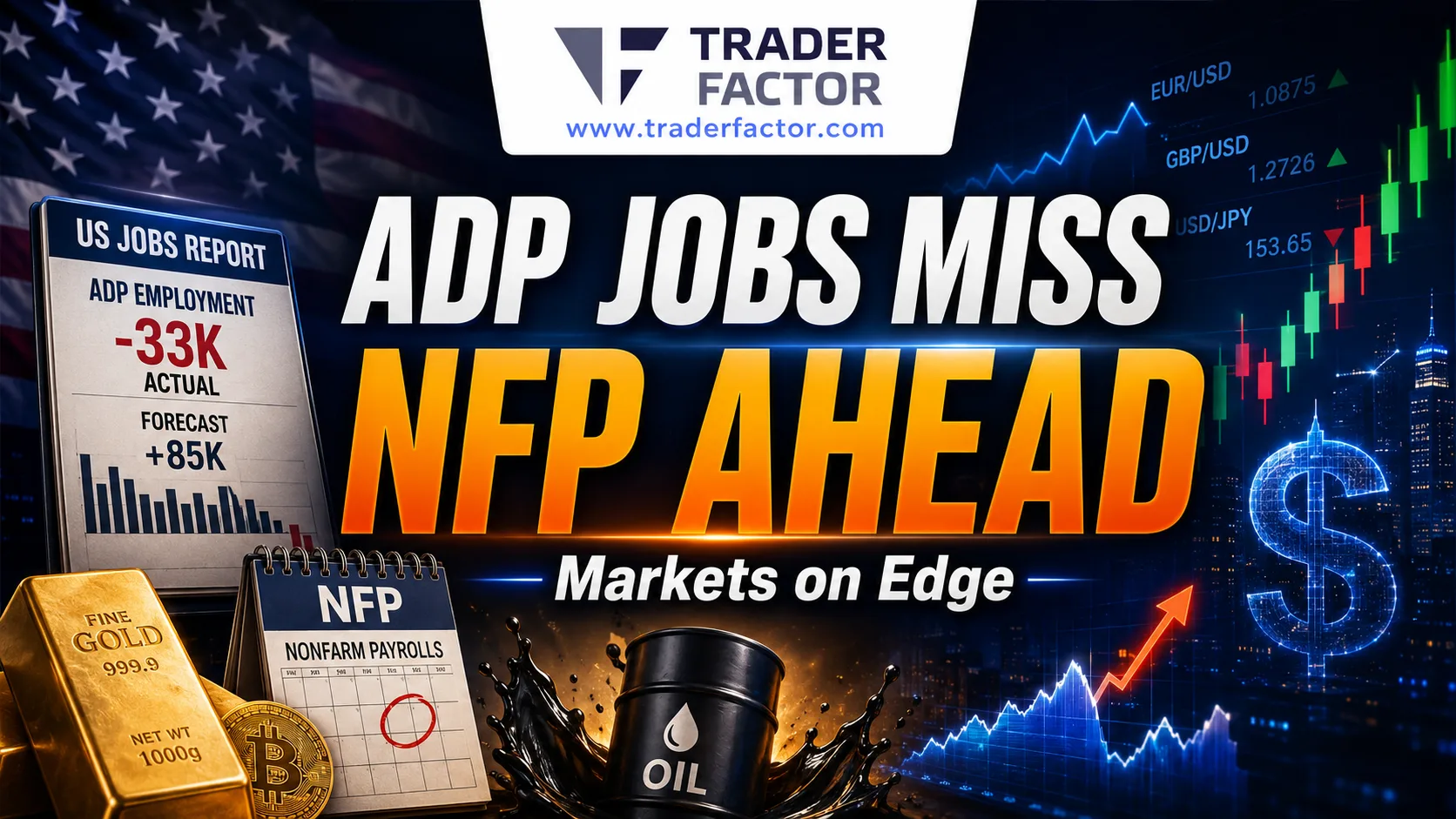

Forex Market Today: ADP jobs miss weakens the dollar as NFP approaches, while Iran tensions lift oil and keep gold, stocks and crypto volatile.
❓ Question of the Day
Will Friday’s NFP confirm the weakness seen in ADP, or will a stronger employment report bring the dollar back into control?
And how will the market react if strong jobs data meets another surge in oil prices?
📌 Forex Market Today: Key Takeaways
✓ ADP private payrolls increased by just 38K, below the 47K expectation
✓ Softer employment data weakened the US dollar and revived risk appetite
✓ Renewed US-Iran military activity keeps oil and geopolitical risk elevated
✓ Friday’s NFP report is now the major market catalyst
✓ Gold remains pressured by dollar and Fed-rate expectations despite geopolitical risk
✓ Bitcoin remains sensitive to liquidity, USD moves and broader risk sentiment
✓ EURUSD and GBPUSD are attempting to recover as the dollar loses momentum
✓ Oil remains vulnerable to sharp moves as markets assess Strait of Hormuz risks
✓ Traders are positioning for elevated volatility ahead of the US employment report
Forex Market Today: ADP Jobs Miss, NFP Ahead as Iran Tensions Drive Dollar, Gold, Oil, Crypto and Stocks
Forex markets are entering a critical part of the week as traders digest a weaker-than-expected ADP employment report and prepare for Friday’s Non-Farm Payrolls release. Private-sector employment increased by 38K against expectations of 47K, weakening the US dollar and helping risk sentiment recover. At the same time, renewed military exchanges between the United States and Iran are keeping oil prices elevated and creating another source of market volatility. With inflation still above the Federal Reserve’s target and Kevin Warsh maintaining a firm stance on inflation, Friday’s employment data could become decisive for USD, gold, stocks, Bitcoin and major currency pairs.
⚡ Quick Market Answer
The weaker-than-expected ADP employment report has reduced some pressure on the US dollar and encouraged a return of risk appetite ahead of Friday’s NFP report.
However, renewed US-Iran military activity is keeping oil prices elevated and limiting the market’s ability to fully embrace risk. Traders are now watching the combination of employment data, Fed expectations and Middle East headlines.
The key question for Friday is whether NFP confirms a softer US labor market. A weak report could pressure the dollar and support gold, equities and Bitcoin, while a strong surprise could revive dollar strength and rate-hike expectations.
Support and Resistance Snapshot
📊 Support, Resistance & Market Bias
| Asset | Current Price | Support | Resistance | Bias |
|---|---|---|---|---|
| DXY | 99.380 | 98.80 | 100.00 | Neutral |
| Gold | 4427 | 4380 | 4500 | Bullish |
| EURUSD | 1.15995 | 1.1550 | 1.1650 | Bullish |
| GBPUSD | 1.34946 | 1.3450 | 1.3550 | Neutral |
| NZDUSD | 0.58582 | 0.5820 | 0.5920 | Bearish |
| AUDUSD | 0.71596 | 0.7120 | 0.7220 | Neutral |
| USDCAD | 1.38336 | 1.3780 | 1.3920 | Neutral |
| USDJPY | 157.574 | 157.00 | 159.50 | Neutral |
| USDCHF | 0.81140 | 0.8060 | 0.8160 | Neutral |
| BTCUSD | 77432 | 76000 | 80000 | Bullish |
| WTI Oil | 90.424 | 88.00 | 94.00 | Bullish Risk |
| NAS100 | 29092 | 28700 | 29500 | Bullish |
| US30 | 53073 | 52600 | 53700 | Bullish |
| SP500 | 7666 | 7580 | 7750 | Bullish |
Levels are market-analysis reference zones and should be reassessed as price action develops.
📅 Forex Calendar & Live Market Tools
Track high-impact releases including JOLTS, ISM Manufacturing PMI, ADP, unemployment claims and NFP using a reliable economic calendar.
📊 TraderFactor Economic Calendar
View the TraderFactor Economic Calendar →
📘 Learn Forex Factory
Learn How to Use the Forex Factory Calendar →
📅 Official Forex Factory Calendar
Visit Forex Factory →
📈 Live Markets
Track Forex, Stocks, Commodities and Crypto on TradingView →
📊 TraderFactor Live Charts
View Live Market Updates →
Use economic calendars to compare actual, forecast and previous readings before trading high-impact releases.
📅 Economic Calendar This Week
Thursday
• Swiss CPI m/m
• US Unemployment Claims
• US ISM Services PMI
Friday — HIGH IMPACT
• BOE Governor Bailey Speaks
• Canada Employment Change
• Canada Unemployment Rate
• US Average Hourly Earnings m/m
• US Non-Farm Employment Change (NFP)
• US Unemployment Rate
• Ivey PMI
❓ Frequently Asked Questions
What is the current situation between the USA and Iran?
The US-Iran tensions and markets today remain a major source of volatility. Military activity, sanctions, Strait of Hormuz developments and diplomatic signals continue influencing oil, the dollar, gold, stocks and crypto markets.
What does “nonfarm” mean?
“Nonfarm” refers to employment outside the agricultural sector. The Non Farm Payroll report measures monthly changes in US employment and is one of the most important releases for forex traders.
How will NFP affect gold?
The Non Farm payrolls effect on Gold is usually transmitted through the US dollar and Treasury yields. Strong NFP data can strengthen USD and pressure gold, while weaker employment data can support gold.
Is it safe to trade NFP?
NFP trading can involve extreme volatility, wider spreads and slippage. Traders should use appropriate position sizing, defined risk and confirmation rather than entering solely because volatility is high.
What is the best way to trade NFP?
A disciplined NFP forex strategy compares the actual release with expectations and watches price action, liquidity and confirmation before entering a position.
What are the latest news on NFP trading?
Traders are watching the upcoming US employment report closely because it can influence Federal Reserve expectations. NFP news today live can produce rapid moves in USD, gold, stocks, oil and Bitcoin.
What is the difference between ADP and non-farm payroll?
ADP estimates private-sector employment using payroll data, while NFP is the official US employment report from the Bureau of Labor Statistics. ADP can provide a useful signal but does not reliably predict the NFP result.
What is the current data for US non-farm payrolls?
The previous US employment report showed an unexpected contraction of 23,000 jobs. Traders are watching the next Non Farm payroll today release closely because it is important for Federal Reserve policy expectations.
Does Bitcoin get affected by NFP?
Yes. Bitcoin can react to NFP through changes in the US dollar, Treasury yields, liquidity and risk appetite. Strong employment data can pressure risk assets, while weaker data may support expectations for easier monetary policy.
Which currencies are affected by NFP?
Major USD pairs such as EURUSD, GBPUSD, USDJPY, AUDUSD, NZDUSD and USDCAD can experience significant volatility when the Non Farm payroll report is released.
Which currency pair is the best for trading NFP?
EURUSD is commonly watched during NFP because of its liquidity. GBPUSD and USDJPY can also experience significant price movement. There is no single best pair for every NFP trading strategy.
How many pips does NFP move?
There is no fixed NFP pip range. The move depends on the difference between actual and expected data, liquidity, positioning and the wider market environment. Major pairs can move sharply within minutes.
What does NFP mean in forex?
NFP meaning in trading refers to the US Non-Farm Payrolls report, a major employment indicator that can influence Federal Reserve expectations, the dollar and global financial markets.
Market Analysis
Currencies / Forex
The forex market has shifted after the latest ADP employment report showed that US private employers added only 38K jobs in August, below the 47K expectation. The weaker number reduced some immediate support for the dollar and encouraged traders to reassess the possibility of a softer US labor market. However, elevated PCE inflation and the Federal Reserve’s firm approach to inflation continue to complicate the outlook.
Friday’s NFP report is therefore critical. Markets are now watching whether employment weakness is becoming significant enough to influence the Fed’s policy path. A weak NFP could extend dollar selling and support risk assets, while a strong report could quickly reverse the current risk-on reaction.
EURUSD
EURUSD is attempting to recover near 1.1600 as the weaker ADP report reduces near-term dollar demand. Holding above this psychological area would keep buyers interested.
A sustained move above 1.1600 could open the way toward 1.1650–1.1700, particularly if NFP disappoints. A stronger employment report could instead push the pair toward 1.1550.
GBPUSD
GBPUSD remains relatively firm around 1.3495 following the softer US employment signal. Sterling could gain further if Friday’s NFP confirms weakening labor conditions.
A break above 1.3550 would improve the short-term structure, while renewed dollar strength could pull the pair toward 1.3450.
NZDUSD
NZDUSD remains vulnerable despite weaker US employment data and is trading near 0.5860. Global risk appetite remains an important driver for the kiwi.
Support around 0.5820 remains important, while a move above 0.5920 could signal improving momentum. Renewed Middle East tensions could quickly reverse gains.
AUDUSD
AUDUSD remains one of the more closely watched major currencies as traders balance Australian economic conditions against changing US rate expectations. The pair is around 0.7160.
Softer US employment data could support AUDUSD through lower dollar demand and improved risk appetite. However, another Middle East-driven oil shock could create inflation concerns and increase volatility.
USDCAD
USDCAD remains around 1.3834 as traders balance weaker US employment data against elevated crude prices. Oil continues to provide an important fundamental influence on CAD.
A break below 1.3780 could strengthen the bearish structure, while renewed USD strength or an oil reversal could push the pair toward 1.3920.
USDJPY
USDJPY remains close to 158.00 after recently approaching the 160 region. The softer ADP report has reduced some dollar momentum while Japanese inflation and BoJ expectations remain important.
The 160 area remains highly sensitive because of intervention concerns. Weak NFP could trigger a deeper correction, while strong employment data could restore upside momentum.
USDCHF
USDCHF remains supported above 0.8100 as traders balance dollar strength against demand for the Swiss franc. Geopolitical risk remains an important variable.
Further Middle East escalation could strengthen CHF through safe-haven flows, while a hawkish interpretation of US employment data could support USDCHF. The 0.8060–0.8160 area remains a useful short-term reference range.
Crypto / Bitcoin
Bitcoin remains around $77,400 as traders assess what weaker US employment data means for liquidity and future Federal Reserve policy. The ADP miss has increased expectations that softer labor conditions could eventually support easier monetary policy.
A weaker dollar could provide additional support for Bitcoin, although renewed US-Iran escalation could trigger another flight from risk assets. The $76,000 area remains important support, while $80,000 is the key psychological resistance.
Gold
Gold is trading around $4,427 after coming under pressure from dollar strength and changing Federal Reserve expectations. The weaker ADP report provides some support because signs of labor-market weakness could reduce expectations for aggressive monetary tightening.
If Friday’s NFP confirms weaker employment conditions, gold could benefit from lower Treasury yields and a softer dollar. However, higher oil prices and geopolitical risk could complicate the Fed outlook. Support sits around $4,380, while $4,500 is the first major upside barrier.
Stocks / Equities
US equities have received some support from the weaker ADP report as investors reassess the possibility of softer monetary policy. The NAS100 is around 29,100, while the US30 and S&P 500 remain elevated.
Lower employment growth can support stocks if it reduces rate pressure without creating recession fears. The key question is whether weak NFP becomes “rate-cut positive” or signals a deeper economic slowdown. Geopolitical escalation remains an additional downside risk.
NAS100
The NAS100 remains particularly sensitive to interest-rate expectations. Lower Treasury yields following a softer NFP could support technology valuations.
A move toward 29,500 and eventually 30,000 could strengthen the bullish structure. However, higher oil prices and renewed geopolitical risk could offset the benefit of weaker employment data.
US30
The US30 remains relatively resilient because of its exposure to mature industrial and value-oriented companies. It is trading around 53,100.
Support is near 52,600, while a continued risk-on response could push the index toward 53,700. A renewed geopolitical sell-off would weaken this outlook.
S&P 500
The S&P 500 remains supported near 7,650 after investors reacted positively to the weaker ADP report. Lower rate expectations could continue supporting the index.
A move above 7,700 would strengthen the short-term bullish structure, while a break below 7,580 could indicate that geopolitical concerns are beginning to dominate monetary-policy optimism.
Geopolitics
Geopolitical risk remains the biggest wildcard for financial markets.
Renewed US-Iran military activity has pushed oil sharply higher and raised fresh concerns about energy supplies and the Strait of Hormuz. The latest flare-up has produced the strongest exchange of fire between the two sides since July, keeping traders alert to the risk of further escalation.
Oil is particularly important because a sustained energy-price shock could feed back into global inflation expectations, complicating the Federal Reserve’s policy outlook while markets are already focused on weaker employment data.
For markets, the result is a difficult combination: weaker US employment can support rate-sensitive assets, while higher oil prices and geopolitical risk can encourage defensive positioning.
Economic Calendar
Tuesday — ISM Manufacturing PMI
ISM Manufacturing PMI came in at 54.6 against expectations of 55.2. The reading still indicated expansion, but the miss provided limited additional support for the dollar as markets focused more heavily on geopolitical developments and upcoming employment data.
Tuesday — JOLTS Job Openings
JOLTS job openings reached approximately 7.27 million versus 7.33 million expected, but remained above the previous 7.18 million. Labor demand remains present, although the market reaction was overshadowed by renewed US-Iran tensions.
Wednesday — RBNZ Monetary Policy Statement
The Reserve Bank of New Zealand raised its policy rate to 2.75%. The decision increased volatility across the New Zealand and Australian dollars as traders reassessed the regional monetary-policy outlook.
Wednesday — ADP Non-Farm Employment Change
Private-sector employment increased by only 38K in August versus 47K expected. The weaker result reduced dollar demand and encouraged a return toward risk-on positioning ahead of Friday’s official employment report.
Thursday — Swiss CPI m/m
Swiss inflation data will provide fresh information about domestic price pressures and could influence expectations for Swiss National Bank policy. The franc may also react to safe-haven flows if Middle East tensions intensify.
Thursday — US Unemployment Claims
Weekly unemployment claims offer another short-term view of US labor-market conditions. Higher claims could reinforce expectations of slowing employment momentum, potentially pressuring the dollar while supporting gold.
Thursday — ISM Services PMI
ISM Services PMI will provide another important signal about US economic activity. A significant surprise could influence Treasury yields, the USD and equities heading into NFP.
Friday — Canada Employment Change
Canadian employment data could create additional volatility for CAD pairs. Strong employment may support CAD, while weak data could pressure the currency. Oil prices remain an important secondary driver.
Friday — US Average Hourly Earnings
Wage growth is an important part of the NFP release. Stronger wages could reinforce inflation concerns and support the dollar, while softer wage growth could strengthen expectations for easier Fed policy.
Friday — Non-Farm Employment Change
The US Non-Farm Employment Change is the week’s major economic event. A strong result could revive dollar strength and lift Treasury yields, while a weak result could extend dollar selling and support gold, equities and Bitcoin.
Friday — US Unemployment Rate
The unemployment rate will be assessed alongside headline payrolls. A rising rate could reinforce expectations of labor-market deterioration, while a stable or falling rate could reduce concerns about the US economy.
Final Outlook
The market has entered a more complicated phase ahead of Friday’s NFP report.
The ADP employment miss has weakened the dollar and encouraged a return toward risk-on positioning, but that reaction is being challenged by renewed US-Iran military escalation and sharply higher oil prices.
The next major question is whether the official US employment report confirms the weakness suggested by ADP. If NFP disappoints, the dollar could face additional selling pressure while gold, equities and Bitcoin gain support from lower-rate expectations.
A stronger-than-expected employment report would produce the opposite reaction, particularly if wage growth also remains firm.
Meanwhile, oil remains the geopolitical pressure point. Any further disruption around the Strait of Hormuz could revive inflation concerns and make the Federal Reserve’s policy outlook more difficult.
Friday therefore presents a potentially unusual market setup: traders are simultaneously watching employment weakness, inflation risks and geopolitical escalation.
| 🚀 Top-Rated Forex Broker Reviews Compare brokers, spreads, leverage, platforms & trading conditions. | ||
|---|---|---|
| 🔥 IronFX Trading Conditions | ⭐ PU Prime Spreads & Platforms | 📈 NAGA Social Trading |
| ⚡ TMGM Execution Speed | 💹 M4 Markets Account Types | 💼 RS Prime Broker Overview |
| 👑 OneRoyal Regulation & Safety | 🎯 Skilling Platform Review | 📊 DeltaStock Broker Features |
| 🚀 Eightcap Trading Experience | 🧪 Alchemy Markets Broker Analysis | ✅ ActivTrades Expert Review |
| 💰 VS Capital Broker Rating | ⚖️ High Leverage Compare Leverage | 📉 Low Spreads Trading Costs |
| Compare Broker Features, Costs, Regulation, Platforms & Leverage Explore our independent broker reviews before choosing your next trading account. | ||
📚 Master Forex Trading with TraderFactor
Build your trading edge with expert guides covering Smart Money Concepts (SMC), liquidity, market structure, price action and professional risk management.
📈 CHoCH & BOS Trading GuideLearn how Smart Money traders identify trend reversals using Change of Character and Break of Structure. | 💧 Identify LiquidityUnderstand where institutional traders hunt liquidity before major market moves. |
🎯 Liquidity Sweep StrategyMaster one of the most powerful Smart Money Concepts used before major reversals. | ⚖ Buy Side vs Sell Side LiquidityUnderstand where institutions target stop-losses and how liquidity drives price. |
🏦 Smart Money Concepts (SMC)Complete beginner’s guide to institutional trading and market structure. | 🚨 Avoid Liquidity GrabsLearn to recognize fake breakouts before they trap retail traders. |
📊 Forex Breakout StrategyDiscover how to trade high-probability breakout opportunities with confidence. | ⚡ Market Imbalance GuideUnderstand Fair Value Gaps and institutional imbalances like a professional trader. |
🛡 Protect Your Trading CapitalDiscover why Negative Balance Protection is essential for every forex trader and how it helps safeguard your account during periods of extreme market volatility. | |
About the Author
Phyllis Wangui
Senior Market Analyst, TraderFactor
Phyllis Wangui is a seasoned financial markets analyst with over a decade of experience in forex and CFD brokerage evaluation. Specializing in regulatory compliance and risk assessment, she leads the TraderFactor reviews team in delivering transparent, data-driven broker breakdowns that help retail traders navigate complex offshore and Tier-1 trading environments.

Reviewed by Alex Kanyi
Head of Compliance | TraderFactor
“This report is for general information only. Trading involves significant risk. Seek independent advice before acting on any content.”
Subscribe to the TraderFactor Newsletters
Last Updated: September 2026
Disclaimer:
All information has been prepared by TraderFactor or partners. The information does not contain a record of TraderFactor or partner’s prices or an offer of or solicitation for a transaction in any financial instrument. No representation or warranty is given as to the accuracy or completeness of this information. Any material provided does not have regard to the specific investment objective and financial situation of any person who may read it. Past performance is not a reliable indicator of future performance.