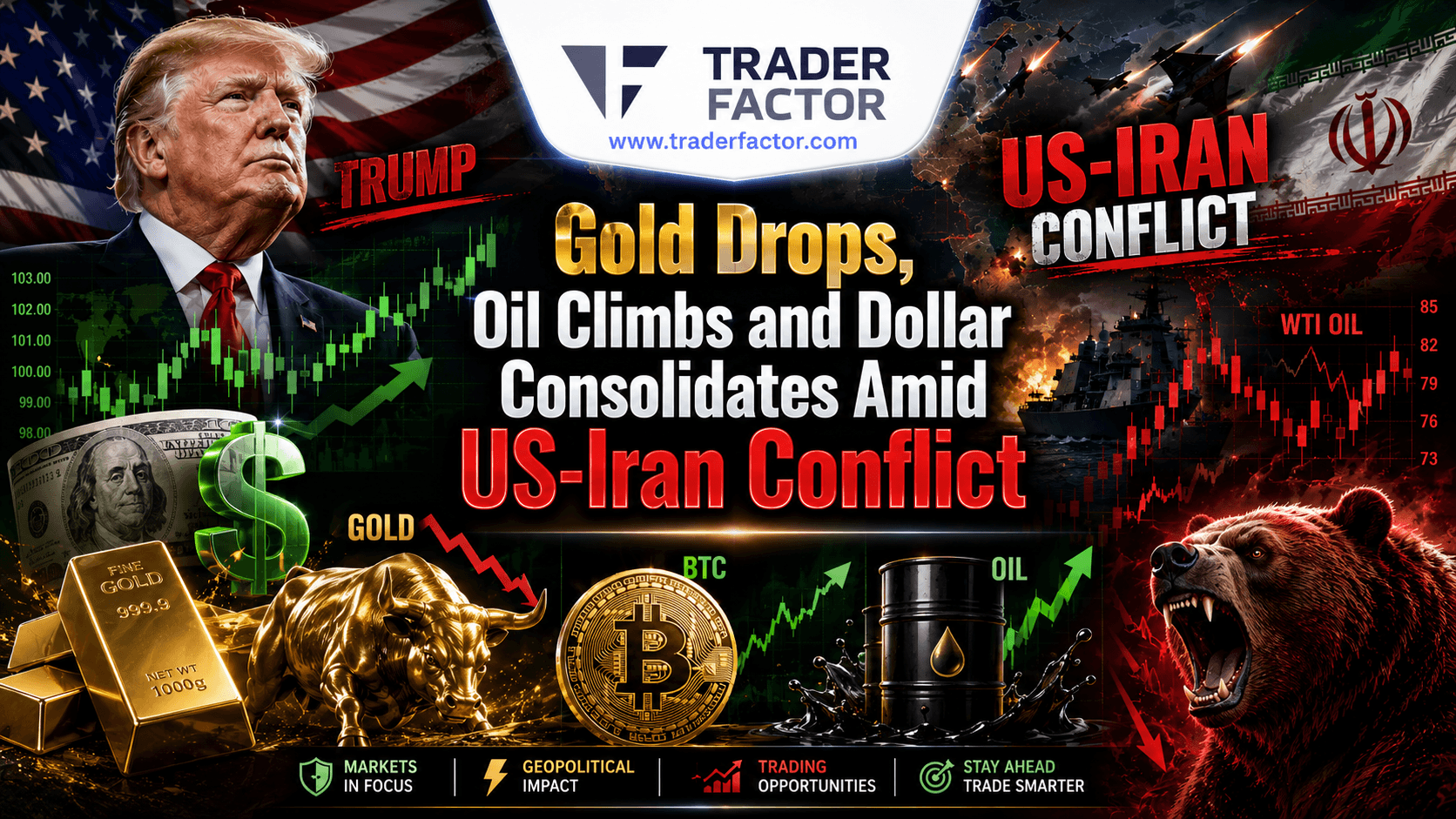

Forex Market Today: Dollar steadies, gold slips below 4,000, oil remains elevated, while stocks and crypto react to US-Iran tensions and softer inflation.
🔥 Today’s Market Snapshot
🟢 Softer US CPI and PPI continue easing inflation concerns.
🟡 The US dollar steadies after recent weakness.
🔴 Gold falls below the 4,000 level as yields remain elevated.
🟢 Oil holds above $79 as US-Iran tensions support prices.
🔵 Bitcoin consolidates near $63K as traders await fresh catalysts.
🟢 Stocks remain resilient despite ongoing geopolitical risks.
🟡 Markets remain headline-driven with Middle East developments dominating sentiment.
🔵 Traders look ahead to next week’s economic data and geopolitical updates.
Forex Market Today: Gold Drops, Oil Climbs and Dollar Consolidates Amid US-Iran Conflict
TraderFactor Market Report: July 17, 2026
Global financial markets are ending the week in a relatively quiet fashion, but underlying risks remain elevated. Softer US inflation data has eased concerns over additional Federal Reserve tightening, allowing the US dollar to stabilize while supporting equities and risk assets. At the same time, renewed military activity involving the United States and Iran around the Strait of Hormuz continues keeping oil prices elevated and investors cautious. Although the economic calendar is light today, traders remain focused on geopolitical developments that could quickly trigger volatility across forex, commodities, cryptocurrencies and stock markets.
⚡ Quick Market Answer
The US dollar is trading steadily after softer inflation data reduced expectations of additional Federal Reserve tightening. However, Fed Chair Kevin Warsh continues emphasizing that inflation remains above the 2% target, limiting expectations for rapid rate cuts.
Meanwhile, renewed US-Iran military activity around the Strait of Hormuz is supporting oil prices and keeping markets highly sensitive to geopolitical headlines. Gold has slipped below 4,000, Bitcoin is consolidating near 63,500, and equity markets remain resilient as investors balance easing inflation with rising geopolitical risks.
Table of Contents
ToggleSupport and Resistance Snapshot
📊 Support, Resistance & Market Bias
| Asset | Current | Support | Resistance | Bias |
|---|---|---|---|---|
| DXY | 100.782 | 100.30 | 101.20 | 🟡 Neutral |
| Gold | 3983 | 3960 | 4025 | 🔴 Bearish |
| EURUSD | 1.14378 | 1.1400 | 1.1480 | 🟢 Bullish |
| GBPUSD | 1.34590 | 1.3410 | 1.3520 | 🟢 Bullish |
| AUDUSD | 0.69795 | 0.6940 | 0.7020 | 🟢 Bullish |
| NZDUSD | 0.58355 | 0.5800 | 0.5880 | 🟢 Bullish |
| USDCAD | 1.40371 | 1.4000 | 1.4100 | 🔴 Bearish |
| USDJPY | 162.414 | 161.80 | 163.00 | 🟢 Bullish |
| USDCHF | 0.80916 | 0.8050 | 0.8140 | 🟡 Neutral |
| BTCUSD | 63496 | 63000 | 64500 | 🟡 Neutral |
| WTI Oil | 79.115 | 77.80 | 80.50 | 🟢 Bullish |
| NAS100 | 28638 | 28400 | 28900 | 🟡 Neutral |
| US30 | 52174 | 51900 | 52500 | 🟢 Bullish |
| SP500 | 7480 | 7440 | 7525 | 🟢 Bullish |
Market Analysis
Currencies / Forex
Currency markets are ending the week with a cautious tone as traders digest softer US inflation data alongside persistent geopolitical risks. Both CPI and PPI came in below expectations, reducing immediate pressure on the Federal Reserve to tighten policy further and weighing on the US dollar. However, Kevin Warsh’s commitment to restoring inflation to the Fed’s 2% target continues supporting expectations that interest rates could remain elevated for longer. Meanwhile, renewed military activity between the United States and Iran around the Strait of Hormuz is keeping safe-haven flows active and increasing the potential for sudden market volatility.
EURUSD
EURUSD continues trading near recent highs as the weaker US dollar supports the pair. Buyers remain encouraged after softer US inflation data, although upside momentum has slowed as traders await fresh catalysts. A sustained move above 1.1480 could expose higher resistance, while 1.1400 remains an important support level if the dollar regains strength.
GBPUSD
GBPUSD remains one of the stronger major currency pairs as investors prepare for the upcoming UK GDP report. Sterling continues benefiting from broad dollar weakness, although comments from Bank of England officials and domestic economic data could determine the next move. Holding above 1.3410 keeps the short-term bullish outlook intact.
AUDUSD
AUDUSD remains supported as improving global risk appetite offsets geopolitical uncertainty. Softer US inflation has reduced demand for the greenback, allowing the Australian dollar to recover. However, renewed escalation in the Middle East could quickly reverse gains if investors move back into safe-haven assets.
NZDUSD
NZDUSD continues its gradual recovery after recent Reserve Bank of New Zealand policy support and improving market sentiment. The pair remains technically constructive while holding above 0.5800, although traders remain alert to geopolitical headlines that could trigger renewed volatility across commodity-linked currencies.
USDCAD
USDCAD remains under pressure as elevated crude oil prices continue supporting the Canadian dollar. While softer US inflation has weakened the dollar broadly, higher oil prices resulting from Middle East tensions are providing additional support for CAD. The pair remains vulnerable while trading below 1.4100.
USDJPY
USDJPY continues trading above the 162.00 level as higher US Treasury yields and policy divergence between the Federal Reserve and the Bank of Japan continue supporting the pair. Nevertheless, traders remain cautious as Japanese authorities could intervene verbally or directly should yen weakness accelerate further.
USDCHF
USDCHF remains relatively stable despite ongoing geopolitical uncertainty. The Swiss franc continues attracting occasional safe-haven demand, but softer US inflation has also reduced support for the dollar. The pair is likely to remain range-bound until a stronger macroeconomic or geopolitical catalyst emerges.

Crypto / Bitcoin
Bitcoin remains in consolidation mode around the $63,500 region as traders balance improving inflation data against persistent geopolitical uncertainty. Softer CPI and PPI have improved overall risk appetite, which is generally supportive for cryptocurrencies, but ongoing US-Iran tensions continue limiting aggressive buying. Institutional investors also remain cautious as they wait for clearer signals on the Federal Reserve’s next policy move.
From a technical perspective, Bitcoin is holding above important support near $63,000, suggesting buyers remain active on dips. A sustained move above $64,500 could open the door toward the psychological $65,000 level, while a break below support may encourage profit-taking and expose lower levels around $62,000.
Gold
Gold has slipped below the important 4,000 level despite easing US inflation, reflecting the market’s continued focus on elevated interest rates and firm Treasury yields. While lower CPI and PPI readings normally support precious metals, Kevin Warsh’s commitment to restoring inflation to the Fed’s 2% target has reinforced expectations that monetary policy could remain restrictive for longer.
Technically, gold remains under short-term pressure after failing to reclaim resistance near 4,025. Immediate support is seen around 3,960, while any renewed escalation in the Middle East could quickly revive safe-haven demand and help the metal recover lost ground.
Stocks / Equities
US equity markets remain relatively resilient despite ongoing geopolitical tensions. Softer inflation has strengthened hopes that the Federal Reserve may be approaching the end of its tightening cycle, providing continued support for risk assets. However, investors remain cautious as military developments involving the United States and Iran continue posing risks to energy markets and global economic growth.
The combination of easing inflation and resilient corporate earnings continues supporting broader market sentiment. Nevertheless, headline-driven volatility is likely to remain elevated, particularly if geopolitical developments worsen or central bank expectations shift.
NAS100
The NAS100 remains under pressure after recent gains as technology stocks react to elevated bond yields and cautious investor positioning. While softer inflation supports growth stocks, geopolitical uncertainty is encouraging profit-taking near recent highs.
Technically, support is located around 28,400, while resistance sits near 28,900. A decisive break above resistance could signal renewed bullish momentum.
US30
The Dow Jones continues outperforming technology-heavy indices as investors favor industrial and defensive sectors during periods of geopolitical uncertainty. Companies benefiting from higher commodity prices continue providing support to the index.
The technical outlook remains constructive while the index trades above 51,900, with resistance located near 52,500.
S&P 500
The S&P 500 continues consolidating near record highs as investors weigh lower inflation against geopolitical risks. Improved inflation data has supported valuations, although concerns over Middle East tensions continue limiting stronger upside momentum.
Support is located near 7,440, while resistance remains around 7,525. A break above resistance could encourage another leg higher if geopolitical risks stabilize.
Geopolitics
Geopolitical developments remain the dominant driver of market sentiment as the United States and Iran continue exchanging military strikes around the Strait of Hormuz. The strategic waterway remains one of the world’s most important energy corridors, meaning any escalation immediately raises concerns over global crude oil supplies and inflationary pressures. President Trump has also warned that further military action remains possible if attacks on commercial shipping continue, keeping investors on alert.

Although diplomatic channels remain open, there is still little clarity on whether negotiations will resume or deteriorate further. Until there is a meaningful breakthrough, traders should expect markets to remain highly headline-driven, with sudden moves across oil, gold, the US dollar, equities and cryptocurrencies whenever fresh developments emerge.
Economic Calendar
Friday – Quiet Economic Calendar
Friday brings a relatively quiet economic calendar with no major scheduled US economic releases. As a result, market participants are likely to focus on positioning ahead of next week while continuing to monitor developments in the Middle East.


With inflation data now behind the market, geopolitical headlines are expected to remain the primary source of volatility. Any unexpected military developments or comments from government officials could quickly influence sentiment across forex, commodities, cryptocurrencies and equity markets.
📅 This Week’s Economic Calendar
| Day | Key Events |
|---|---|
| Friday | Quiet trading session • Markets likely driven by geopolitical headlines and positioning ahead of next week. |
👉 Full Economic Calendar:
TraderFactor Economic Calendar
Forex Factory
📅 Trade Smarter with the Forex Factory Calendar
Stay ahead of market-moving news by tracking inflation reports, employment data, central bank speeches and other high-impact economic releases.
👉 Learn how to use the Forex Factory Calendar:
TraderFactor Forex Factory Guide
👉 Visit the official Forex Factory Calendar:
ForexFactory.com
Understanding economic events can significantly improve trade timing, risk management and overall market awareness.
📈 Track live Forex, Stocks, Commodities and Crypto:
TradingView Live Markets
📊 Live Market Updates:
TraderFactor Live Market Charts
Final Outlook
Markets are closing the week in a cautious mood as traders continue balancing improving inflation data against escalating geopolitical risks. Softer CPI and PPI reports have eased immediate concerns over further Federal Reserve tightening, but Kevin Warsh has reiterated that inflation remains above the Fed’s long-term target and that policy decisions will continue to depend on incoming economic data.
At the same time, renewed military activity between the United States and Iran around the Strait of Hormuz remains the biggest source of uncertainty. With the economic calendar largely quiet today, market direction is likely to be driven by geopolitical headlines, keeping volatility elevated across the US dollar, gold, oil, equities and cryptocurrencies.
📊 Current Market Bias
| Asset | Bias | Asset | Bias |
|---|---|---|---|
| USD | 🟡 Neutral | Gold | 🔴 Bearish |
| EURUSD | 🟢 Bullish | Bitcoin | 🟡 Neutral |
| GBPUSD | 🟢 Bullish | WTI Oil | 🟢 Bullish |
| AUDUSD | 🟢 Bullish | NAS100 | 🟡 Neutral |
| NZDUSD | 🟢 Bullish | US30 | 🟢 Bullish |
| USDCAD | 🔴 Bearish | S&P 500 | 🟢 Bullish |
| USDJPY | 🟢 Bullish | USDCHF | 🟡 Neutral |
📚 Continue Building Your Forex Trading Knowledge
Explore these in-depth TraderFactor guides to strengthen your Smart Money Concepts (SMC), price action, and risk management skills.
| Trading Guide | Read |
|---|---|
| How to Use CHoCH and BOS in Trading | Read → |
| How to Identify Liquidity in Forex Trading | Read → |
| Liquidity Sweep in Forex (Smart Money) | Read → |
| Buy Side vs Sell Side Liquidity Explained | Read → |
| What Is Smart Money Concept (SMC)? | Read → |
| How to Spot and Avoid Liquidity Grabs | Read → |
| Forex Breakout Strategy Guide | Read → |
| Understanding Forex Market Imbalance | Read → |
| What Is Negative Balance Protection? | Read → |
About the Author
Phyllis Wangui
Senior Market Analyst, TraderFactor
Phyllis Wangui is a seasoned financial markets analyst with over a decade of experience in forex and CFD brokerage evaluation. Specializing in regulatory compliance and risk assessment, she leads the TraderFactor reviews team in delivering transparent, data-driven broker breakdowns that help retail traders navigate complex offshore and Tier-1 trading environments.
Reviewed by Alex Kanyi
Head of Compliance | TraderFactor
“This report is for general information only. Trading involves significant risk. Seek independent advice before acting on any content.”
Subscribe to the TraderFactor Newsletters
Last Updated: July 2026
Disclaimer:
All information has been prepared by TraderFactor or partners. The information does not contain a record of TraderFactor or partner’s prices or an offer of or solicitation for a transaction in any financial instrument. No representation or warranty is given as to the accuracy or completeness of this information. Any material provided does not have regard to the specific investment objective and financial situation of any person who may read it. Past performance is not a reliable indicator of future performance.