
Learn Forex Trading Sessions and how to trade Asian, London and New York using liquidity sweeps, BOS, CHoCH, market structure and SMC.
Key Takeaways: Forex Trading Sessions
- The main forex sessions are Sydney, Tokyo, London and New York.
- The Asian session often creates important intraday ranges and liquidity levels.
- London frequently brings greater volatility and expansion into major European currency pairs.
- New York can continue the London move or create a reversal after sweeping London liquidity.
- Asian High, Asian Low, London High and London Low can become important liquidity references.
- Do not trade a liquidity sweep without confirmation.
- BOS, CHoCH, displacement and Fair Value Gaps can help confirm session setups.
- Always consider higher-timeframe market structure before taking an intraday session trade.
- Session tendencies are frameworks, not guaranteed daily patterns.
- Major economic news can completely change normal session behaviour.
Forex Trading Sessions: How to Trade Asian, London and New York Sessions
Forex Trading Sessions are not simply different times on a clock.
Each session introduces different market participants, liquidity conditions, volatility and trading opportunities.
A setup that works beautifully during the London open may perform poorly during a quiet Asian session.
A breakout that looks convincing during Asia may turn into nothing more than liquidity for London traders.
And a strong move created during London can either continue during New York or become the liquidity that New York uses to reverse price.
This is why understanding when you are trading can be almost as important as understanding where price is trading.
For Smart Money Concepts (SMC) traders, sessions become even more important.
Instead of simply asking:
Is EURUSD bullish or bearish?
You begin asking:
Which session created this high?
Which session created this low?
Where is buy-side liquidity?
Where is sell-side liquidity?
Has London swept the Asian range?
Has New York taken the London high?
Has a genuine Break of Structure or Change of Character occurred?
That shift in thinking can completely change the way you read an intraday chart.
What Are Forex Trading Sessions?
The forex market operates continuously during the working week because currency trading moves from one major financial centre to another.
The four sessions traders normally watch are:
- Sydney
- Tokyo
- London
- New York
When Sydney and Tokyo are active, traders commonly refer to the period broadly as the Asian session.
As Asian markets begin winding down, European markets become active.
London then dominates much of the European trading day.
Several hours later, New York opens while London is still active.
This creates the important London-New York overlap.
After London closes, New York continues until the trading day transitions back toward Sydney and Asia.
The forex market therefore operates as a continuous global cycle rather than having one centralized opening bell.
Forex Trading Session Times
The following are useful approximate standard-time references.
| Forex Session | Approximate UTC Open | Approximate UTC Close | Markets to Watch |
|---|---|---|---|
| Sydney | 22:00 | 07:00 | AUD, NZD |
| Tokyo | 00:00 | 09:00 | JPY, AUD, NZD |
| London | 08:00 | 17:00 | EUR, GBP, CHF |
| New York | 13:00 | 22:00 | USD, CAD |
These times should not be treated as permanently fixed UTC values.
London, New York and Sydney can shift relative to UTC because of daylight-saving changes. There can also be short periods during the year when the US and UK change their clocks on different dates.
Always check your chart’s timezone before marking a trading session.
For an intraday trader, getting this wrong by one hour can mean marking the wrong Asian High, London open or New York trading window.
Why Forex Trading Sessions Matter
Price does not behave identically throughout the trading day.
Different sessions bring different participants into the market.
Banks, funds, corporations, institutions, retail traders and algorithmic systems become active at different times.
Liquidity therefore changes.
Volatility changes.
Spreads can change.
Economic announcements occur.
Orders accumulated during one session can become targets during the next.
Consider EURUSD.
During parts of the Asian session, EURUSD may remain relatively contained.
London opens.
European participation increases.
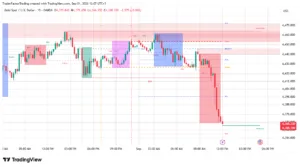
Price suddenly attacks the Asian High.
Retail traders may interpret this as a bullish breakout.
But price quickly falls back below the Asian High.
A bearish displacement follows.
Market structure shifts.
What initially looked like a breakout may actually have been a buy-side liquidity sweep.
This is why session context matters.

The Three-Session Framework
A useful way to simplify intraday forex trading is:
Asian Session → London Session → New York Session
Think of the sessions as three chapters of the same trading day.
A commonly observed framework is:
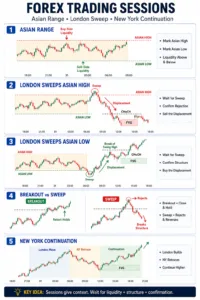
Asia creates the range
↓
London interacts with the range
↓
New York reacts to what London created
But this should never become a rigid rule.
Some days Asia trends aggressively.
Some days London remains trapped inside Asia.
Some days New York does almost nothing.
Other days high-impact economic news completely resets the intraday structure.
The objective is therefore not to predict what each session must do.
The objective is to understand what each session has already done and respond to the evidence on the chart.

Start With Higher-Timeframe Market Structure
Before deciding how to trade a session, determine the bigger picture.
You should know whether price is generally:
- Bullish
- Bearish
- Ranging
- Approaching major resistance
- Approaching major support
- Moving toward external liquidity
Start with higher timeframes such as:
- Daily
- 4-hour
- 1-hour
Then move down to:
- 15-minute
- 5-minute
- 1-minute where appropriate
Knowing how to correctly mark meaningful structural turning points is essential.
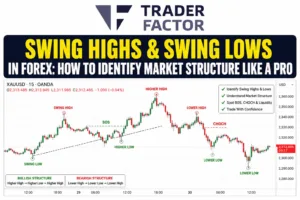
If you struggle with that part, first study our complete guide to Swing Highs and Swing Lows in Forex.
The important question is not:
Where is every tiny swing?
It is:
Which swing actually matters to the current market structure?

How Smart Money Concepts Apply to Forex Sessions
Smart Money Concepts can make session analysis significantly more structured.
Instead of entering simply because London has opened, you wait for price to interact with something meaningful.
That may include:
- Previous Day High
- Previous Day Low
- Asian High
- Asian Low
- London High
- London Low
- Major swing high
- Major swing low
- Equal highs
- Equal lows
- Fair Value Gap
- Order block
- Premium or discount
- Higher-timeframe liquidity
If you are new to this approach, read our introduction to Smart Money Concepts trading before attempting more advanced session models.
Time by itself is not an entry signal.
Time + Price + Liquidity + Structure + Confirmation is far more useful.
Understanding Session Liquidity
Liquidity is one of the most important concepts when trading different forex sessions.
Orders frequently accumulate around obvious highs and lows.
For example:
Stops above highs → potential buy-side liquidity
Stops below lows → potential sell-side liquidity
During Asia, price may create a clearly visible range.
That gives us:
Asian High
and
Asian Low
When London opens, these levels can become obvious areas of interest.
To understand this concept more deeply, see our guide on how to identify liquidity in forex trading.
You should also understand the difference between Buy-Side and Sell-Side Liquidity because these concepts appear repeatedly throughout session trading.

How to Trade the Asian Forex Session
The Asian forex session includes activity from major centres such as Sydney and Tokyo.
For many major European and US currency pairs, this period can produce less volatility than London or New York.
But that does not make Asia unimportant.
In fact, Asian price action often creates some of the most useful reference levels for the trading day.
What to Look for During the Asian Session
Rather than forcing trades during Asia, many intraday traders use the session to identify:
- Asian High
- Asian Low
- Asian range
- Equal highs
- Equal lows
- Minor liquidity pools
- Overnight swing highs
- Overnight swing lows
- Premium and discount
- Higher-timeframe levels being approached
You are building a map.
When London opens, you already know where important liquidity may be located.
The Asian High
The Asian High is the highest price reached during the Asian range you have defined.
Stops from short positions may accumulate above it.
Breakout traders may also place buy orders above it.
This makes the Asian High a potential buy-side liquidity area.
But that does not mean price must reverse when it reaches the high.
Price can:
- Reject it.
- Sweep it and reverse.
- Break through and continue.
- Consolidate around it.
Confirmation determines which scenario is developing.

The Asian Low
The Asian Low is the lowest price reached during the defined Asian session.
Sell stops may accumulate beneath it.
It therefore becomes a potential sell-side liquidity area.
London traders may later watch how price reacts around this level.
Again, do not automatically buy simply because the Asian Low has been touched.
Wait for price to show you what is happening.
The Asian Range
Imagine EURUSD trading inside this structure:
        Asian High
     ----------------
          │     │
       │  │ │ │
     │ │  │ │ │ │
       │ │  │
     ----------------
        Asian Low
Your initial job is simple.
Mark the range.
Then wait.
The trade often becomes clearer when the next session begins interacting with those boundaries.
Best Currency Pairs for the Asian Session
Pairs involving Asian-Pacific currencies may experience increased relevance during this period.
Examples include:
- USDJPY
- AUDUSD
- NZDUSD
- AUDJPY
- NZDJPY
- AUDNZD
This does not mean every pair will move significantly every Asian session.
Economic data, central-bank expectations and broader risk sentiment still matter.
Asian Session Range Trading
One possible Asian-session approach is range trading.
Suppose price repeatedly rejects the Asian High and Asian Low.
A trader may look for short-term opportunities from one side of the range toward the other.
But range trading becomes dangerous once real displacement enters the market.
Never assume:
Asian High = sell
or
Asian Low = buy.
A range eventually breaks.
Asian Session Breakouts
Some Asian sessions produce genuine breakouts, especially when important regional economic data is released.
A breakout becomes more convincing when you see:
- Strong displacement
- Large-bodied closing candles
- A clean structural break
- Limited immediate rejection
- Retest of the broken area
- Continuation toward external liquidity
Learn more about distinguishing genuine expansion from false breaks in our Forex Breakout Strategy guide.

How to Trade the London Forex Session
London is one of the most important sessions for forex day traders.
EURUSD and GBPUSD can become particularly active as European participation increases.
But the London open should not be treated as a command to immediately enter a trade.
First ask:
What did Asia create?
Then:
What is London doing with it?
London and the Asian Range
This is one of the most important relationships in intraday session trading.
Assume Asia creates:
Asian High = Buy-Side Liquidity
Asian Low = Sell-Side Liquidity
London opens.
Price now has several possibilities.
Scenario 1: London Sweeps the Asian High and Reverses
Price moves above the Asian High.
Breakout traders buy.
Stops from sellers are triggered.
But price fails to maintain the breakout.
A strong bearish candle appears.
A lower-timeframe bullish swing low breaks.

You may now have:
Asian High sweep → bearish displacement → CHoCH/MSS → bearish opportunity
This is completely different from blindly selling the Asian High.
You waited for evidence.
London Liquidity Sweep Strategy
A bearish example could look like this:
                 London
                   ▲
                   │ Sweep
            ───────┼────── Asian High
                   │
                  █│
                 █ █
                █
              ▼ Displacement
             ▼
        CHoCH / MSS

            ────────────── Asian Low
                    Target
Potential process:
Step 1: Determine higher-timeframe bias.
Step 2: Mark Asian High and Asian Low.
Step 3: Wait for London.
Step 4: Watch for one side of the Asian range to be attacked.
Step 5: Do not enter immediately.
Step 6: Look for rejection and displacement.
Step 7: Confirm a structural shift.
Step 8: Identify an FVG, order block or retracement entry.
Step 9: Target opposing liquidity where appropriate.
For a deeper explanation of this exact market behaviour, read our Liquidity Sweep in Forex guide.
London Sweeps the Asian Low and Reverses
Now reverse the idea.
Suppose the broader market is bullish.
Price drops beneath the Asian Low shortly after London becomes active.
Sell stops are triggered.
But instead of continuing downward, price violently reclaims the range.
A lower-timeframe swing high breaks.
This may produce:
Asian Low sweep → bullish displacement → CHoCH/MSS → bullish continuation
Potential targets may include:
- Asian High
- Previous Day High
- Equal highs
- London external liquidity
- Higher-timeframe swing high

Why CHoCH and BOS Matter During Session Trading
A sweep by itself is not enough.
Suppose London trades above the Asian High.
That is merely a liquidity event.
Price could continue rallying another 50 pips.
You need additional evidence.
Two useful concepts are:
CHoCH — Change of Character
and
BOS — Break of Structure
A bearish session reversal might look like:
Buy-side liquidity taken
↓
Bearish displacement
↓
Bullish structure fails
↓
CHoCH
↓
Lower low forms
↓
Bearish retracement entry
Understanding the difference between structural continuation and potential reversal is crucial. Our complete CHoCH and BOS Trading Guide explains these concepts in detail.

London Breakout vs London Liquidity Sweep
This is where many traders get trapped.
Both situations initially look similar.
Price reaches the Asian High.
Then breaks above it.
But what happens next determines whether you are seeing a breakout or sweep.
Potential Genuine Breakout
Look for:
- Strong candle close outside the range
- Displacement
- Continued bullish structure
- Previous resistance becoming support
- Successful retest
- New higher highs
- No immediate rejection back inside the range
Potential Liquidity Sweep
Look for:
- Wick or brief move above the high
- Weak follow-through
- Fast rejection
- Price closes back inside the range
- Bearish displacement
- CHoCH/MSS
- FVG created lower
Do not assume every breakout is manipulation.
And do not assume every sweep is a reversal.
Context decides.
If false breakouts are a recurring problem in your trading, study our guide on how to spot and avoid liquidity grabs.

Fair Value Gaps After London Displacement
A powerful session move often creates imbalance.
For example:
London sweeps Asian Low.
Price explosively rallies.
A bullish CHoCH forms.
The displacement leaves a Fair Value Gap.
Instead of chasing the large bullish candle, a trader may wait for price to retrace into that imbalance.
Conceptually:
Asian Low Swept
      ↓
Liquidity Taken
      ↓
Bullish Displacement
      ↓
CHoCH / MSS
      ↓
Fair Value Gap
      ↓
Retracement
      ↓
Possible Entry
      ↓
External Liquidity Target
If Fair Value Gaps and inefficient price delivery are still confusing, read our guide to Forex Market Imbalance.
Best Currency Pairs for the London Session
Popular instruments to watch include:
- EURUSD
- GBPUSD
- EURGBP
- GBPJPY
- EURJPY
- USDCHF
- XAUUSD
The important point is not to trade all of them.
Choose a small number of instruments whose behaviour you understand.

How to Trade the New York Forex Session
The New York session introduces another major liquidity event into the trading day.
By the time New York becomes active, London may already have produced a significant move.
Therefore, the first question should be:
What has London already done?
Not:
What do I want New York to do?
New York Has Two Important Possibilities
New York frequently presents traders with two broad scenarios:
London Continuation
London establishes direction.
New York retraces.
Then price continues toward the next liquidity objective.
Or:
New York Reversal
London makes an extended move.
New York attacks London liquidity or a major external level.
Structure changes.
Price reverses.
Learning to distinguish these two scenarios is extremely important.

New York Continuation Strategy
Imagine the daily bias is bullish.
London sweeps the Asian Low.
A bullish market structure shift appears.
Price rallies strongly.
When New York begins, price retraces into a previously created bullish FVG.
Rather than immediately assuming New York will reverse London, you may look for continuation.
Potential structure:
HTF bullish bias
↓
Asian Low swept
↓
London bullish displacement
↓
London BOS
↓
New York retracement
↓
FVG / Order Block reaction
↓
Bullish continuation
↓
Previous Day High / external liquidity
This is a very different setup from chasing price after London has already expanded.

New York Reversal Strategy
Now consider the opposite situation.
London has already rallied aggressively.
Price approaches:
- Previous Day High
- Equal highs
- Higher-timeframe resistance
- Major swing high
New York opens.
Price sweeps the London High.
But momentum fails.
A bearish CHoCH forms.
Now the structure may be signalling a New York reversal.
Potential process:
London High taken
↓
External liquidity reached
↓
Bearish displacement
↓
CHoCH
↓
FVG retracement
↓
Short opportunity
↓
Internal or opposing liquidity
Again, there is no automatic rule saying:
New York must reverse London.
Price must confirm the idea.

London High and London Low
By the time New York arrives, London may have created two additional important references:
London High
and
London Low
These can become liquidity areas during New York.
For example:
If price is bullish and London Low remains protected while New York trades above it, London High may become a continuation target.
If New York sweeps London High and immediately creates bearish displacement, however, a reversal model may be developing.
The significance of each level depends on market structure.
Previous Day High and Previous Day Low
Session traders should also mark:
PDH — Previous Day High
PDL — Previous Day Low
These are obvious external liquidity references.
Suppose London sweeps Asian Low and rallies.
Where could price be going?
Look left.
If Previous Day High remains untouched above price, it may become a logical liquidity objective.
Likewise, in bearish conditions, Previous Day Low may become the target.

Combining PDH, PDL and Session Liquidity
A useful chart map may contain:
Previous Day High
       ↑
 External Liquidity

London High
       ↑

Asian High
       ↑
 Buy-Side Liquidity

CURRENT PRICE

Asian Low
       ↓
 Sell-Side Liquidity

London Low
       ↓

Previous Day Low
       ↓
 External Liquidity
Not every line will matter equally.
Your job is to determine which liquidity is most relevant to the current directional narrative.

The London-New York Overlap
London and New York are simultaneously active for part of each trading day.
This overlap tends to attract significant attention because two major financial centres are participating at the same time, often increasing liquidity and market activity.
This can be particularly important for:
- EURUSD
- GBPUSD
- USDJPY
- USDCHF
- USDCAD
- XAUUSD
It also coincides with many important US economic releases.
That combination can produce rapid price expansion.
But greater volatility also means greater risk.
Economic News During New York
New York session traders must know the economic calendar.
Major events may include:
- US CPI
- Non-Farm Payrolls
- PCE inflation
- Retail Sales
- GDP
- Jobless Claims
- ISM PMI
- JOLTS
- Federal Reserve decisions
- FOMC press conferences
- Speeches from Federal Reserve officials
A beautiful technical setup can be destroyed in seconds when high-impact news is released.
Spreads can widen.
Slippage can increase.
Price can sweep liquidity on both sides before choosing direction.
Always check the economic calendar before entering.

Forex Kill Zones
The term kill zone is commonly used in ICT-style trading to describe a selected intraday window in which a trader focuses on potential setups.
A kill zone is not the entire trading session.
And it does not mean price must provide a trade.
Common ICT-style reference windows include:
| Window | Common New York-Time Reference |
|---|---|
| Asian Range | Around 8:00 PM–12:00 AM |
| London Kill Zone | Around 2:00 AM–5:00 AM |
| New York Kill Zone | Around 7:00 AM–10:00 AM |
| London Close Window | Around 10:00 AM–12:00 PM |
These windows are generally anchored to New York time in ICT-style teaching, which helps avoid some confusion caused by changing broker server times and UTC daylight-saving offsets. Different teaching material can use slightly different subwindows, so traders should define the model they are actually testing rather than constantly changing session settings.
The key principle is simple:
A kill zone tells you when to pay attention.
It does not tell you when to click Buy or Sell.

What Is the Best Session for Trading Gold?
Gold, or XAUUSD, can trade throughout the day.
However, London and New York often attract particular attention from intraday gold traders because liquidity and volatility can increase.
Gold traders may monitor:
- Asian High
- Asian Low
- London High
- London Low
- Previous Day High
- Previous Day Low
- Major USD economic releases
- Dollar strength
- US Treasury yields
- Higher-timeframe gold liquidity
Gold is capable of producing much deeper intraday sweeps than many currency pairs.
This is why entering simply because an Asian High or London High has been touched can be dangerous.
Confirmation matters.
Trading XAUUSD During London
A possible bullish framework:
HTF bullish
↓
London trades below Asian Low
↓
Sell-side liquidity swept
↓
Bullish displacement
↓
CHoCH
↓
FVG retracement
↓
Long
↓
Asian High / PDH
Again, this is a model to study, not a guaranteed pattern.

Trading XAUUSD During New York
New York gold volatility can become particularly aggressive around US economic releases.
Wait for the initial reaction to reveal structure rather than trying to predict the number.
For example:
CPI is released.
Gold spikes below London Low.
Price immediately reclaims the level.
A bullish market structure shift follows.
Only then may a liquidity-based long idea become interesting.
The news created the volatility.
The chart provided the confirmation.
Session Trading With Swing Highs and Swing Lows
Session highs and lows become even more useful when combined with structural swing points.
Imagine a bearish higher-timeframe market.
During London, price rallies and forms a swing high.
Then it breaks an important 15-minute swing low.
That break tells you more than simply observing that London is active.
The sequence may be:
London High
↓
Swing High confirmed
↓
Bearish displacement
↓
15M Swing Low broken
↓
BOS
↓
Retracement
↓
Continuation
This is why understanding Swing Highs and Swing Lows should come before attempting complex session entries.

Higher-Timeframe Bias + Session Liquidity
One of the biggest improvements a trader can make is combining session trading with higher-timeframe bias.
Suppose the 4-hour structure is bullish.
Price is trading inside a discount area.
Previous Day High remains untouched.
Asia forms a range.
London sweeps Asian Low.
A bullish CHoCH appears.
This setup has a coherent narrative:
HTF bullish
Discount
Sell-side liquidity sweep
Bullish structural confirmation
External liquidity above
That is far more meaningful than:
London opened, so I bought.

A Complete Asian → London → New York Example
Suppose EURUSD starts the day bullish on the 4-hour chart.
Asia consolidates.
You mark:
Asian High: 1.1740
Asian Low: 1.1715
Previous Day High sits at:
1.1780
London opens.
Price initially drops.
It trades below 1.1715.
Asian sell-side liquidity has been taken.
But price does not continue lower.
Instead, a strong bullish displacement candle appears.
The most recent 5-minute swing high breaks.
A bullish CHoCH has developed.
The displacement creates an FVG.
Price retraces.
A long setup becomes possible.
Your initial target could be:
Asian High
If momentum continues:
Previous Day High
By the time New York arrives, EURUSD is trading above the Asian High.
Now you reassess.
Do not automatically buy again.
Ask:
Has London already completed most of the expected move?
Is PDH still available?
Did New York sweep London Low?
Did New York create continuation structure?
If New York retraces into the London bullish imbalance and produces another bullish structural confirmation, continuation toward PDH may remain valid.
But if New York sweeps London High and breaks bullish structure, the narrative has changed.
That is session trading.
You are continuously reading new information.

Five Practical Session Trading Models
1. Asian Range Reversal
Look for:
- Defined Asian range
- Repeated rejection
- No strong displacement
- Entry near range boundary
- Target toward opposite side or internal liquidity
Best suited to genuine ranging conditions.
2. London Liquidity Sweep
Look for:
- Asian High or Low
- London sweep
- Strong rejection
- CHoCH/MSS
- FVG or order block
- Opposing liquidity target
3. London Breakout Continuation
Look for:
- Strong range breakout
- Candle close outside Asian range
- Displacement
- BOS
- Retest
- Continuation toward external liquidity
4. New York Continuation
Look for:
- Strong London directional move
- HTF alignment
- New York retracement
- London structure remains protected
- FVG/OB reaction
- Continuation toward next target
5. New York Reversal
Look for:
- Extended London move
- External liquidity reached
- London High/Low swept
- Strong counter-direction displacement
- CHoCH
- Retracement entry
Each strategy requires context.
Which Forex Session Is Best?
There is no universally best session.
The best session depends on:
- Your strategy
- Your timezone
- Currency pair
- Risk tolerance
- Available trading hours
- Desired volatility
- Experience
A rough framework is:
| Trading Preference | Session to Study |
|---|---|
| Range trading | Asian |
| JPY/AUD/NZD focus | Asian |
| EUR and GBP majors | London |
| Breakout trading | London |
| Liquidity sweep trading | London / New York |
| US economic news | New York |
| USD pairs | New York |
| Gold day trading | London / New York |
| High-liquidity overlap | London-New York |
Do not select a session merely because somebody online claims it makes the most money.
Select the session that fits your tested strategy.
| 🚀 Top-Rated Forex Broker Reviews Compare brokers, spreads, leverage, platforms & trading conditions. | ||
|---|---|---|
| 🔥 IronFX Trading Conditions | ⭐ PU Prime Spreads & Platforms | 📈 NAGA Social Trading |
| ⚡ TMGM Execution Speed | 💹 M4 Markets Account Types | 💼 RS Prime Broker Overview |
| 👑 OneRoyal Regulation & Safety | 🎯 Skilling Platform Review | 📊 DeltaStock Broker Features |
| 🚀 Eightcap Trading Experience | 🧪 Alchemy Markets Broker Analysis | ✅ ActivTrades Expert Review |
| 💰 VS Capital Broker Rating | ⚖️ High Leverage Compare Leverage | 📉 Low Spreads Trading Costs |
| Compare Broker Features, Costs, Regulation, Platforms & Leverage Explore our independent broker reviews before choosing your next trading account. | ||
Best Forex Pairs by Session
Asian Session
Consider watching:
- USDJPY
- AUDUSD
- NZDUSD
- AUDJPY
- NZDJPY
London Session
Consider watching:
- EURUSD
- GBPUSD
- EURGBP
- EURJPY
- GBPJPY
- USDCHF
New York Session
Consider watching:
- EURUSD
- GBPUSD
- USDJPY
- USDCAD
- USDCHF
- XAUUSD
Liquidity can vary from day to day, particularly around economic events.

Do Not Trade Every Session
One of the biggest mistakes new traders make is trying to trade Asia, London and New York every day.
More screen time does not automatically equal more opportunity.
It may simply create:
- Overtrading
- Fatigue
- Revenge trading
- Poor entries
- Reduced discipline
Instead, specialize.
You might decide:
I trade EURUSD during London.
Or:
I trade XAUUSD during New York.
Or:
I only trade London liquidity sweeps after Asia creates a clear range.
Specialization makes journaling and backtesting much easier.

Common Forex Session Trading Mistakes
Trading Simply Because the Session Opened
London opening is not a buy or sell signal.
Wait for price.
Assuming the Asian Range Must Be Swept
Sometimes London never touches either side.
Do not force the model.
Selling Every Asian High Sweep
A break above Asian High can become a genuine bullish breakout.
Wait for bearish confirmation.
Buying Every Asian Low Sweep
The market may simply be continuing downward.
A sweep without displacement or structure change is weak evidence.
Ignoring Higher-Timeframe Structure
A beautiful 1-minute CHoCH against strong 4-hour direction may produce only a small retracement.
Context matters.

Confusing Internal and External Structure
Tiny lower-timeframe pivots should not automatically override important structural swings.
Ignoring News
A setup five minutes before NFP, CPI or an FOMC announcement carries very different risk from a normal technical setup.
Chasing Displacement
Large candles often make traders feel they are missing the move.
Wait for a retracement if your strategy requires one.
Trading Too Many Currency Pairs
Watching twelve charts often reduces focus.
Specialization usually produces cleaner decision-making.
Forgetting Daylight Saving Time
Your carefully marked London window can be wrong by an hour if you do not account for clock changes.
Risk Management When Trading Sessions
A high-quality session setup can still lose.
Never treat SMC, liquidity or market structure as certainty.
Define:
- Entry
- Stop-loss
- Take-profit
- Maximum account risk
- Maximum daily loss
- News exposure
before entering.
If your stop needs to be wider because volatility is high, reduce position size rather than increasing financial risk.
Never widen the stop simply because you do not want to accept the loss.
Traders should also understand how their broker handles extreme losses and account deficits. Our guide to Negative Balance Protection explains this important account-protection concept.

Forex Session Trading Checklist
Before placing a trade, ask:
Higher-Timeframe Analysis
- What is the Daily bias?
- What is the 4-hour structure?
- Where are major swing highs?
- Where are major swing lows?
- Where is external liquidity?
Previous Day Levels
- Where is Previous Day High?
- Where is Previous Day Low?
Asian Session
- Where is Asian High?
- Where is Asian Low?
- Is Asia trending or ranging?
- Are equal highs/lows present?
London Session
- Has Asian liquidity been swept?
- Was the move a sweep or genuine breakout?
- Did displacement occur?
- Has BOS or CHoCH formed?
- Was an FVG created?
New York Session
- What did London already accomplish?
- Where is London High?
- Where is London Low?
- Is New York continuing or reversing?
- Is major US news approaching?
Entry
- Has liquidity been taken?
- Is structure aligned?
- Is my entry location logical?
- Where is invalidation?
- Where is the target?
- Is the risk-to-reward acceptable?
If several answers are unclear, there may be no trade.

A Simple Session Trading Workflow
Use this routine each trading day.
Step 1: Determine Higher-Timeframe Bias
Start with Daily, 4H and 1H.
Step 2: Mark Major Swing Points
Identify the highs and lows controlling current structure.
Step 3: Mark PDH and PDL
These can become important external liquidity targets.
Step 4: Mark Asian High and Asian Low
Create your intraday liquidity map.
Step 5: Wait for Your Trading Session
Do not enter early because you are impatient.
Step 6: Observe the Liquidity Event

Did price:
- Sweep?
- Break?
- Reject?
- Consolidate?
Step 7: Wait for Structural Confirmation
Look for:
- CHoCH
- MSS
- BOS
- Displacement
Step 8: Identify the Entry
Possible areas include:
- FVG
- Order block
- Breaker
- Retest
- Premium/discount retracement
Step 9: Identify the Target
Targets may include:
- Session High
- Session Low
- PDH
- PDL
- Equal highs
- Equal lows
- Major swing point
Step 10: Manage Risk
Know your invalidation before entering.
Frequently Asked Questions About Forex Trading Sessions

What are the main forex trading sessions?
The four major forex trading sessions are Sydney, Tokyo, London and New York. Sydney and Tokyo are commonly grouped into the broader Asian trading period.
What is the best forex trading session?
There is no single best session for every trader. London and the London-New York overlap can provide strong liquidity for major currency pairs, while the Asian session can be useful for JPY, AUD and NZD pairs and for establishing intraday ranges.
What is the best time to trade forex?
The best time depends on the currency pair and strategy being traded. EUR and GBP pairs often receive greater attention during London, while USD-related markets become particularly important during New York.
What is the Asian range in forex?
The Asian range is the price range formed during a defined portion of Asian trading. Traders commonly mark its high and low because these levels can later become liquidity references during London.
Why does London sweep the Asian High?
It does not happen every day. When it does occur, stops and pending orders around the Asian High can create liquidity. Traders should still wait for confirmation before assuming the sweep will reverse.
What is an Asian High sweep?
An Asian High sweep occurs when price trades above the established Asian-session high, taking liquidity resting above it. The market may subsequently reverse or continue higher.
What is an Asian Low sweep?
An Asian Low sweep occurs when price trades below the Asian-session low. This can remove sell-side liquidity before either reversing upward or continuing lower.
What is the London-New York overlap?
It is the period when both London and New York trading hours are active simultaneously. This can result in increased liquidity and trading activity in major currency pairs.
Does New York always reverse London?
No. New York can continue London’s direction, retrace part of the move, consolidate, or reverse it. Traders should analyse liquidity and market structure rather than assuming a reversal.
What is the best session for trading EURUSD?
London and the London-New York overlap are commonly watched because both European and US participants are active during parts of these periods.
What is the best session for GBPUSD?
GBPUSD is particularly relevant during London because the British pound is actively traded as UK markets become active. New York can then create additional movement because of USD participation.
What is the best session to trade XAUUSD?
Many intraday gold traders concentrate on London and New York, particularly around US economic announcements. However, gold can produce opportunities during other periods as well.
What is a forex kill zone?
A kill zone is an ICT-style term describing a selected intraday time window in which traders focus on potential trade setups. It is not an automatic buy or sell signal.
Should beginners trade every forex session?
No. Beginners may benefit more from selecting one session and a small number of currency pairs, then collecting enough historical data to understand how their setup behaves.
Final Thoughts
Understanding Forex Trading Sessions adds something extremely important to technical analysis:
time.
You may already understand support and resistance.
You may understand swing highs and swing lows.
You may understand liquidity.
You may understand BOS and CHoCH.
But intraday trading becomes much clearer when you begin asking:
When was this liquidity created?
Which session created this high?
Which session created this low?
Which session is now attacking that liquidity?
The Asian session can provide the map.
London can create expansion.
New York can continue that expansion or completely reshape the intraday structure.
But none of these outcomes should be assumed in advance.
Read what price actually does.
A strong session trading process therefore becomes:
Higher-Timeframe Bias
↓
Swing Highs & Swing Lows
↓
PDH & PDL
↓
Asian High & Asian Low
↓
Session Liquidity Sweep or Breakout
↓
Displacement
↓
CHoCH / BOS / MSS
↓
FVG or Structured Retracement
↓
Entry
↓
External Liquidity Target
That is a much stronger approach than simply buying because London opened or selling because New York started.
Trade the session.
But more importantly:
trade what price does during the session.
📚 Master Forex Trading with TraderFactor
Build your trading edge with expert guides covering Smart Money Concepts, liquidity, market structure, price action and professional risk management.
📈 CHoCH & BOS Trading GuideLearn how traders identify structural continuation and potential reversals using Change of Character and Break of Structure. | 💧 Identify LiquidityUnderstand where liquidity can form around highs, lows and important market structure levels. |
🎯 Liquidity Sweep StrategyLearn how liquidity sweeps develop and why market structure confirmation after a sweep is important. | ⚖ Buy Side vs Sell Side LiquidityUnderstand the difference between liquidity above market highs and liquidity resting beneath market lows. |
🏦 Smart Money ConceptsStart with our complete introduction to Smart Money Concepts, institutional-style price action and market structure. | 🚨 Avoid Liquidity GrabsLearn how to distinguish potential liquidity grabs from genuine breakout continuation. |
📊 Forex Breakout StrategyLearn how to confirm breakouts using structure, momentum and retests instead of entering every move beyond support or resistance. | ⚡ Market Imbalance GuideUnderstand Fair Value Gaps, market imbalance and how displacement may create potential retracement areas. |
About the Author
Zahari Rangelov
Head of Business Development, TraderFactor
Zahari specializes in broker analysis, regulatory research, and trading education. He has over a decade of experience helping traders navigate the complex world of online brokers. His expertise spans technical and fundamental analysis, medium-term trading strategies, risk management, and trading psychology. A respected mentor and speaker, Zahari regularly leads webinars and seminars covering market sentiment, speculative instruments, and automated trading systems. His research-backed, practical approach has established him as a trusted authority within the global trading community.

Reviewed By:
Reviewed by Alex Kanyi, Head of Compliance at TraderFactor
“This report is for general information only. Trading involves significant risk. Seek independent advice before acting on any content.”